Williamston in Martin County, North Carolina — The American South (South Atlantic)
The History of Williamston
By F.M. Manning
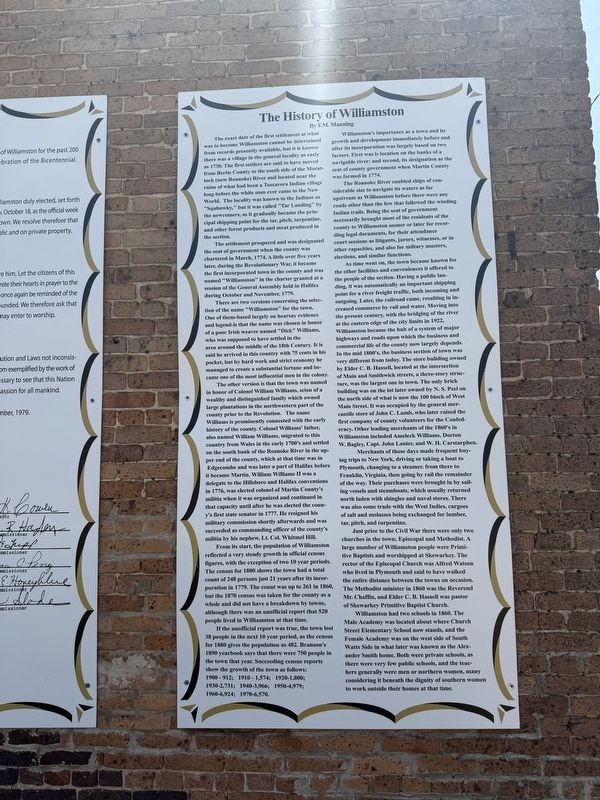
The exact date of the first settlement at what was to become Williamston cannot be determined from records presently available, but it is known there was a village in the general locality as early as 1730. The first settlers are said to have moved from Bertie County to the south side of the Morattock (now Roanoke) River and located near the ruins of what had become a Tuscarora Indian village long before the white man ever came to the New World. The locality was known to the Indians as "Squhawky," but it was called "Tar Landing" by the newcomers, as it gradually became the principal shipping point for the tar, pitch, turpentine, and other forest products and meat produced in the section.
The settlement prospered and was designated the seat of government when the county was chartered in March, 1774. A little over five years later, during the Revolutionary War, it became the first incorporated town in the county and was named "Williamston" in the charter granted at session of the General Assembly held in Halifax during October and November, 1779.
There are two versions concerning the selection of the name "Williamston"
this page online
The other version is that the town was named in honor of Colonel William Williams, scion of a wealthy and distinguished family which owned large plantations in the northwestern part of the county prior to the Revolution. The name Williams is prominently connected with the early history of the county. Colonel Williams' father, also named William Williams, migrated to this country from Wales in the early 1700's and settled on the south bank of the Roanoke River in the upper end of the county, which at that time was in Edgecombe and was later a part of Halifax before it became Martin. William Williams II was a delegate to the Hillsboro and Halifax conventions in 1776, was elected colonel of Martin County's

From its start, the population of Williamston reflected a very steady growth in official census figures, with the exception of two 10 year periods. The census for 1800 shows the town had a total count of 248 persons for just 21 years after its incorporation in 1779. The count was up to 261 in 1860, but the 1870 census was taken for the county as a whole and did not have a breakdown by towns, although there was an unofficial report that 520 people lived in Williamston at that time.
If the unofficial report was true, the town lost 38 people in the next 10 year period, as the census for 1880 give the population as 482. Branson's 1890 yearbook says that there were 750 people in the town that year. Succeeding census reports show the growth of the town as follows:
1900 - 912; 1910 - 1,574; 1920 - 1,800; 1930 - 2,731; 1940 - 3,966; 1950 - 4,979; 1960- 6,294; 1970 - 6,570By Devry Becker Jones (CC0), June 14, 20253. Proclamation of the town's 1979 bicentennial to the left of the marker

Williamston's importance as a town and its growth and development immediately before and after its incorporation was largely based on two factors. First was is location on the banks of a navigable river; and second, its designation as the seat of county government when Martin County was formed in 1774.
The Roanoke River enabled ships of considerable size to navigate its waters as far upstream as Williamston before there were any roads other than the few that followed the winding Indian trails. Being the seat of government necessarily brought most of the residents of the county to Williamston sooner or later for recording legal documents, for their attendance court sessions as litigants, jurors, witnesses, or in other capacities, and also for military musters, elections, and similar functions.
As time went on, the town became known for other facilities and conveniences it offered to the people of the section. Having a public landing, it was automatically an important shipping point for a river freight traffic, both incoming and outgoing. Later, the railroad came, resulting in increased commerce by rail and water. Moving into the present century, with the bridging of the river at the eastern edge of the city limits in 1922, Williamston became the hub of a system of major highways and roads upon which the business and commercial life of the county largely depends. In the mid 1800's, the business section of town was very different from today. The store buliding owned by Elder C. B. Hassell, located at the intersection of Main and Smithwick streets, a three-story structure, was the largest one in town. The only brick building was on the lot later owned by N. S. Peel on the north side of what is now the 100 block of West Main Street. It was occupied by the general mercantile store of John C. Lamb, who later raised the first company of county volunteers for the Confederacy. Other leading merchants of the 1860's in Williamston included Ameleck Williams, Docton W. Bagley, Capt. John Lanier, and W. H. Carstarphen.
Merchants of those days made frequent buying trips to New York, driving or taking a boat to Plymouth, changing to a steamer. from there to Franklin, Virginia, then going by rail the remainder of the way. Their purchases were brought in by sailing vessels and steamboats, which usually returned north laden with shingles and naval stores. There was also some trade with the West Indies, cargoes of salt and molasses being exchanged for lumber, tar, pitch, and turpentine.
Just prior to the Civil War there were only two churches in the town; Episcopal and Methodist. A large number of Williamston people were Primitive Baptists and worshipped at Skewarkey. The rector of the Episcopal Church was Alfred Watson who lived in Plymouth and said to have walked the entire distance between the towns on occasion. The Methodist minister in 1860 was the Reverend Mr. Chaffin, and Elder C. B. Hassell was pastor of Skewarkey Primitive Baptist Church.
Williamston had two schools in 1860. The Male Academy was located about where Church Street Elementary School now stands, and the Female Academy was on the west side of South Watts Side in what later was known as the Alexander Smith home. Both were private schools, as there were very few public schools, and the teachers generally were men or northern women, many considering it beneath the dignity of southern women to work outside their homes at that time.
Topics. This historical marker is listed in these topic lists: Industry & Commerce • Political Subdivisions • Settlements & Settlers • Waterways & Vessels. A significant historical month for this entry is March 1774.
Location. 35° 51.284′ N, 77° 3.323′ W. Marker is in Williamston, North Carolina, in Martin County. It is on West Main Street (Business U.S. 17) west of North Watts Street, on the left when traveling west. Touch for map. Marker is at or near this postal address: 113 W Main St, Williamston NC 27892, United States of America. Touch for directions.

Regionally, this marker is in the Coastal Plain. It is also in the American South and specifically in the Upper South. Globally, it is in North America, the Western Hemisphere, the Western World, and the Anglosphere. Historically, it finds itself in what was once the territory of the Mississippian Culture, one of the original Thirteen Colonies, one of the Confederate States of America, and the Antebellum South.
Other nearby markers. At least 8 other markers are within walking distance of this marker: Samuel Johnston (1733-1816) (here, next to this marker); Gen. Frank Armstrong (here, next to this marker); Williamston Prisoner-of-War Camp (a few steps from this marker); The Original Drum Majors of the Williamston Civil Rights Movement (a few steps from this marker); Asa Biggs (within shouting distance of this marker); Memorial Baptist Church (about 500 feet away, measured in a direct line); Asa Biggs House (about 600 feet away); Martin County Courthouse (approx. 0.2 miles away). Touch for a list and map of all markers in Williamston.
Credits. This page was last revised on June 22, 2025. It was originally submitted on June 22, 2025, by Devry Becker Jones of Washington, District of Columbia. This page has been viewed 280 times since then and 121 times this year. Photos: 1, 2, 3. submitted on June 22, 2025, by Devry Becker Jones of Washington, District of Columbia.
