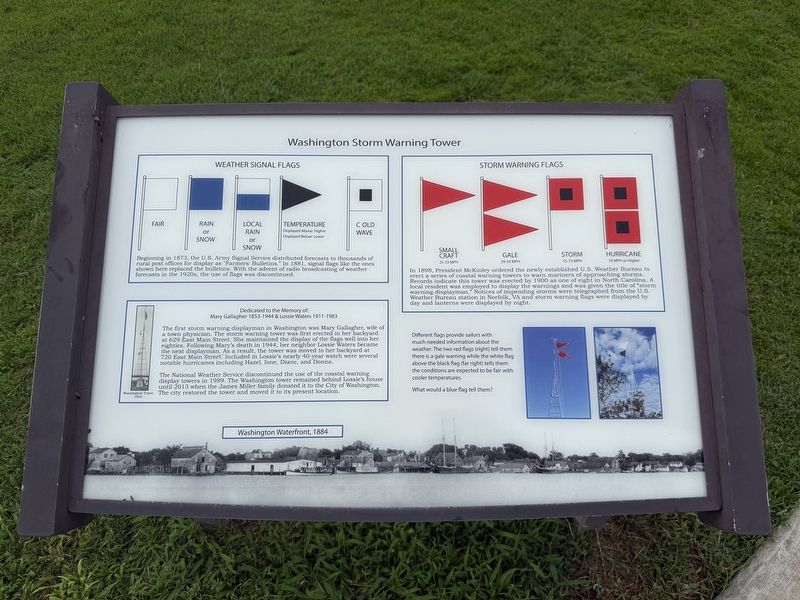
Weather Signal Flags. Beginning in 1873, the U.S. Army Signal Service distributed forecasts to thousands of rural post offices for display as "Farmers' Bulletins." In 1881, signal flags, like the ones shown here replaced the bulletins. With the advent of radio broadcasting of weather forecasts in the 1920s, the use of flags was discontinued.,
Dedicated to the Memory of: Mary Gallagher 1853-1944 and Lossie Waters 1911-1983. The first storm warning displayment in Washington was Mary Gallagher, wife of a town physician. The storm warning tower was first erected in her backyard at 629 East Main Street. She maintained the display of the flags well into her eighties. Following Mary's death in 1944, her neighbor Lossie Waters became the next displayman. As a result, the tower was moved to her backyard at 720 East Main Street. Included in Lossie's nearly 40-year watch were several notable hurricanes including Hazel, Ione, Diane, and Donna., The National Weather Service discontinued the use of the coastal warning display towers in 1989. The Washington tower remained behind Lossie's house until 2013 when the James Miller family donated it to the City of Washington. The city restored the tower and moved it to its present location.,
Storm Warning Flags. In 1898, President McKinley ordered the newly established U.S. Weather Bureau to erect a series of coastal warning towers to warn mariners of approaching storms. Records indicate this tower was erected by 1900 as one of eight in North Carolina. A local resident was employed to display the warnings and was given the title of "storm warning displayman." Notices of impending storms were telegraphed from the U.S. Weather Bureau station in Norfolk, VA and storm warning flags were displayed by day and lanterns were displayed by night., Different flags provide sailors with much-needed information about the weather. The two red flags (right) tell them there is a gale warning while the white flag above the black flag (far right) tells them the conditions are expected to be fair with cooler temperatures., What would a blue flag tell them?
Weather Signal Flags
Beginning in 1873, the U.S. Army Signal Service distributed forecasts to thousands of rural post offices for display as "Farmers' Bulletins." In 1881, signal flags, like the ones shown here replaced the bulletins. With the advent of radio broadcasting of weather forecasts in the 1920s, the use of flags was discontinued.
Dedicated to the Memory of:
Mary Gallagher 1853-1944 & Lossie Waters 1911-1983
The first storm warning displayment in Washington was Mary Gallagher, wife of a town physician. The storm warning tower was first erected in her backyard at 629 East Main Street. She maintained the display of the flags well into her eighties. Following Mary's death in 1944, her neighbor Lossie Waters became the next displayman. As a result, the tower was moved to her backyard at 720 East Main Street. Included in Lossie's nearly 40-year watch were several notable hurricanes including Hazel, Ione, Diane, and Donna.
The National Weather Service discontinued the use of the coastal warning display towers in 1989. The Washington tower remained behind Lossie's house until 2013 when the James Miller family donated it to the City of Washington. The city restored the tower and moved it to its present location.
Storm Warning Flags
In
Click or scan to see this page online
1898, President McKinley ordered the newly established U.S. Weather Bureau to erect a series of coastal warning towers to warn mariners of approaching storms. Records indicate this tower was erected by 1900 as one of eight in North Carolina. A local resident was employed to display the warnings and was given the title of "storm warning displayman." Notices of impending storms were telegraphed from the U.S. Weather Bureau station in Norfolk, VA and storm warning flags were displayed by day and lanterns were displayed by night.
Different flags provide sailors with much-needed information about the weather. The two red flags (right) tell them there is a gale warning while the white flag above the black flag (far right) tells them the conditions are expected to be fair with cooler temperatures.
What would a blue flag tell them?
Topics. This historical marker is listed in these topic lists: Communications • Waterways & Vessels. A significant historical year for this entry is 1873.
Location. 35° 32.386′ N, 77° 3.248′ W. Marker is in Washington, North Carolina, in Beaufort County. It is at the intersection of East Water Street and South Bonner Street, on the right when traveling east on East Water Street. Touch for map. Marker is at or near this postal address: 223 E Water St, Washington NC 27889, United States of America. Touch for directions.
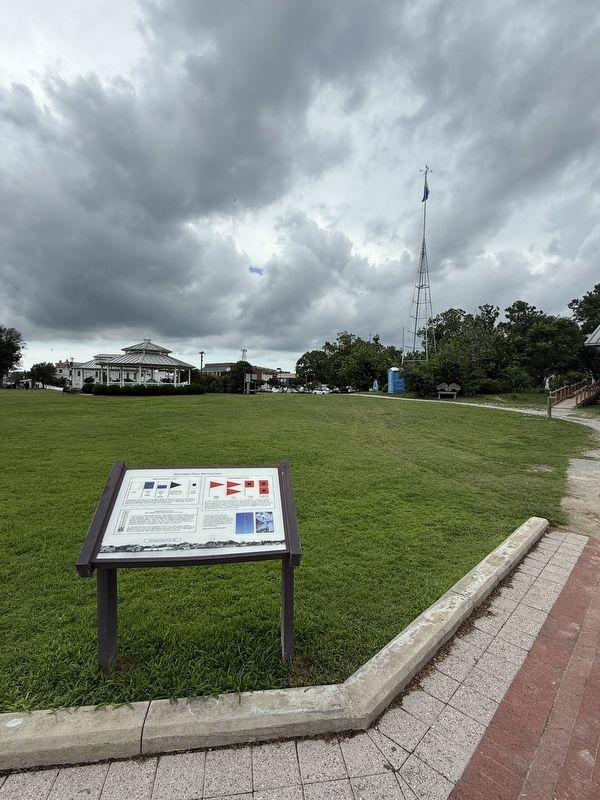
Regionally, this marker is in North Carolina’s Coastal Plain. It is also in the American South, specifically in the Upper South, and in the Tidewater. Globally, it is in the North Atlantic Region, North America, the Western Hemisphere, the Western World, and the Anglosphere. Historically, it finds itself in what was once the territory of the Mississippian Culture, one of the original Thirteen Colonies, one of the Confederate States of America, and the Antebellum South.
Other nearby markers. At least 8 other markers are within walking
Photographed by Devry Becker Jones (CC0), June 14, 2025
Credits. This page was last revised on June 22, 2025. It was originally submitted on June 22, 2025, by Devry Becker Jones of Washington, District of Columbia. This page has been viewed 123 times since then and 16 times this year. Photos:1, 2. submitted on June 22, 2025, by Devry Becker Jones of Washington, District of Columbia.