Majorstuen in Oslo, Norway — Northern Europe (a Nordic Country in Scandinavia)
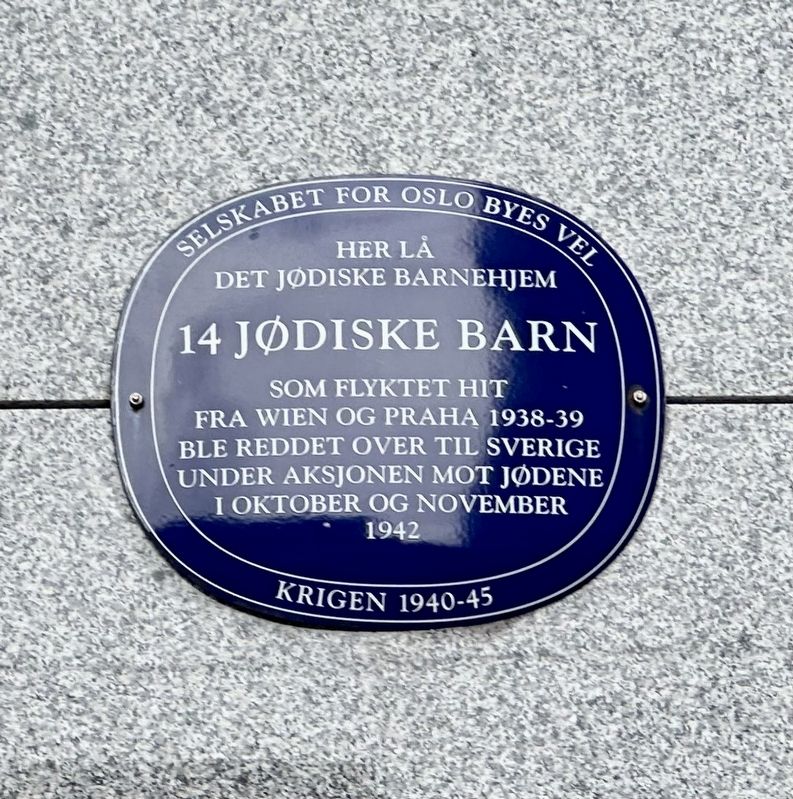
14 Jødiske Barn
⎯⎯⎯
14 Jewish Children
Photographed by Andrew Ruppenstein, June 23, 2025
1. 14 Jødiske Barn / 14 Jewish Children Marker

14 jødiske barn som flyktet hit fra Wien og Praha 1938-39 ble reddet over til sverige under aksjonen mot jødene i oktober og november 1942
Erected by Selskabet For Oslo Byes Vel, Krigen 1940-45.
Topics and series. This historical marker is listed in these topic lists: Notable Events • War, World II. In addition, it is included in the Selskabet For Oslo Byes Vel series list. A significant historical date for this entry is November 26, 1942.
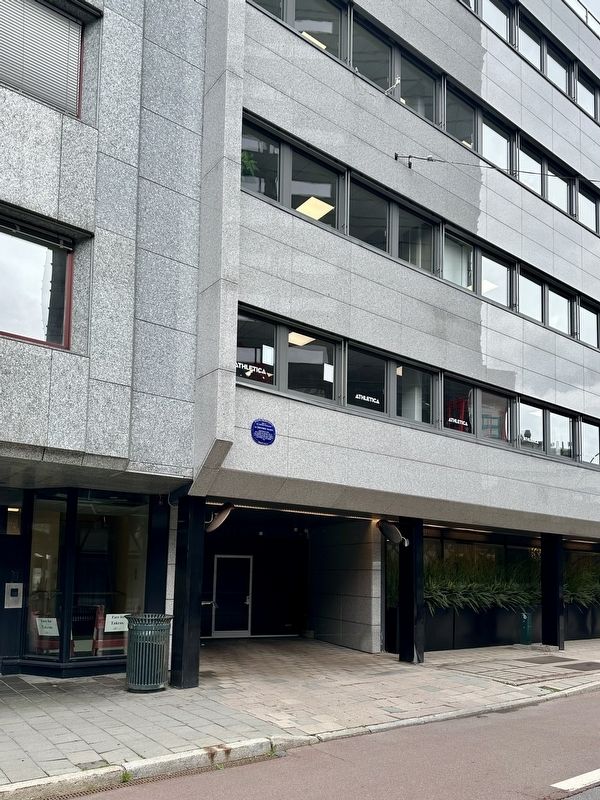
Location. 59° 55.105′ N, 10° 43.996′ E. Marker is in Oslo. It is in Majorstuen. It is on Holbergs gate, on the left when traveling north. Touch for map. Marker is at or near this postal address: Holbergs gate 21, Oslo 0166, Norway. Touch for directions.

Regionally, it is in the North Atlantic Region, on the Atlantic Arc, in Europe, in Atlantic Europe, in Scandinavia, in the Nordic Countries, in the Schengen Area, and in the Western
this page online
Other nearby markers. At least 8 other markers are within walking distance of this marker: Friedrich Weiner (a few steps from this marker); Lewek Levi Jacobowitz (a few steps from this marker); Ida Weiner (a few steps from this marker); Anne-Cath Vestly (about 120 meters away, measured in a direct line); Det Teologiske Menighetsfakultet / The Theological Parish School (about 150 meters away); Rikard Noordrak (about 150 meters away); Trygve Haavelmo (1911-99) (about 180 meters away); Ragnar Frisch (1895-1973) (about 180 meters away). Touch for a list and map of all markers in Oslo.
Also see . . .
1. 14 Jødiske Barn (Selskabet Oslo Byes Vel). Excerpt (in translation):
The Nazi persecution of Jews began already in the interwar period. Norway became one of the places of refuge for Jewish refugees. In Holbergs gate was the Jewish orphanage, which took care of Jewish children who were rescued from Austria and Czechoslovakia in 1938-39. But the Germans followed the refugees. Together with the Norwegian Quisling regime, Jewish campaigns were launched in Norway in October and November 1942. The children had to flee again.
Photographed by Andrew Ruppenstein, June 23, 2025
2. 14 Jødiske Barn / 14 Jewish Children Marker - wide view
2. Nic Waal (Wikipedia). On the rescue:
…On 25 November 1942, the head of the Nansen Committee Sigrid Lunn received a phone call from an unknown man, who warned them that "there would be another party, this time they would be collecting the smallest parcels". This meant the Nazi would start arresting children and women. Indeed, on 26 November 1942 a law was published, outlawing the residence of Jews in Norway. In the early morning of that day, 26 November 1942, Nick and Nina drove the 14 children of the orphanage, the oldest at the time 12 years old, to the villa of Waal's friend Gerde Tandberg in Ullern, a suburb of Oslo. Being a licensed doctor, Nick had a special driving permit and cards for gas. In the morning when they were getting ready, the children were told to put on two of each item of clothing, the eldest boy was instructed to hide 10,000 kronor in his boots - this money was to pay for a taxi to the Swedish border. They had to carry the boots in their hands - there was a woman who lived on the ground floor of their house who was sympathetic to the Nazis, and the children had to leave without attracting her attention. The children were carried on the floor of Nick's car - first the younger ones, then Waal went back for the older ones. On the second trip, the Germans blocked the crossing at Majorstua, but Vaal refused to stop the car and broke through the roadblock. The children were then taken one by one from the Tandberg house into homes of Vaal's relatives. For a week they stayed in hiding in the houses. During this week Sigrid Lunn helped a lot - she helped to look after the children and got ration cards so that they didn't have to starve. Seven days later all the children, hiding on the floor of a taxi, were taken to a hunting lodge near Elverum. The next morning Resistance members helped them walk three kilometres through the forest and to cross the border with Sweden. From the hut all the way to the border, the children followed each other's steps so that possible pursuers would not count their number by their footprints in the fresh snow. Until the end of the war, the children lived in a house on the outskirts of Gothenburg, funded by the Jewish community...(Submitted on June 23, 2025.)
Additional keywords. blå skilt
Credits. This page was last revised on June 23, 2025. It was originally submitted on June 23, 2025, by Andrew Ruppenstein of Lamorinda, California. This page has been viewed 226 times since then and 137 times this year. Photos: 1, 2. submitted on June 23, 2025, by Andrew Ruppenstein of Lamorinda, California.
