Courtland in Southampton County, Virginia — The American South (Mid-Atlantic)
Conditions of Slavery
"A Peculiar Institution"
| — | Nat Turner Trail: 1831 Southampton Insurrection | — |
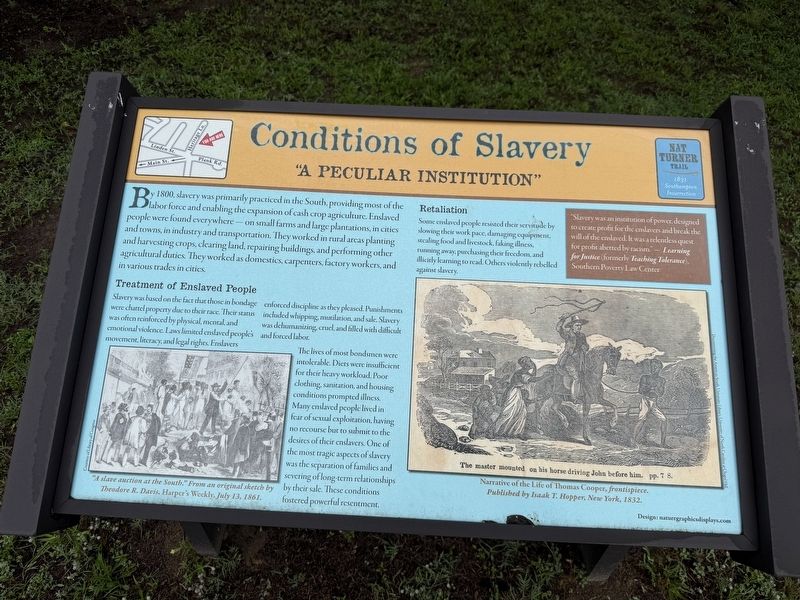
By 1800, slavery was primarily practiced in the South, providing most of the labor force and enabling the expansion of cash crop agriculture. Enslaved people were everywhere — on small farms and large plantations, in cities and towns, in industry and transportation. They worked in rural areas planting and harvesting crops, clearing land, repairing buildings, and performing other agricultural duties. They worked as domestics, carpenters, factory workers, and in various trades in cities.
Treatment of Enslaved People
Slavery was based on the fact that those in bondage were chattel property due to their race. Their status was often reinforced by physical, mental, and emotional violence. Laws limited enslaved people's movement, literacy, and legal rights. Enslavers enforced discipline as they pleased. Punishments included whipping, mutilation, and sale. Slavery was dehumanizing, cruel, and filled with difficult and forced labor.
the lives of most bondsmen were intolerable. Diets were insufficient for their heavy workload. Poor clothing, sanitation, and housing conditions prompted illness. Many enslaved people lived
this page online
Retaliation
Some enslaved people resisted their servitude by slowing their work pace, damaging equipment, stealing food and livestock, faking illness, running away, purchasing their freedom, and illicitly learning to read. Others violently rebelled against slavery.
"Slavery was an institution of power, designed to create profit for the enslavers and break the will of the enslaved. It was a relentless quest for profit abetted by racism." — Learning for Justice (formerly Teaching Tolerance), Southern Poverty Law Center
Erected by Nat Turner Insurrection Trail.
Topics and series. This historical marker is listed in these topic lists: African Americans • Agriculture • Industry & Commerce. In addition, it is included in the Nat Turner Trail: 1831 Southampton Insurrection series list. A significant historical year for this entry is 1800.
Location. 36° 42.654′ N, 77° 3.464′ W.
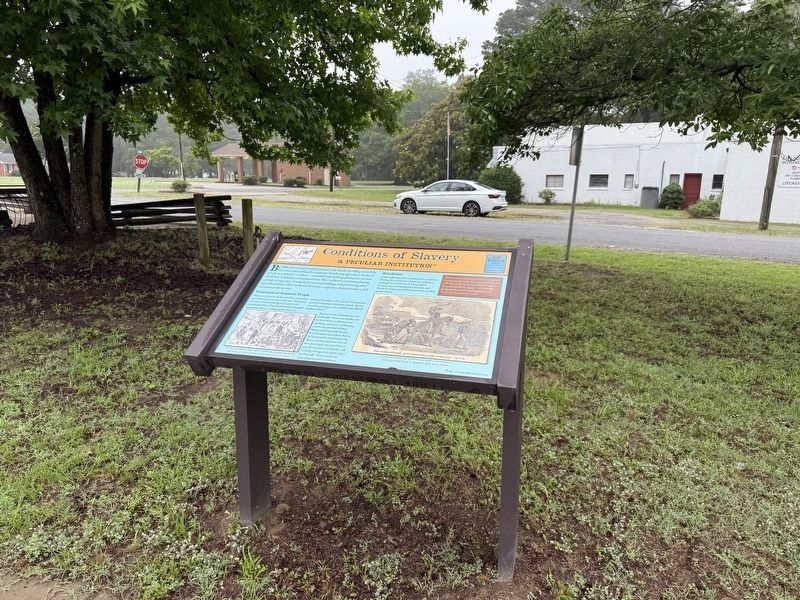

Regionally, this marker is in Coastal Virginia and in the Hampton Roads Metropolitan Area. It is also in the American South, specifically in the Upper South, and in the Tidewater. Globally, it is in North America, the Western Hemisphere, the Western World, and the Anglosphere. Historically, it finds itself in what was once the territory of the Mississippian Culture, one of the original Thirteen Colonies, one of the Confederate States of America, and the Antebellum South.
Other nearby markers. At least 8 other markers are within walking distance of this marker: Slavery's Roots (a few steps from this marker); The 1831 Insurrection (a few steps from this marker); Rebecca Vaughan House (a few steps from this marker); Slave Revolts (a few steps from this marker); St. Luke's Church (approx. half a mile away); Seven Gables (approx. half a mile away); Rochelle-Prince House (approx. half a mile away); Southampton County (approx. half a mile away). Touch for a list and map of all markers in Courtland.
Another marker is no longer nearby. The Rebecca Vaughan House (was within shouting distance of this marker but has been replaced with another marker now near it).
Additional keywords. slave labor; enslaved labor
Credits. This page was last revised on June 24, 2025. It was originally submitted on June 24, 2025, by Devry Becker Jones of Washington, District of Columbia. This page has been viewed 137 times since then and 32 times this year. Photos: 1, 2. submitted on June 24, 2025, by Devry Becker Jones of Washington, District of Columbia.
