Platteville in Grant County, Wisconsin — The American Midwest (Great Lakes)
The Mitchell-Rountree Stone Cottage
Photographed by Fitzie Heimdahl, June 24, 2025
1. The Mitchell-Rountree Stone Cottage Marker
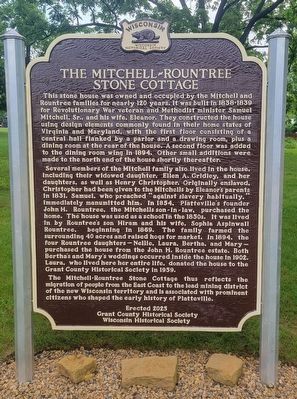
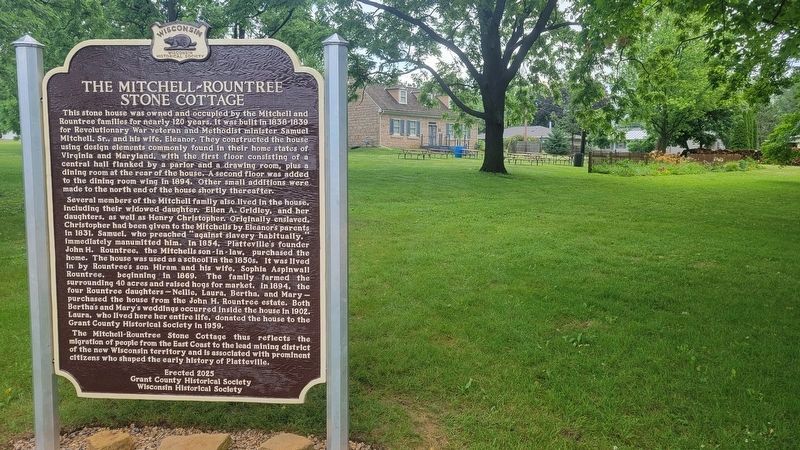
This stone house was owned and occupied by the Mitchell and Rountree families for nearly 120 years. It was built in 1838–1839 for Revolutionary War veteran and Methodist minister Samuel Mitchell, Sr., and his wife, Eleanor. They constructed the house using design elements commonly found in their home states of Virginia and Maryland, with the first floor consisting of a central hall flanked by a parlor and a drawing room, plus a dining room at the rear of the house. A second floor was added to the dining room wing in 1894. Other small additions were made to the north end of the house shortly thereafter.
Several members of the Mitchell family also lived in the house, including their widowed daughter, Ellen A. Gridley, and her daughters, as well as Henry Christopher. Originally enslaved, Christopher had been given to the Mitchells by Eleanor’s parents in 1831. Samuel, who preached “against slavery habitually,” immediately manumitted him. In 1854, Platteville’s founder John H. Rountree, the Mitchells’ son-in-law, purchased the home. The house was used as a school in the 1850s. It was lived in by Rountree’s son Hiram and his
this page online
The Mitchell-Rountree Stone Cottage thus reflects the migration of people from the East Coast to the lead mining district of the new Wisconsin territory and is associated with prominent citizens who shaped the early history of Platteville.
Erected 2025
Grant County Historical Society
Wisconsin Historical Society
Erected 2025 by Grant County Historical Society and Wisconsin Historical Society. (Marker Number 624.)
Topics and series. This historical marker is listed in these topic lists: Architecture • Immigration • War, US Revolutionary. In addition, it is included in the Wisconsin Historical Society series list. A significant historical year for this entry is 1894.
Location. 42° 44.43′ N, 90° 28.955′ W.
Photographed by Fitzie Heimdahl, June 24, 2025
2. The Mitchell-Rountree Stone Cottage Marker

Regionally, this marker is in the American Midwest, in the Corn Belt, in the Driftless Area — Bluff Country, and in the Great River Road Region. Globally, it is in North America, the Western Hemisphere, the Western World, and the Anglosphere. Historically, it finds itself in what was once the territory of the Mississippian Culture and also the Northwest Territory.
Other nearby markers. At least 8 other markers are within walking distance of this marker: Beebe-Johnson House (approx. 0.2 miles away); Platteville Carnegie Library (approx. 0.4 miles away); Lewis & Clark Expedition Member Alexander H. Willard Lived Here (approx. 0.4 miles away); First Congregational Church (approx. 0.4 miles away); First State Normal School (approx. 0.4 miles away); The Frank Burg House (approx. 0.4 miles away); Main Street Commercial Historic District Platteville

Photographed by Greta Schassler, October 25, 2025
3. The Mitchell-Rountree Stone Cottage Marker
Stone cottage museum

Photographed by Greta Schassler, October 25, 2025
4. The Mitchell-Rountree Stone Cottage Marker
Credits. This page was last revised on October 28, 2025. It was originally submitted on June 26, 2025, by Fitzie Heimdahl of Eau Claire, Wisconsin. This page has been viewed 446 times since then and 129 times this year. Photos: 1, 2. submitted on June 26, 2025, by Fitzie Heimdahl of Eau Claire, Wisconsin. 3, 4. submitted on October 25, 2025, by Greta Mulder of Milwaukee, Wisconsin. • J. Makali Bruton was the editor who published this page.
