Norman in Cleveland County, Oklahoma — The American South (West South Central)
Jim Thorpe Multicultural Center
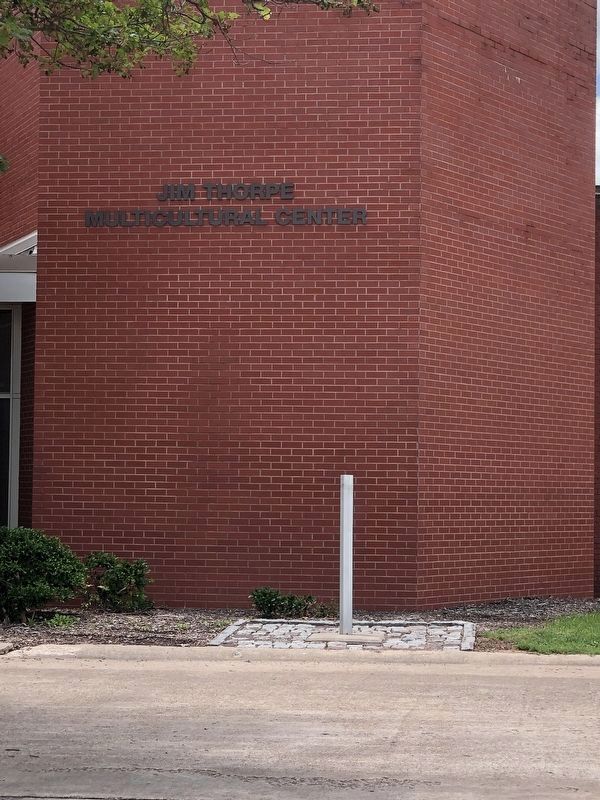
Photographed by Duane and Tracy Marsteller, June 19, 2025
1. Jim Thorpe Multicultural Center Marker (Missing)
The original Jim Thorpe Multicultural Center was dedicated in 1998 in memory of the late James Francis Thorpe of Yale, Oklahoma. In 2010, the facility was permanently relocated to this building. Today it houses offices of all American Indian, Hispanic, Asian American, and international student organizations. It is also home to disabled student organizations and diversity programs.
It was named for dim Thorpe, who was born on Sac-and-Fox Indian land near Prague, Oklahoma. His Indian name, Wa-Tho-Huk, is translated “Bright Path.” As a student at Carlisle Indian School in Pennsylvania, Thorpe excelled in every sport. His superior athletic ability was evident when he was named All-American in football in 1908 and again in 1912.
The greatest accomplishment of his athletic career came in the 1912 Olympic Games in Stockholm, Sweden. He became the only athlete in Olympic history to win both the pentathlon and the decathlon in the same Olympic Games. Thorpe went on to play six years of professional baseball from 1913 to 1919 for the New York Giants, the Cincinnati Reds, and the Boston Braves. In 1915, Thorpe agreed to play
this page online
Jim Thorpe was voted the greatest athlete during the first half of the 20th Century in 1950 by the Associated Press. Today, the Jim Thorpe Award is given for the best defensive back in college football and the Jim Thorpe Trophy for the National Football League's “Most Valuable Player.” The 106th Congress passed a resolution in 1999 recognizing Jim Thorpe as “America's Athlete of the Century.”
Erected by The University of Oklahoma.
Topics and series. This historical marker is listed in these topic lists: Indigenous Peoples and Communities • Sports. In addition, it is included in the University of Oklahoma series list. A significant historical year for this entry is 1912.
Location. Marker is missing. It was located near 35° 11.925′ N, 97° 26.743′ W. Marker was in Norman, Oklahoma, in Cleveland
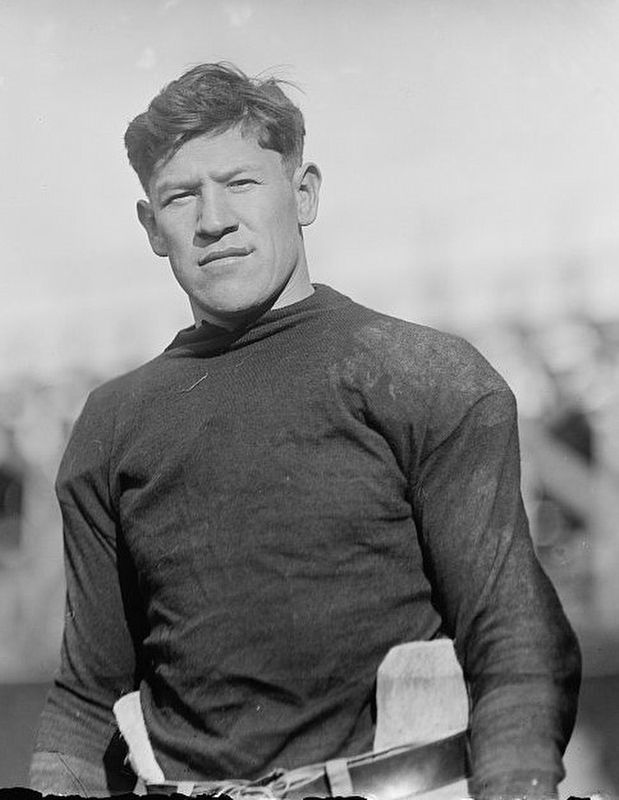
Harris & Ewing, via Library of Congress Prints and Photographs Division (Public Domain), circa 1915/20
2. James “Jim” Francis Thorpe (1887-1953)
He also played professional basketball, and is enshrined in both the college and professional football halls of fame.

Regionally, this marker was in Central Oklahoma—Frontier Country and in Greater Oklahoma City. It was also in the American South, specifically on the prairies, and on the Southern Plains. Globally, it was in North America, the Western Hemisphere, the Western World, and the Anglosphere. Historically, it found itself in what was once the territory of the Mississippian Culture and also the Louisiana Purchase.
Other nearby markers. At least 8 other markers are within walking distance of this location: Pete Kyle McCarter Hall (about 300 feet away, measured in a direct line); Couch Center (about 700 feet away); David Burr Park (approx. 0.2 miles away); R. Boyd Gunning Park (approx. 0.2 miles away); Home of Alpha Phi (approx. 0.2 miles away); Alpha Tau Omega Fraternity (approx. 0.2 miles away); The William J. Ross Courtyard (approx. 0.2 miles away); The University of Oklahoma College of Law (approx. 0.2 miles away). Touch for a list and map of all markers in Norman.
Credits. This page was last revised on July 19, 2025. It was originally submitted on June 28, 2025, by Duane and Tracy Marsteller of Murfreesboro, Tennessee. This page has been viewed 402 times since then and 145 times this year. Photos: 1, 2. submitted on June 28, 2025, by Duane and Tracy Marsteller of Murfreesboro, Tennessee.
Editor’s want-list for this marker. Closeup photographs of both sides of restored/replacement marker • Can you help?
