Medina in Orleans County, New York — The American Northeast (Mid-Atlantic)
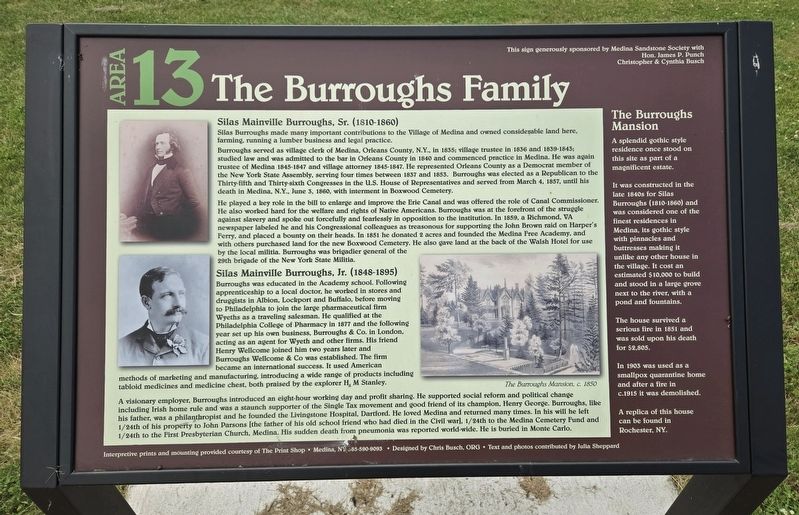
The Burroughs Family
Area 13
Photographed by Bradley Owen, June 27, 2025
1. The Burroughs Family Marker
Silas Mainville Burroughs, Sr. (1810-1860)
Silas Burroughs made many important contributions to the Village of Medina and owned considerable land here, farming, running a lumber business and legal practice.
Burroughs served as village clerk of Medina, Orleans County, N.Y., in 1835; village trustee in 1836 and 1839-1843; studied law and was admitted to the bar in Orleans County in 1840 and commenced practice in Medina. He was again trustee of Medina 1845-1847 and village attorney 1845-1847. He represented Orleans County as a Democrat member of the New York State Assembly, serving four times between 1837 and 1853. Burroughs was elected as a Republican to the Thirty-fifth and Thirty-sixth Congresses in the U.S. House of Representatives and served from March 4, 1857, until his death in Medina, N.Y., June 3, 1860, with interment in Boxwood Cemetery.
He played a key role in the bill to enlarge and improve the Erie Canal and was offered the role of Canal Commissioner. He also worked hard for the welfare and rights of Native Americans. Burroughs was at the forefront of the struggle against slavery and spoke out forcefully
this page online
Silas Mainville Burroughs, Jr. (1848-1895)
Burroughs was educated in the Academy school. Following apprenticeship to a local doctor, he worked in stores and druggists in Albion, Lockport and Buffalo, before moving to Philadelphia to join the large pharmaceutical firm Wyeths as a traveling salesman. He qualified at the Philadelphia College of Pharmacy in 1877 and the following year set up his own business, Burroughs & Co. in London, acting as an agent for Wyeth and other firms. His friend Henry Wellcome joined him two years later and Burroughs Wellcome & Co was established. The firm became an international success. It used
Photographed by Bradley Owen, June 27, 2025
2. The Burroughs Family Marker
A visionary employer, Burroughs introduced an eight-hour working day and profit sharing. He supported social reform and political change including Irish home rule and was a staunch supporter of the Single Tax movement and good friend of its champion, Henry George. Burroughs, like his father, was a philanthropist and he founded the Livingstone Hospital, Dartford. He loved Medina and returned many times. In his will he left 1/24th of his property to John Parsons [the father of his old school friend who had died in the Civil war], 1/24th to the Medina Cemetery Fund and 1/24th to the First Presbyterian Church, Medina. His sudden death from pneumonia was reported world-wide. He is buried in Monte Carlo.
The Burroughs Mansion
A splendid gothic style residence once stood on this site as part of a magnificent estate.
It was constructed in the late 1840s for Silas Burroughs (1810-1860) and was considered one of the finest residences in Medina, its gothic style with pinnacles and buttresses making it unlike any other house in the village. It cost an estimated $10,000 to build and stood in a large grove next to the river, with a pond and fountains.
The house survived a serious fire in 1851 and was sold upon his death for $2,805.
In 1903 was used as a smallpox quarantine home and after a fire in c.1915 it was demolished.
A replica of this house can be found in Rochester, NY.
(Caption):
The Burroughs Mansion, c. 1850
Erected by Medina Sandstone Society, Hon. James P. Punch and Christopher & Cynthia Busch.
Topics. This historical marker is listed in these topic lists: Government & Politics • Industry & Commerce • Notable Buildings • Science & Medicine. A significant historical date for this entry is March 4, 1857.
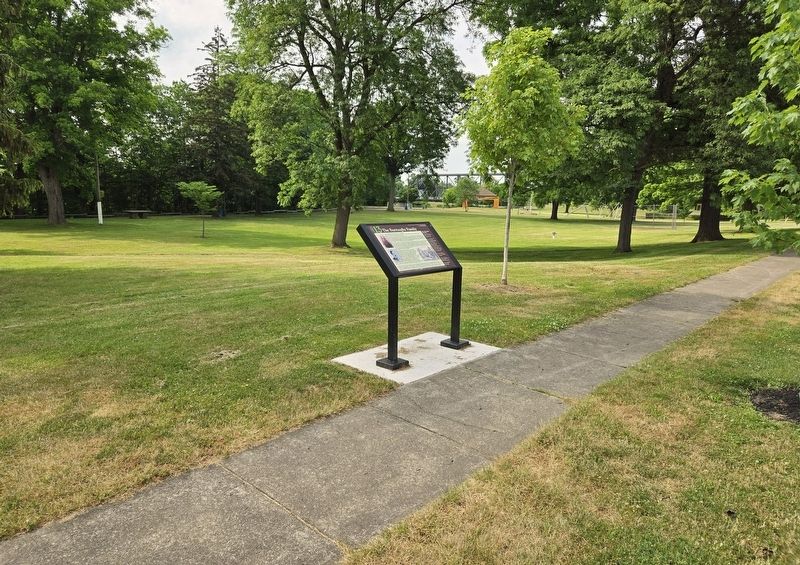
Location. 43° 13.25′ N, 78° 22.822′ W. Marker is in Medina, New York, in Orleans County. It is on State Street north of East Center Street (New York State Route 31), on the left when traveling north. Marker is located in State Street Park. Touch for map. Marker is at or near this postal address: 107 State Street, Medina NY 14103, United States of America. Touch for directions.

Regionally, this marker is in Upstate New York, specifically in Western New York, in the Finger Lakes, and in the Rochester Metropolitan Area. It is also in the American Northeast and in the Mid-Atlantic. Globally, it is in North America, on the Great Lakes, in the Western Hemisphere, in the Western World, and in the Anglosphere. Historically, it finds itself in what was once the Haudenosaunee (Iroquois) Confederacy, New Netherland, and one of the original Thirteen Colonies.
Other nearby markers. At least 8 other markers are within walking distance of this marker: World War I Monument (a few steps from this marker); In Honor of Our Departed Comrades (a few steps from this marker); Freedom (approx. 0.2 miles away); Earliest Church (approx. ¼ mile away); Erie Canal (approx. 0.3 miles away); Greater Medina Area (approx. 0.3 miles away); Medina Aqueduct (approx. 0.3 miles away); Medina (approx. 0.3 miles away). Touch for a list and map of all markers in Medina.
Credits. This page was last revised on June 29, 2025. It was originally submitted on June 29, 2025, by Bradley Owen of Morgantown, West Virginia. This page has been viewed 144 times since then and 50 times this year. Photos: 1, 2. submitted on June 29, 2025, by Bradley Owen of Morgantown, West Virginia.
