Tracy City in Grundy County, Tennessee — The American South (East South Central)
The Civil War on the Plateau ⎯⎯⎯ Troop Movements Across the Plateau Following the Tullahoma Campaign
Photographed by Darren Jefferson Clay, June 18, 2025
1. The Civil War on the Plateau Marker
Inscription.
The Civil War on the Plateau, also, Troop Movements Across the Plateau Following the Tullahoma Campaign. . , (front) , The Civil War on the Plateau, Confederate sympathizers in occupied Middle Tennessee were thrilled when they heard in July 2, 1862 that Nathan Bedford Forrest, with 1,400 men, had surprised the Federal garrison in Murfreesboro on the 13th, capturing 1,200 men, including their commander, General Thomas Crittenden, four guns, sixty wagons, and numerous stores. The raid had started in Altamont, where Forrest rested his men and horses for twenty-four hours before moving on to McMinnville, where, on the 11th, he received reinforcements., After the Battle of Stones River, December 31 to January 2, 1863, there was a period of relative inactivity in Southern Middle Tennessee as General Rosecrans was content to remain with his Federal army of 65,000 at Murfreesboro while General Bragg's 43,000 man Army of Tennessee was at Fairfield, Shelbyville and Tullahoma. By late May, General Grant was investing Vicksburg and anxious for Rosecrans to move on Bragg to keep him from reinforcing Pemberton at Vicksburg. Rosecrans finally gave the order for the Army of the Cumberland to move south from Murfreesboro on June 23rd. Bragg's army of two corps was stretched from Fairfield on the east to the Duck River on the west. That evening Rosecrans' troops surprised and routed several regiments of Hardee's Corp at Hoover's Gap before moving on the village of Manchester. Outflanked, Bragg fell back from Shelbyville to Tullahoma. By July 3, Bragg's Army was in full retreat. Bragg took the cars from Cowan to Chattanooga via Bridgeport while his left flank, under Polk climbed the mountain to University Place. On July 4th the last battle of the Middle Tennessee campaign took place in present-day Sewanee where Texas Rangers under General Wheeler and the 4th Tennessee Cavalry held off an attack by the 5th and 6th Kentucky Union Calvary under Col. Lewis Watkins, U.S.A., As General Nathan Bedford Forrest rode through Cowan with his command, headed for the mountain passes near Pelham, a woman shook her fist at him and shrieked "You great big cowardly rascal, why don't you turn and fight like a man, instead of running like a cur? I wish old Forrest were here. He'd make you fight" Forrest rode on to cover the retreat of Hardee's Corps that climbed the mountain a few miles to the northeast, some on what became known as Bragg's Defeat Road. Soldiers of Starnes Brigade of Forrest's Cavalry, commanded by Colonel George G. Dibrell, protecting against potential Federal attack at the rear of Hardee's retreat, are thought to have camped one night at Poplar Springs in present-day Monteagle before descending the mountain into Battle Creek Valley. Bragg's Point near Sunset Rock, recalls the final days of the Middle Tennessee Campaign of 1863. Forrest Point was named for Nathan Bedford Forrest because in August 1862, he reconnoitered enemy troops closing in on his men in the valley below from the point and devised an escape plan., In July 1863, the cornerstone of the proposed University of the South, a magnificent block of Tennessee marble laid October 10, 1860, disappeared. The mystery was solved when a correspondent of the Chicago Evening Journal described, on July 16, what happened. He wrote, "Some of the vandals of our Brigade, hearing there was money in the stone, a few nights since, broke it open and rifled it of its contents. It was a shameful, disgraceful deed, and Colonel (Luther P.) Bradley has taken steps to ferret our the perpetrators of this sacrilege, and will bring them to punishments., Two weeks later, on July 26, bushwhackers and renegades struck John Armfield's hotel at Beersheba and the nearby cottages of absentee owners ransacking them. The bushwhackers were joined by mountain people, who presumed they were justified in taking away furniture, dishes, clothes and wines to keep them from falling into the hands of the bushwhackers. Mr. Armfield, seeing what was happening, told his Negroes to remove whatever they wanted from the homes of Dr. Thomas Harding and John M. Bass. "The Negroes pitched in with a will.", Later that summer, Union cavalrymen rode several times through Beersheba, presumably looking for Confederates, chickens, or forage. On two such occasions they broke into the already-ransacked hotel, inflicting further damage., On January 20, 1864, the 4th Tennessee Cavalry, consisting of between 100 and 150 men, raided a Federal outpost in Tracy City, killing one Union soldier, capturing eleven others, and burning the depot, engine house, and several other buildings. Before leaving several hours later, the Confederates, under the command of Major Willis S. Bedsloe, of Jamestown, paroled their prisoners. On their way to the Tracy City raid, Bledsoe's troops halted in Altamont at the dwelling of Captain Stephen Tipton, considered to be a "Union Tory". They summoned him outside where they shot him dead., Captain Tipton led a company of the 1st Alabama and Tennessee Vedette Cavalry Regiment, U.S.A. It was a ragtag company in Grundy County that included Confederate deserters and scalawags. Another company commander in the Vedette Cavalry was Captain Calvin Brixey, the most notorious bushwhacker in the annals of Grundy County. This captain and most of his men had supported the Confederacy so long as it had been the dominant power in Middle Tennessee but with the arrival of Union troops in 1863, Brixey quickly changed sides and became a terror to the countryside. For generations after his acts of terror and plunder, the worse epithet that could be uttered at someone was "Brixeyite"., The only other skirmish to take place in Grundy County during the balance of the war was a minor one at Tracy City on August 4, 1864 in which no one was killed., Acknowledgement: Author, Ridley Wills, II , Producer: William L. Beard, (back) , Troop Movements Across the Plateau Following the Tullahoma Campaign, General Bragg's withdrawal from Middle Tennessee and General Rosecrans' advance on Chattanooga resulted in tens of thousands of troops being moved across the plateau., While Bragg took advantage of the Cowan to Chattanooga railroad connection to move some men and supplies, he had Generals Polk and Buckner's troops march from Cowan to University Place (Sewanee) then to Sweeten's Cove and down the Southwest side of Battle Creek. General Hardee utilized the road up Breakfield Point to ascend the mountain. Hardee then descended the mountain from Monteagle to the Northeast side of Battle Creek where he was joined by Forrest's Cavalry., General Rosecrans was faced with a more difficult challenge. He had to move a superior force over the rugged mountains, maintain an extended supply line, and secretly position his troops for an attack on Bragg at Chattanooga. Rosecrans decided to sent McCook (XX Corps) and Thomas (XIV Corps) to cross the Tennessee River south of Bridgeport, Alabama and attack Chattanooga from the south. Crittenden (XXI Corps) was directed to cross the plateau at several locations and confuse Bragg into thinking that he would be attacked from the north. McCook moved to Bridgeport following the railroad from Cowen to Anderson and on to Stevenson and Bridgeport. Thomas used a combination of Hardee's and Polk's routes by ascending the mountain at Brakefield Point (Hardee) then to University Place and on to Sweeten's Cove and the Southwest side of Battle Creek (Polk)., Crittenden sent troops across the plateau in 4 locations., 1. Van Cleve's troops with Minty's Cavalry from McMinnville were sent across Harrison Ferry Mountain (Hwy 8) to the northern end of the Sequatchie Valley, 2. Palmer's troops from Manchester were sent through Viola and across the mountain to Irving College. From there they traveled Hill's Trace across the mountain to Dunlop., 3. Wood's troops with Wilder's Mounted Cavalry as an advance unit from Hillsboro were sent through Pelham, to Tracy City, and then north toward Altamont before turning east to connect with the MeMinnville to Chattanooga Stage Road (Tatesville) and descending to Daus., 4. A smaller force went from Tracy City directly to Jasper and most likely descended at Castle Rock., This represents the movement of major forces through the area. There were, no doubt, many squads and small units that scouted and foraged throughout the area during the July and August 1863 timeframe., Acknowledgement: Author, Ralph Thompson; Maps by C. S. Mergell (1865); and Troop Positions by Captain S. C. Kellogg, U.S. 5th Cavalry (1891)
(front) The Civil War on the Plateau
Confederate sympathizers in occupied Middle Tennessee were thrilled when they heard in July 2, 1862 that Nathan Bedford Forrest, with 1,400 men, had surprised the Federal garrison in Murfreesboro on the 13th, capturing 1,200 men, including their commander, General Thomas Crittenden, four guns, sixty wagons, and numerous stores. The raid had started in Altamont, where Forrest rested his men and horses for twenty-four hours before moving on to McMinnville, where, on the 11th, he received reinforcements.
After the Battle of Stones River, December 31 to January 2, 1863, there was a period of relative inactivity in Southern Middle Tennessee as General Rosecrans was content to remain with his Federal army of 65,000 at Murfreesboro while General Bragg's 43,000 man Army of Tennessee was at Fairfield, Shelbyville and Tullahoma. By late May, General Grant was investing Vicksburg and anxious for Rosecrans to move on Bragg to keep him from reinforcing Pemberton at Vicksburg. Rosecrans finally gave the order for the Army of the Cumberland to move south from Murfreesboro on June 23rd. Bragg's
Click or scan to see this page online
army of two corps was stretched from Fairfield on the east to the Duck River on the west. That evening Rosecrans' troops surprised and routed several regiments of Hardee's Corp at Hoover's Gap before moving on the village of Manchester. Outflanked, Bragg fell back from Shelbyville to Tullahoma. By July 3, Bragg's Army was in full retreat. Bragg took the cars from Cowan to Chattanooga via Bridgeport while his left flank, under Polk climbed the mountain to University Place. On July 4th the last battle of the Middle Tennessee campaign took place in present-day Sewanee where Texas Rangers under General Wheeler and the 4th Tennessee Cavalry held off an attack by the 5th and 6th Kentucky Union Calvary under Col. Lewis Watkins, U.S.A.
As General Nathan Bedford Forrest rode through Cowan with his command, headed for the mountain passes near Pelham, a woman shook her fist at him and shrieked "You great big cowardly rascal, why don't you turn and fight like a man, instead of running like a cur? I wish old Forrest were here. He'd make you fight" Forrest rode on to cover the retreat of Hardee's Corps that climbed the mountain a few miles to
Photographed by Darren Jefferson Clay, June 18, 2025
2. The Civil War on the Plateau Marker
the northeast, some on what became known as Bragg's Defeat Road. Soldiers of Starnes Brigade of Forrest's Cavalry, commanded by Colonel George G. Dibrell, protecting against potential Federal attack at the rear of Hardee's retreat, are thought to have camped one night at Poplar Springs in present-day Monteagle before descending the mountain into Battle Creek Valley. Bragg's Point near Sunset Rock, recalls the final days of the Middle Tennessee Campaign of 1863. Forrest Point was named for Nathan Bedford Forrest because in August 1862, he reconnoitered enemy troops closing in on his men in the valley below from the point and devised an escape plan.
In July 1863, the cornerstone of the proposed University of the South, a magnificent block of Tennessee marble laid October 10, 1860, disappeared. The mystery was solved when a correspondent of the Chicago Evening Journal described, on July 16, what happened. He wrote, "Some of the vandals of our Brigade, hearing there was money in the stone, a few nights since, broke it open and rifled it of its contents. It was a shameful, disgraceful deed, and Colonel (Luther P.) Bradley has taken steps
Photographed by Darren Jefferson Clay, June 18, 2025
3. The Civil War on the Plateau / Troop Movements Across the Plateau Following the Tullahoma Campaign M
to ferret our the perpetrators of this sacrilege, and will bring them to punishments.
Two weeks later, on July 26, bushwhackers and renegades struck John Armfield's hotel at Beersheba and the nearby cottages of absentee owners ransacking them. The bushwhackers were joined by mountain people, who presumed they were justified in taking away furniture, dishes, clothes and wines to keep them from falling into the hands of the bushwhackers. Mr. Armfield, seeing what was happening, told his Negroes to remove whatever they wanted from the homes of Dr. Thomas Harding and John M. Bass. "The Negroes pitched in with a will."
Later that summer, Union cavalrymen rode several times through Beersheba, presumably looking for Confederates, chickens, or forage. On two such occasions they broke into the already-ransacked hotel, inflicting further damage.
On January 20, 1864, the 4th Tennessee Cavalry, consisting of between 100 and 150 men, raided a Federal outpost in Tracy City, killing one Union soldier, capturing eleven others, and burning the depot, engine house, and several other buildings. Before leaving several hours later, the Confederates, under the command of Major Willis S. Bedsloe, of Jamestown, paroled their prisoners. On their way to the Tracy City raid, Bledsoe's troops halted in Altamont at the dwelling of Captain Stephen Tipton, considered to be a "Union Tory". They summoned him outside where they shot him dead.
Captain Tipton led a company of the 1st Alabama and Tennessee Vedette Cavalry Regiment, U.S.A. It was a ragtag company in Grundy County that included Confederate deserters and scalawags. Another company commander in the Vedette Cavalry was Captain Calvin Brixey, the most notorious bushwhacker in the annals of Grundy County. This captain and most of his men had supported the Confederacy so long as it had been the dominant power in Middle Tennessee but with the arrival of Union troops in 1863, Brixey quickly changed sides and became a terror to the countryside. For generations after his acts of terror and plunder, the worse epithet that could be uttered at someone was "Brixeyite".
The only other skirmish to take place in Grundy County during the balance of the war was a minor one at Tracy City on August 4, 1864 in which no one was killed.
Acknowledgement: Author, Ridley Wills, II
Producer: William L. Beard
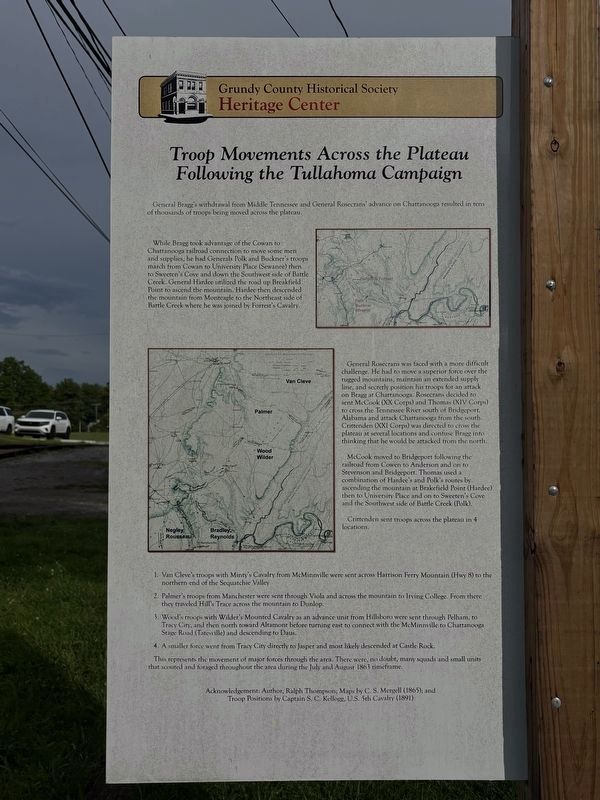
(back) Troop Movements Across the Plateau Following the Tullahoma Campaign
General Bragg's withdrawal from Middle Tennessee and General Rosecrans' advance on Chattanooga resulted in tens of thousands of troops being moved across the plateau.
While Bragg took advantage of the Cowan to Chattanooga railroad connection to move some men and supplies, he had Generals Polk and Buckner's troops march from Cowan to University Place (Sewanee) then to Sweeten's Cove and down the Southwest side of Battle Creek. General Hardee utilized the road up Breakfield Point to ascend the mountain. Hardee then descended the mountain from Monteagle to the Northeast side of Battle Creek where he was joined by Forrest's Cavalry.
General Rosecrans was faced with a more difficult challenge. He had to move a superior force over the rugged mountains, maintain an extended supply line, and secretly position his troops for an attack on Bragg at Chattanooga. Rosecrans decided to sent McCook (XX Corps) and Thomas (XIV Corps) to cross the Tennessee River south of Bridgeport, Alabama and attack Chattanooga from the south. Crittenden (XXI Corps) was directed to cross the plateau at several locations and confuse Bragg into thinking that he would be attacked from the north.
McCook moved to Bridgeport following the railroad from Cowen to Anderson and on to Stevenson and Bridgeport. Thomas used a combination of Hardee's and Polk's routes by ascending the mountain at Brakefield Point (Hardee) then to University Place and on to Sweeten's Cove and the Southwest side of Battle Creek (Polk).
Crittenden sent troops across the plateau in 4 locations.
1. Van Cleve's troops with Minty's Cavalry from McMinnville were sent across Harrison Ferry Mountain (Hwy 8) to the northern end of the Sequatchie Valley
2. Palmer's troops from Manchester were sent through Viola and across the mountain to Irving College. From there they traveled Hill's Trace across the mountain to Dunlop.
3. Wood's troops with Wilder's Mounted Cavalry as an advance unit from Hillsboro were sent through Pelham, to Tracy City, and then north toward Altamont before turning east to connect with the MeMinnville to Chattanooga Stage Road (Tatesville) and descending to Daus.
4. A smaller force went from Tracy City directly to Jasper and most likely descended at Castle Rock.
This represents the movement of major forces through the area. There were, no doubt, many squads and small units that scouted and foraged throughout the area during the July and August 1863 timeframe.
Acknowledgement: Author, Ralph Thompson; Maps by C. S. Mergell (1865); and Troop Positions by Captain S. C. Kellogg, U.S. 5th Cavalry (1891)
Erected by Grundy County Historical Society Heritage Center.
Topics. This historical marker is listed in this topic list: War, US Civil.
Location. 35° 15.613′ N, 85° 44.272′ W. Marker is in Tracy City, Tennessee, in Grundy County. It can be reached from Railroad Avenue (U.S. 41) south of Depot Street, on the right when traveling south. Touch for map. Marker is at or near this postal address: 331 Railroad Ave, Tracy City TN 37387, United States of America. Touch for directions.
Regionally, this marker is in Tennessee’s Cumberland Plateau and in the Highland Rim. It is also in the American South, specifically in the Upper South, in Appalachia, and specifically in Southern Appalachia. Globally, it is in North America, the Western Hemisphere, the Western World, and the Anglosphere. Historically, it finds itself in what was once the territory of the Mississippian Culture, one of the Confederate States of America, and the Antebellum South.
Credits. This page was last revised on September 2, 2025. It was originally submitted on June 30, 2025, by Darren Jefferson Clay of Duluth, Georgia. This page has been viewed 312 times since then and 56 times this year. Photos:1, 2. submitted on June 30, 2025, by Darren Jefferson Clay of Duluth, Georgia. 3. submitted on August 31, 2025, by Darren Jefferson Clay of Duluth, Georgia. • Bernard Fisher was the editor who published this page.
Editor’s want-list for this marker. Photo of the back side of the marker. • Can you help?