Beavercreek Township in Riverside in Montgomery County, Ohio — The American Midwest (Great Lakes)
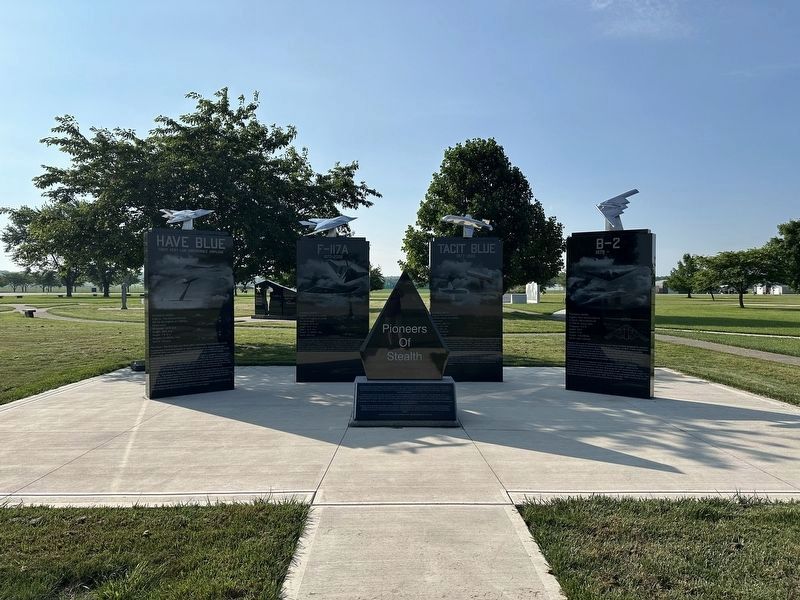
Pioneers of Stealth
Photographed by Pete Skillman, June 28, 2025
1. Pioneers of Stealth Marker
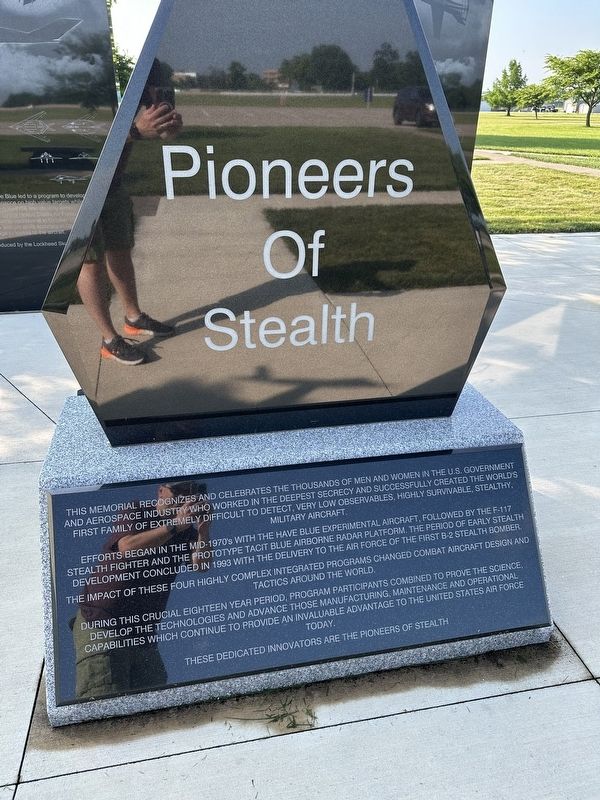
Inscription.
Pioneers of Stealth. . This memorial recognizes and celebrates the thousands of men and women in the U.S. Government and aerospace industry who worked in the deepest secrecy and successfully created the world's first family of extremely difficult to detect, very low observables, highly survivable, stealthy, military aircraft.
Efforts began in the mid-1970's with the Have Blue experimental aircraft, followed by the F-117 Stealth Fighter and the prototype Tacit Blue Airborne Radar Platform. The period of early stealth development concluded in 1993 with the delivery to the Air Force of the first B-2 Stealth Bomber.
The impact of these four highly complex integrated programs changed combat aircraft design and tactics around the world.
During this crucial eighteen year period, program participants combined to prove the science, develop the technologies and advance the manufacturing, maintenance and operational capabilities which continue to provide an invaluable advantage to the United States Air Force today.
These dedicated innovators are the pioneers of stealth.
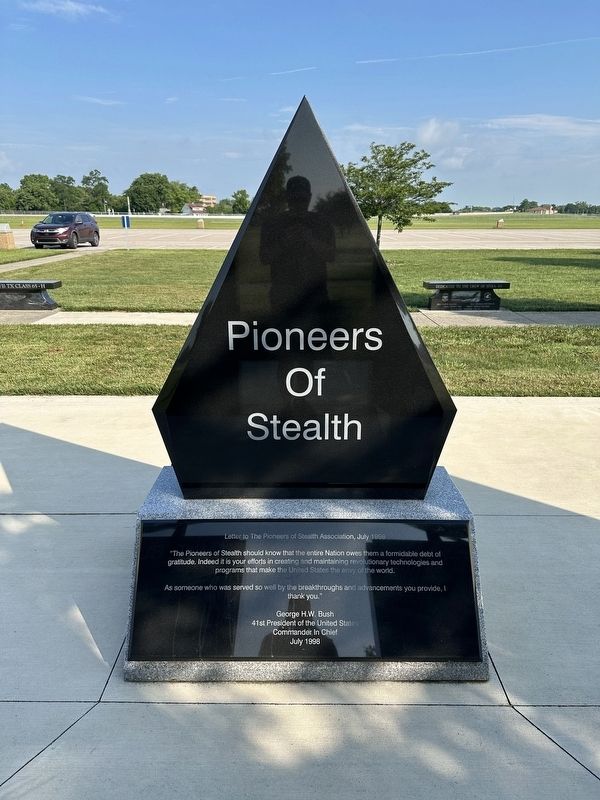
(Reverse)
Letter to the Pioneers of Stealth Association, July 1998
"The Pioneers of Stealth should know that the entire Nation owes them a formidable debt of gratitude. Indeed it is your efforts in creating and maintaining revolutionary technologies and programs that make the United States the envy of the world.
As someone who was served so well by the breakthroughs and advancement you provide, I thank you."
George H.W. Bush 41st President of the United States Commander In Chief July 1998
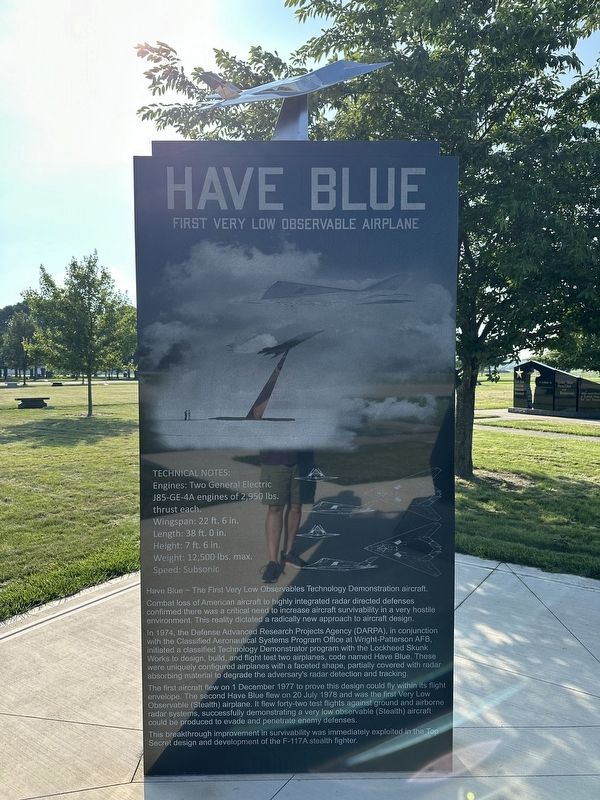
Have Blue First Very Low Observable Airplane .
Technical Notes: Engines: Two General Electric J85-GE-4A engines of 2950 lbs. thrust each. Wingspan: 22 ft. 6 in. Length: 38 ft. 0 in. Height: 7 ft. 6 in. Weight: 12,500 lbs. max. Speed: Subsonic
Have Blue ~ The First Very Low Observables Technology Demonstration aircraft.
Combat loss of American aircraft to highly integrated radar directed defenses confirmed there was a critical need to increase aircraft survivability in a very hostile environment. This reality dictated a radically new approach to aircraft design.
In 1974, the Defense Advanced Research Projects Agency (DARPA), in conjunction with the Classified Aeronautical Systems Program Office at Wright-Patterson AFB, initiated a classified Technology Demonstrator program with the Lockheed Skunk Works to design, build, and flight test two airplanes, code named Have Blue. These were uniquely configured airplanes with a faceted shape, partially covered with radar absorbing material to degrade the adversary's radar detection and tracking.
The first aircraft flew on 1 December 1977 to prove this design could fly within its flight envelope. The second Have Blue flew on 20 July 1978 and was the first Very Low Observable (Stealth) airplane. It flew forty-two test flights against ground and airborne radar systems, successfully demonstrating a very low observable (Stealth) aircraft could be produced to evade and penetrate enemy defenses.
This breakthrough improvement in survivability was immediately exploited in the Top Secret design and development of the F-117A stealth fighter.
(Reverse)
Have Blue First Very Low Observable Airplane .
Multiple government and industry studies of the lethality of radar guided air defense systems, as encountered in Vietnam and the Yom Kippur war, led to the conclusion the Soviet Integrated Air Defense System (IADS) could not be penetrated without a prohibitive loss of USAF aircraft.
In the early 1970s, low observable technology studies and tests were conducted by the Remotely Piloted Vehicle System Program Office (RPVSPO) at Wright-Patterson AFB on reconnaissance and signal intelligence drones. Based on the finding from the RPV SPO, Defense Advanced Research Projects Agency (DARPA) posed two questions to the aircraft industry: (1) Is there a threshold of low observability that would deny effective radar detection and tracking? (2) Could a piloted aircraft be designed and fabricated to meet this threshold?
In 1974, HQ USAF and DARPA, in conjunction with the Classified Aeronautical Systems Program Office at Wright-Patterson AFB, initiated the Experimental Survivable Testbed (XST) program. This was a two-phase program with the aim of developing an aircraft concept that dramatically reduced radar signatures. The Lockheed Skunk Works and Northrop were selected to compete in this program. The first phase required tests of a full scale pole model at the Radar Target Scatter Test Range (RATSCAT) in New Mexico. Testing confirmed both contractor concepts essentially met the goals for a Very Low Observable (VLO) aircraft.
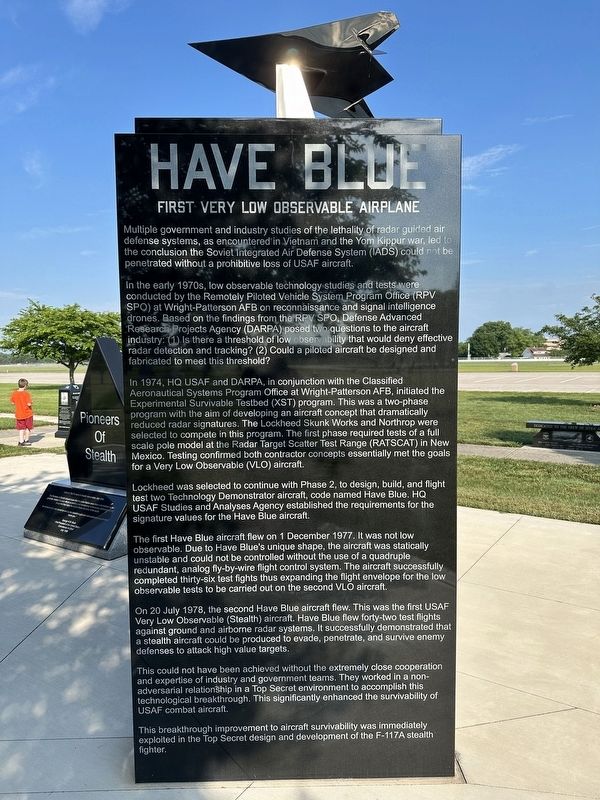
Lockheed was selected to continue with Phase 2, to design, build, and flight test two Technology Demonstrator aircraft, code named Have Blue. HQ USAF Studies and Analyses Agency established the requirements for the signature values for the Have Blue aircraft.
The first Have Blue aircraft flew on 1 December 1977. It was not low observable. Due to Have Blue's unique shape, the aircraft was statically unstable and could not be controlled without the use of a quadruple redundant, analog fly-by-wire flight control system. The aircraft successfully completed thirty-sex test flights thus expanding the flight envelope for the low observable tests to be carried out on the second VLO aircraft.
On 20 July 1978, the second Have Blue aircraft flew. This was the first USAF Very Low Observable (Stealth) aircraft. Have Blue flew forty-two test flights against ground and airborne radar systems. It successfully demonstrated that a stealth aircraft could be produced to evade, penetrate, and survive enemy defenses to attach high value targets.
This could not have been achieved without the extremely close cooperation and expertise of industry and government teams. They worked in a non-adversarial relationship in a Top Secret environment to accomplish this technological breakthrough. This significantly enhanced the survivability of USAF combat aircraft.
This breakthrough improvement to aircraft survivability was immediately exploited in the Top Secret design and development of the F-117A stealth fighter.
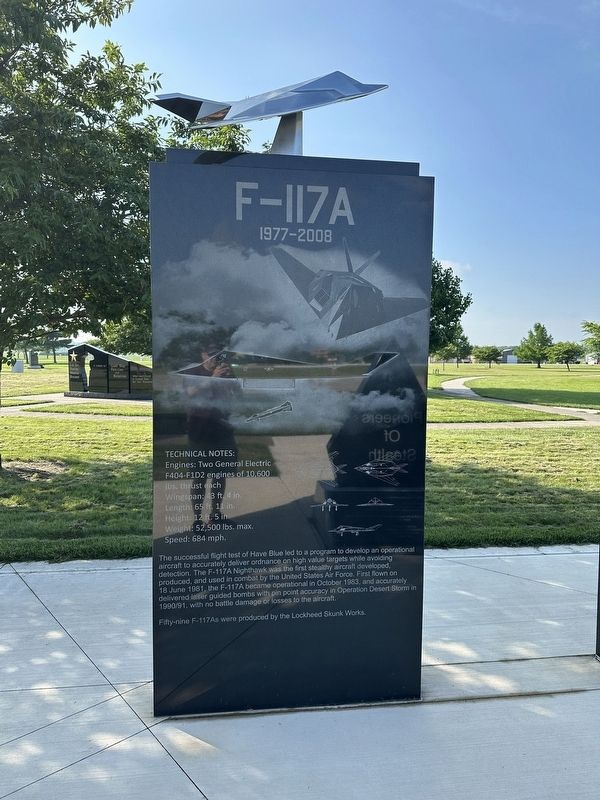
F-117A 1977-2008 .
Technical Notes: Engines: Two General Electric F404-F1D2 engines of 10,600 lbs. thrust each Wingspan: 43 ft. 4 in. Length: 65 ft. 11 in. Height: 12 ft. 5 in Weight: 52,500 lbs. max. Speed: 684 mph.
The successful flight test of Have Blue led to a program to develop an operational aircraft to accurately deliver ordnance on high value targets while avoiding detection. The F-117A Nighthawk was the first stealthy aircraft developed, produced, and used in combat by the United States Air Force. First flown on 19 June 1981, the F-117A became operational in October 1983, and accurately delivered laser guided bombs with pin point accuracy in Operation Desert Storm in 1990/91, with no battle damage or losses to the aircraft.
Fifty-nine F-117As were produced by the Lockheed Skunk Works.
(Reverse)
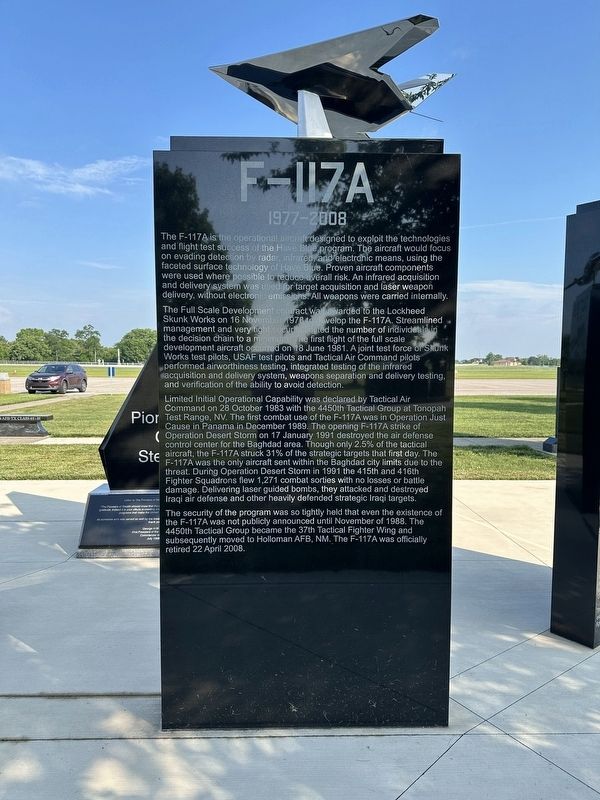
F-117A 1977-2008 .
The F-117A is the operational aircraft designed to exploit the technologies and flight test success of the Have Blue program. The aircraft would focus on evading detection by radar, infrared, and electronic means, using the faceted surface technology of Have Blue. Proven aircraft components were used where possible to reduce overall risk. An infrared acquisition and delivery system was used for target acquisition and laser weapon delivery, without electronic emissions. All weapons were carried internally.
The Full Scale Development contract was awarded to the Lockheed Skunk Works on 16 November 1978 to develop the F-117A. Streamlined management and very tight security limited the number of individuals in the decision chain to a minimum. The first flight of the full scale development aircraft occurred on 18 June 1981. A joint test force of Skunk Works test pilots, USAF test pilots and Tactical Air Command pilots performed airworthiness testing, integrated testing of the infrared acquisition and delivery system, weapons separation and delivery testing, and verification of the ability to avoid detection.
Limited Initial Operational Capability was declared by Tactical Air Command on 28 October 1983 with the 4450th Tactical Group at Tonopah Test Range, NV. The first combat use of the F-117A was in Operation Just Cause in Panama in December 1989. The opening F-117A strike of Operation Desert Storm on 17 January 1991 destroyed the air defense control center for the Baghdad area. Though only 2.5% of the tactical aircraft, the F-117A struck 31% of the strategic targets that first day. The F-117A was the only aircraft sent within the Baghdad city limits due to the threat. During Operation Desert Storm in 1991 the 415th and 416th Fighter Squadrons flew 1,271 combat sorties with no losses or battle damage. Delivering laser guided bombs, they attacked and destroyed Iraqi air defense and other heavily defended strategic Iraqi targets.
The security of the program was so tightly held that even the existence of the F-117A was not publicly announced until November of 1988. The 4450th Tactical Group became the 37th Tactical Fighter Wing and subsequently moved to Holloman AFB, NM. The F-117A was officially retired 22 April 2008.
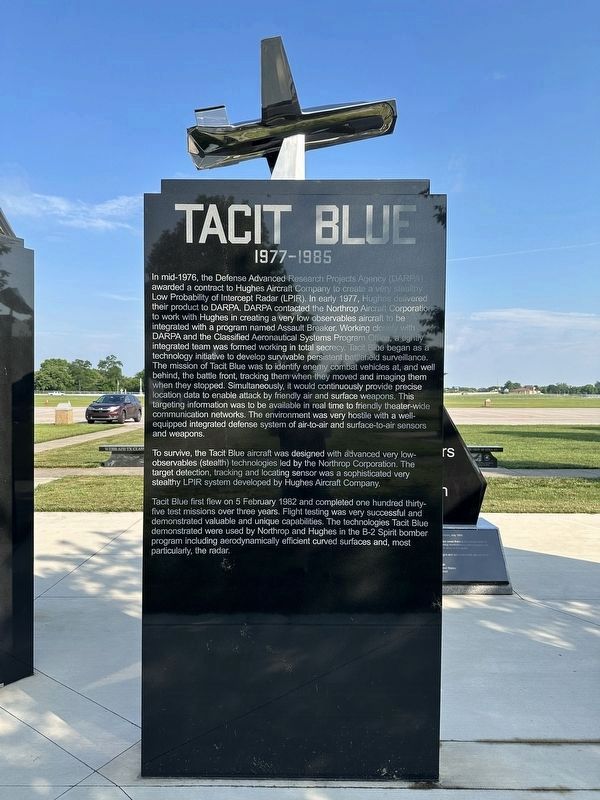
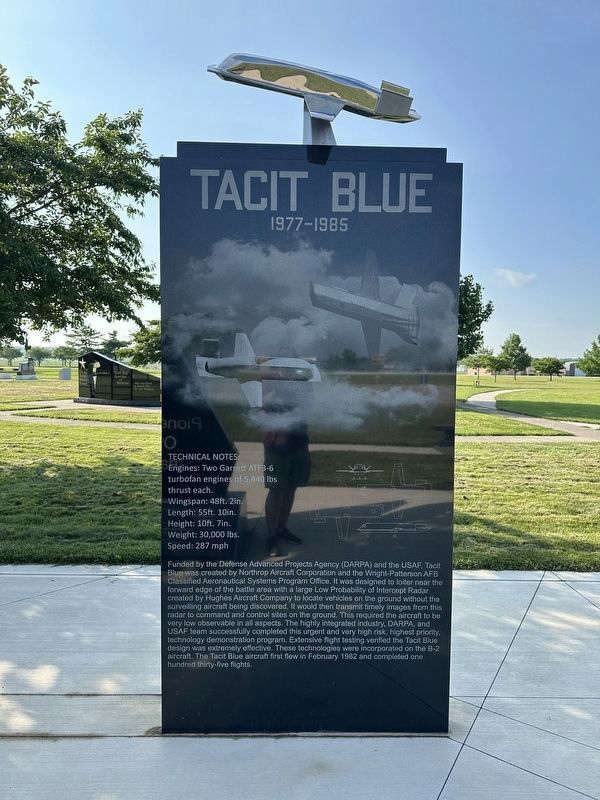
Tacit Blue 1977-1985 .
Technical Notes: Engines: Two Garrett ATF3-6 turbofan engines of 5,440 lbs thrust each. Wingspan: 48 ft. 2 in. Length: 55 ft. 10 in. Height: 10 ft. 7 in. Weight: 30,000 lbs. Speed: 287 mph
Funded by the Defense Advanced Projects Agency (DARPA) and the USAF, Tacit Blue was created by Northrop Aircraft Corporation and the Wright-Patterson AFB Classified Aeronautical Systems Program Office. It was designed to loiter near the forward edge of the battle area with a large Low Probability of Intercept Radar created by Hughes Aircraft Company to locate vehicles on the ground without the surveilling aircraft being discovered. It would then transmit timely images from this radar to command and control sites on the ground. This required the aircraft to be very low observable in all aspects. The highly integrated industry, DARPA, and USAF team successfully completed this urgent and very high risk, highest priority, technology demonstration program. Extensive flight testing verified the Tacit Blue design was extremely effective. These technologies were incorporated on the B-2 aircraft. The Tacit Blue aircraft first flew in February 1982 and completed one hundred thirty-five flights.
(Reverse)
Tacit Blue 1977-1985 .
In mid-1976, the Defense Advanced Research Projects Agency (DARPA) awarded a contract to Hughes Aircraft Company to create a very stealthy Low Probability of Intercept Radar (LPIR). In early 1977, Hughes delivered their product to DARPA. DARPA contacted the Northrop Aircraft Corporation to work with Hughes in creating a very low observables aircraft to be integrated with a program named Assault Breaker. Working closely with DARPA and the Classified Aeronautical Systems Program Office, a tightly integrated team was formed working in total secrecy. Tacit Blue began as a technology initiative to develop survivable persistent battlefield surveillance. The mission of Tacit Blue was to identify enemy combat vehicles at, and well behind, the battle front, tracking them when they moved and imaging them when they stopped. Simultaneously, it would continuously provide precise location data to enable attack by friendly air and surface weapons. This targeting information was to be available in real time to friendly theater-wide communication networks. The environment was very hostile with a well-equipped integrated defense system of air-to-air and surface-to-air sensors and weapons.
To survive, the Tacit Blue aircraft was designed with advanced very low-observables (stealth) technologies led by the Northrop Corporation. The target detection, tracking and locating sensor was a sophisticated very stealthy LPIR system developed by Hughes Aircraft Company.
Tacit Blue first flew on 5 February 1982 and completed one hundred thirty-five test missions over three years. Flight testing was very successful and demonstrated valuable and unique capabilities. The technologies Tacit Blue demonstrated were used by Northrop and Hughes in the B-2 Spirit bomber program including aerodynamically efficient curved surfaces and, most particularly, the radar.
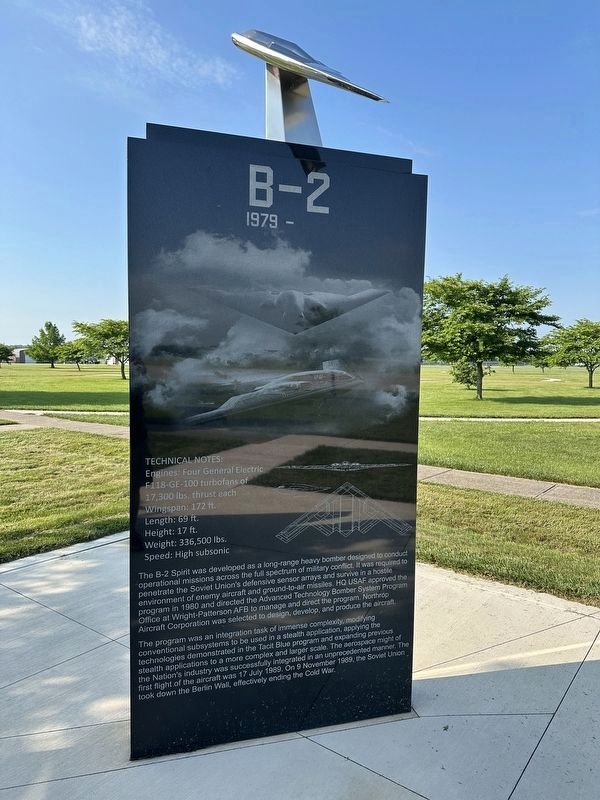
B-2 1979- .
Technical Notes: Engines: Four General Electric F118-GE-100 turbofans of 17,300 lbs. thrust each Wingspan: 172 ft. Length: 69 ft. Height: 17 ft. Weight: 336,500 lbs. Speed: High subsonic
The B-2 Spirit was developed as a long-range heavy bomber designed to conduct operational missions across the full spectrum of military conflict. It was required to penetrate the Soviet Union's defensive sensor arrays and survive in a hostile environment of enemy aircraft and ground-to-air missiles. HQ USAF approved the program in 1980 and directed the Advanced Technology Bomber System Program Office at Wright-Patterson AFB to manage and direct the program. Northrop Aircraft Corporation was selected to design, develop, and produce the aircraft.
The program was an integration task of immense complexity, modifying conventional subsystems to be used in a stealth application, applying the technologies demonstrated in the Tacit Blue program and expanding previous stealth applications to a more complex and larger scale. The aerospace might of the Nation's industry was successfully integrated in an unprecedented manner. The first flight of the aircraft was 17 July 1989. On 9 November 1989, the Soviet Union took down the Berlin Wall, effectively ending the Cold War.
(Reverse)
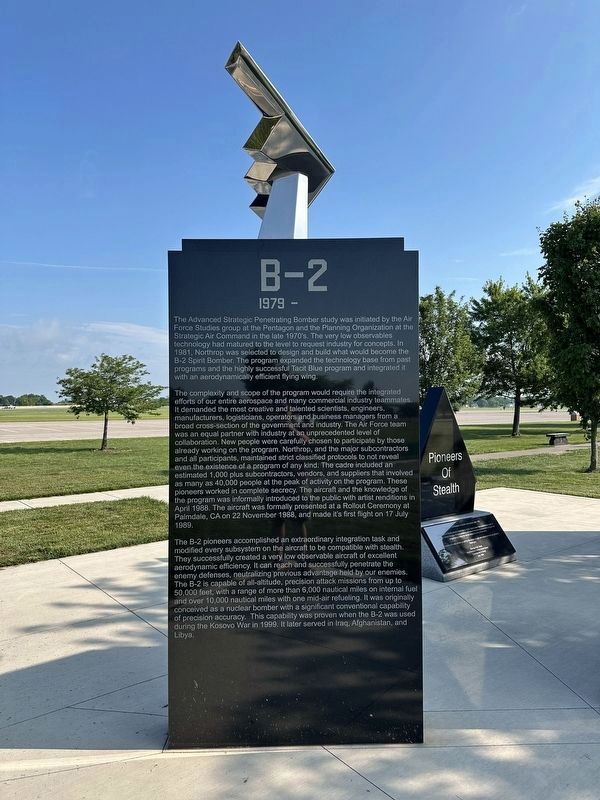
B-2 1979- .
The Advanced Strategic Penetrating Bomber study was initiated by the Air Force Studies group at the Pentagon and the Planning Organization at the Strategic Air Command in the late 1970's. The very low observables technology had matured to the level to request industry for concepts. In 1981, Northrop was selected to design and build what would become the B-2 Spirit Bomber. The program expanded the technology base from past programs and the highly successful Tacit Blue program and integrated it with an aerodynamically efficient flying wing.
The complexity and scope of the program would require the integrated efforts of our entire aerospace and many commercial industry teammates. It demanded the most creative and talented scientists, engineers, manufacturers, logisticians, operators and business managers from a broad cross-section of the government and industry. The Air Force team was an equal partner with industry at an unprecedented level of collaboration. New people were carefully chosen to participate by those already working on the program. Northrop, and the major subcontractors and all participants, maintained strict classified protocols to not reveal even the existence of a program of any kind. The cadre included an estimated 1,000 plus subcontractors, vendors, and suppliers that involved as many as 40,000 people at the peak of activity on the program. These pioneers worked in complete secrecy. The aircraft and the knowledge of the program was informally introduced to the public with artist renditions in April 1988. The aircraft was formally presented at a Rollout Ceremony at Palmdale, CA on 22 November 1988, and made it's first flight on 17 July 1989.
The B-2 pioneers accomplished an extraordinary integration task and modified every subsystem on the aircraft to be compatible with stealth. They successfully created a very low observable aircraft of excellent aerodynamic efficiency. It can reach and successfully penetrate the enemy defenses, neutralizing previous advantage held by our enemies. The B-2 is capable of all-altitude, precision attack missions from up to 50,000 feet, with a range of more than 6,000 nautical miles on internal fuel and over 10,000 nautical miles with one mid-air refueling. It was originally conceived as a nuclear bomber with a significant conventional capability of precision accuracy. This capability was proven when the B-2 was used during the Kosovo War in 1999. It later served in Iraq, Afghanistan, and Libya.
This memorial was made possible by the Pioneers of Stealth and the following Corporations
Lockheed Martin Northrop Grumman Boeing Raytheon GE Aerospace .
This memorial recognizes and celebrates the thousands of men and women in the U.S. Government and aerospace industry who worked in the deepest secrecy and successfully created the world's first family of extremely difficult to detect, very low observables, highly survivable, stealthy, military aircraft.
Efforts began in the mid-1970's with the Have Blue experimental aircraft, followed by the F-117 Stealth Fighter and the prototype Tacit Blue Airborne Radar Platform. The period of early stealth development concluded in 1993 with the delivery to the Air Force of the first B-2 Stealth Bomber.
The impact of these four highly complex integrated programs changed combat aircraft design and tactics around the world.
During this crucial eighteen year period, program participants combined to prove the science, develop the technologies and advance the manufacturing, maintenance and operational capabilities which continue to provide an invaluable advantage to the United States Air Force today.
These dedicated innovators are the pioneers of stealth.
(Reverse)
Letter to the Pioneers of Stealth Association, July 1998
"The Pioneers of Stealth should know that the entire Nation owes them a formidable debt of gratitude. Indeed it is
Click or scan to see this page online
your efforts in creating and maintaining revolutionary technologies and programs that make the United States the envy of the world.
As someone who was served so well by the breakthroughs and advancement you provide, I thank you."
George H.W. Bush
41st President of the United States
Commander In Chief
July 1998
Have Blue
First Very Low Observable Airplane
Technical Notes:
Engines: Two General Electric J85-GE-4A engines of 2950 lbs. thrust each.
Wingspan: 22 ft. 6 in.
Length: 38 ft. 0 in.
Height: 7 ft. 6 in.
Weight: 12,500 lbs. max.
Speed: Subsonic
Have Blue ~ The First Very Low Observables Technology Demonstration aircraft.
Combat loss of American aircraft to highly integrated radar directed defenses confirmed there was a critical need to increase aircraft survivability in a very hostile environment. This reality dictated a radically new approach to aircraft design.
In 1974, the Defense Advanced Research Projects Agency (DARPA), in conjunction with the Classified Aeronautical Systems Program Office at Wright-Patterson AFB, initiated a classified Technology Demonstrator program with the Lockheed Skunk Works to design, build, and flight test two airplanes, code named Have Blue. These were uniquely
Photographed by Pete Skillman, June 28, 2025
2. Pioneers of Stealth Marker - reverse
configured airplanes with a faceted shape, partially covered with radar absorbing material to degrade the adversary's radar detection and tracking.
The first aircraft flew on 1 December 1977 to prove this design could fly within its flight envelope. The second Have Blue flew on 20 July 1978 and was the first Very Low Observable (Stealth) airplane. It flew forty-two test flights against ground and airborne radar systems, successfully demonstrating a very low observable (Stealth) aircraft could be produced to evade and penetrate enemy defenses.
This breakthrough improvement in survivability was immediately exploited in the Top Secret design and development of the F-117A stealth fighter.
(Reverse)
Have Blue
First Very Low Observable Airplane
Multiple government and industry studies of the lethality of radar guided air defense systems, as encountered in Vietnam and the Yom Kippur war, led to the conclusion the Soviet Integrated Air Defense System (IADS) could not be penetrated without a prohibitive loss of USAF aircraft.
In the early 1970s, low observable technology studies and tests were conducted by the Remotely Piloted Vehicle System Program Office (RPVSPO) at Wright-Patterson AFB on reconnaissance and signal intelligence drones. Based on the finding
Photographed by Pete Skillman, June 28, 2025
3. Pioneers of Stealth Marker - Have Blue
from the RPV SPO, Defense Advanced Research Projects Agency (DARPA) posed two questions to the aircraft industry: (1) Is there a threshold of low observability that would deny effective radar detection and tracking? (2) Could a piloted aircraft be designed and fabricated to meet this threshold?
In 1974, HQ USAF and DARPA, in conjunction with the Classified Aeronautical Systems Program Office at Wright-Patterson AFB, initiated the Experimental Survivable Testbed (XST) program. This was a two-phase program with the aim of developing an aircraft concept that dramatically reduced radar signatures. The Lockheed Skunk Works and Northrop were selected to compete in this program. The first phase required tests of a full scale pole model at the Radar Target Scatter Test Range (RATSCAT) in New Mexico. Testing confirmed both contractor concepts essentially met the goals for a Very Low Observable (VLO) aircraft.
Lockheed was selected to continue with Phase 2, to design, build, and flight test two Technology Demonstrator aircraft, code named Have Blue. HQ USAF Studies and Analyses Agency established the requirements for the signature values for the Have Blue aircraft.
The first Have Blue aircraft flew on 1 December 1977. It was not low observable. Due to Have Blue's unique shape, the aircraft was statically unstable and could not be controlled without
Photographed by Pete Skillman, June 28, 2025
4. Pioneers of Stealth Marker - Have Blue reverse
the use of a quadruple redundant, analog fly-by-wire flight control system. The aircraft successfully completed thirty-sex test flights thus expanding the flight envelope for the low observable tests to be carried out on the second VLO aircraft.
On 20 July 1978, the second Have Blue aircraft flew. This was the first USAF Very Low Observable (Stealth) aircraft. Have Blue flew forty-two test flights against ground and airborne radar systems. It successfully demonstrated that a stealth aircraft could be produced to evade, penetrate, and survive enemy defenses to attach high value targets.
This could not have been achieved without the extremely close cooperation and expertise of industry and government teams. They worked in a non-adversarial relationship in a Top Secret environment to accomplish this technological breakthrough. This significantly enhanced the survivability of USAF combat aircraft.
This breakthrough improvement to aircraft survivability was immediately exploited in the Top Secret design and development of the F-117A stealth fighter.
F-117A
1977-2008
Technical Notes:
Engines: Two General Electric F404-F1D2 engines of 10,600 lbs. thrust each
Wingspan: 43 ft. 4 in.
Length: 65 ft. 11 in.
Height: 12 ft. 5 in
Weight: 52,500 lbs.
Photographed by Pete Skillman, June 28, 2025
5. Pioneers of Stealth Marker - F-117A
max.
Speed: 684 mph.
The successful flight test of Have Blue led to a program to develop an operational aircraft to accurately deliver ordnance on high value targets while avoiding detection. The F-117A Nighthawk was the first stealthy aircraft developed, produced, and used in combat by the United States Air Force. First flown on 19 June 1981, the F-117A became operational in October 1983, and accurately delivered laser guided bombs with pin point accuracy in Operation Desert Storm in 1990/91, with no battle damage or losses to the aircraft.
Fifty-nine F-117As were produced by the Lockheed Skunk Works.
(Reverse)
F-117A
1977-2008
The F-117A is the operational aircraft designed to exploit the technologies and flight test success of the Have Blue program. The aircraft would focus on evading detection by radar, infrared, and electronic means, using the faceted surface technology of Have Blue. Proven aircraft components were used where possible to reduce overall risk. An infrared acquisition and delivery system was used for target acquisition and laser weapon delivery, without electronic emissions. All weapons were carried internally.
The Full Scale Development contract was awarded to the Lockheed Skunk Works on 16 November 1978 to develop the F-117A.
Photographed by Pete Skillman, June 28, 2025
6. Pioneers of Stealth Marker - F-117A reverse
Streamlined management and very tight security limited the number of individuals in the decision chain to a minimum. The first flight of the full scale development aircraft occurred on 18 June 1981. A joint test force of Skunk Works test pilots, USAF test pilots and Tactical Air Command pilots performed airworthiness testing, integrated testing of the infrared acquisition and delivery system, weapons separation and delivery testing, and verification of the ability to avoid detection.
Limited Initial Operational Capability was declared by Tactical Air Command on 28 October 1983 with the 4450th Tactical Group at Tonopah Test Range, NV. The first combat use of the F-117A was in Operation Just Cause in Panama in December 1989. The opening F-117A strike of Operation Desert Storm on 17 January 1991 destroyed the air defense control center for the Baghdad area. Though only 2.5% of the tactical aircraft, the F-117A struck 31% of the strategic targets that first day. The F-117A was the only aircraft sent within the Baghdad city limits due to the threat. During Operation Desert Storm in 1991 the 415th and 416th Fighter Squadrons flew 1,271 combat sorties with no losses or battle damage. Delivering laser guided bombs, they attacked and destroyed Iraqi air defense and other heavily defended strategic Iraqi targets.
The security of the program was so tightly held
Photographed by Pete Skillman, June 28, 2025
7. Pioneers of Stealth Marker - Tacit Blue
that even the existence of the F-117A was not publicly announced until November of 1988. The 4450th Tactical Group became the 37th Tactical Fighter Wing and subsequently moved to Holloman AFB, NM. The F-117A was officially retired 22 April 2008.
Tacit Blue
1977-1985
Technical Notes:
Engines: Two Garrett ATF3-6 turbofan engines of 5,440 lbs thrust each.
Wingspan: 48 ft. 2 in.
Length: 55 ft. 10 in.
Height: 10 ft. 7 in.
Weight: 30,000 lbs.
Speed: 287 mph
Funded by the Defense Advanced Projects Agency (DARPA) and the USAF, Tacit Blue was created by Northrop Aircraft Corporation and the Wright-Patterson AFB Classified Aeronautical Systems Program Office. It was designed to loiter near the forward edge of the battle area with a large Low Probability of Intercept Radar created by Hughes Aircraft Company to locate vehicles on the ground without the surveilling aircraft being discovered. It would then transmit timely images from this radar to command and control sites on the ground. This required the aircraft to be very low observable in all aspects. The highly integrated industry, DARPA, and USAF team successfully completed this urgent and very high risk, highest priority, technology demonstration program. Extensive flight testing verified the Tacit Blue design was
Photographed by Pete Skillman, June 28, 2025
8. Pioneers of Stealth Marker - Tacit Blue reverse
extremely effective. These technologies were incorporated on the B-2 aircraft. The Tacit Blue aircraft first flew in February 1982 and completed one hundred thirty-five flights.
(Reverse)
Tacit Blue
1977-1985
In mid-1976, the Defense Advanced Research Projects Agency (DARPA) awarded a contract to Hughes Aircraft Company to create a very stealthy Low Probability of Intercept Radar (LPIR). In early 1977, Hughes delivered their product to DARPA. DARPA contacted the Northrop Aircraft Corporation to work with Hughes in creating a very low observables aircraft to be integrated with a program named Assault Breaker. Working closely with DARPA and the Classified Aeronautical Systems Program Office, a tightly integrated team was formed working in total secrecy. Tacit Blue began as a technology initiative to develop survivable persistent battlefield surveillance. The mission of Tacit Blue was to identify enemy combat vehicles at, and well behind, the battle front, tracking them when they moved and imaging them when they stopped. Simultaneously, it would continuously provide precise location data to enable attack by friendly air and surface weapons. This targeting information was to be available in real time to friendly theater-wide communication networks. The environment was very hostile with a well-equipped
Photographed by Pete Skillman, June 28, 2025
9. Pioneers of Stealth Marker - B-2
integrated defense system of air-to-air and surface-to-air sensors and weapons.
To survive, the Tacit Blue aircraft was designed with advanced very low-observables (stealth) technologies led by the Northrop Corporation. The target detection, tracking and locating sensor was a sophisticated very stealthy LPIR system developed by Hughes Aircraft Company.
Tacit Blue first flew on 5 February 1982 and completed one hundred thirty-five test missions over three years. Flight testing was very successful and demonstrated valuable and unique capabilities. The technologies Tacit Blue demonstrated were used by Northrop and Hughes in the B-2 Spirit bomber program including aerodynamically efficient curved surfaces and, most particularly, the radar.
B-2
1979-
Technical Notes:
Engines: Four General Electric F118-GE-100 turbofans of 17,300 lbs. thrust each
Wingspan: 172 ft.
Length: 69 ft.
Height: 17 ft.
Weight: 336,500 lbs.
Speed: High subsonic
The B-2 Spirit was developed as a long-range heavy bomber designed to conduct operational missions across the full spectrum of military conflict. It was required to penetrate the Soviet Union's defensive sensor arrays and survive in a hostile environment of enemy aircraft and ground-to-air missiles.
Photographed by Pete Skillman, June 28, 2025
10. Pioneers of Stealth Marker - B-2 reverse
HQ USAF approved the program in 1980 and directed the Advanced Technology Bomber System Program Office at Wright-Patterson AFB to manage and direct the program. Northrop Aircraft Corporation was selected to design, develop, and produce the aircraft.
The program was an integration task of immense complexity, modifying conventional subsystems to be used in a stealth application, applying the technologies demonstrated in the Tacit Blue program and expanding previous stealth applications to a more complex and larger scale. The aerospace might of the Nation's industry was successfully integrated in an unprecedented manner. The first flight of the aircraft was 17 July 1989. On 9 November 1989, the Soviet Union took down the Berlin Wall, effectively ending the Cold War.
(Reverse)
B-2
1979-
The Advanced Strategic Penetrating Bomber study was initiated by the Air Force Studies group at the Pentagon and the Planning Organization at the Strategic Air Command in the late 1970's. The very low observables technology had matured to the level to request industry for concepts. In 1981, Northrop was selected to design and build what would become the B-2 Spirit Bomber. The program expanded the technology base from past programs and the highly successful Tacit Blue program and integrated it with an
Photographed by Pete Skillman, June 28, 2025
11. Pioneers of Stealth Marker - Dedication
aerodynamically efficient flying wing.
The complexity and scope of the program would require the integrated efforts of our entire aerospace and many commercial industry teammates. It demanded the most creative and talented scientists, engineers, manufacturers, logisticians, operators and business managers from a broad cross-section of the government and industry. The Air Force team was an equal partner with industry at an unprecedented level of collaboration. New people were carefully chosen to participate by those already working on the program. Northrop, and the major subcontractors and all participants, maintained strict classified protocols to not reveal even the existence of a program of any kind. The cadre included an estimated 1,000 plus subcontractors, vendors, and suppliers that involved as many as 40,000 people at the peak of activity on the program. These pioneers worked in complete secrecy. The aircraft and the knowledge of the program was informally introduced to the public with artist renditions in April 1988. The aircraft was formally presented at a Rollout Ceremony at Palmdale, CA on 22 November 1988, and made it's first flight on 17 July 1989.
The B-2 pioneers accomplished an extraordinary integration task and modified every subsystem on the aircraft to be compatible with stealth. They successfully created a very low observable aircraft
Photographed by Pete Skillman, June 28, 2025
12. Pioneers of Stealth Marker - wide view
of excellent aerodynamic efficiency. It can reach and successfully penetrate the enemy defenses, neutralizing previous advantage held by our enemies. The B-2 is capable of all-altitude, precision attack missions from up to 50,000 feet, with a range of more than 6,000 nautical miles on internal fuel and over 10,000 nautical miles with one mid-air refueling. It was originally conceived as a nuclear bomber with a significant conventional capability of precision accuracy. This capability was proven when the B-2 was used during the Kosovo War in 1999. It later served in Iraq, Afghanistan, and Libya.
This memorial was made possible by the
Pioneers of Stealth
and the following Corporations
Lockheed Martin
Northrop Grumman
Boeing
Raytheon
GE Aerospace
Location. 39° 46.705′ N, 84° 6.883′ W. Marker is in Riverside, Ohio, in Montgomery County. It is in Beavercreek Township. It can be reached from Spaatz Circle. Touch for map. Marker is at or near this postal address: 38 Spaatz Cir, Dayton OH 45431, United States of America. Touch for directions.

Regionally, this marker is in Ohio’s Dayton Metro and in the Miami Valley. It is also in the American Midwest and in the Corn Belt. Globally, it is in North America, the Western Hemisphere, the Western World, and the Anglosphere. Historically, it finds itself in what was once the Haudenosaunee (Iroquois) Confederacy, the territory of the Mississippian Culture, and the Northwest Territory.
Credits. This page was last revised on July 1, 2025. It was originally submitted on June 30, 2025, by Pete Skillman of Townsend, Delaware. This page has been viewed 201 times since then and 55 times this year. Photos:1, 2, 3, 4, 5, 6. submitted on June 30, 2025, by Pete Skillman of Townsend, Delaware. 7, 8, 9, 10, 11, 12. submitted on July 1, 2025, by Pete Skillman of Townsend, Delaware.