Tracy City in Grundy County, Tennessee — The American South (East South Central)
Dr. Lilian W. Johnson (1864-1956), Advocate for Agricultural Cooperatives ⎯⎯⎯ "Highlander's An Idea"
Photographed by Darren Jefferson Clay, June 18, 2025
1. Dr. Lilian W. Johnson (1864-1956), Advocate for Agricultural Cooperatives / "Highlander's An Idea" M
Inscription.
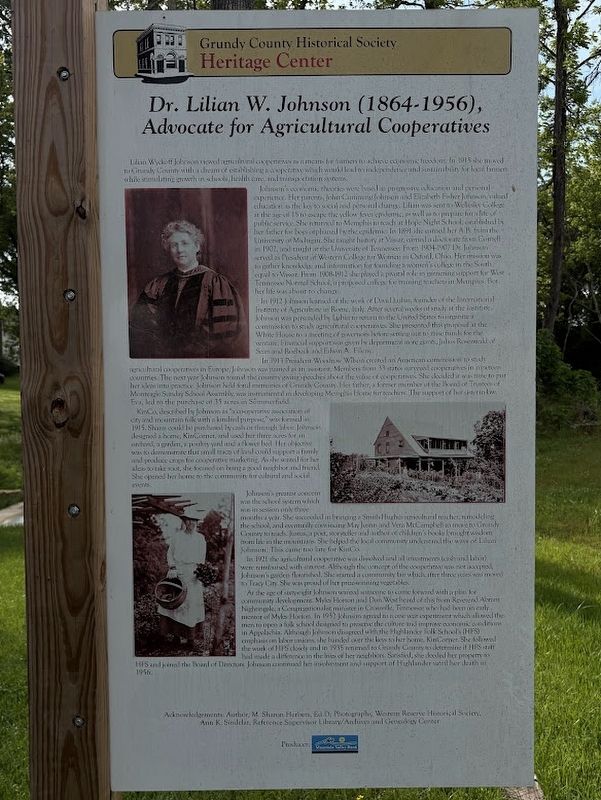
Dr. Lilian W. Johnson (1864-1956), Advocate for Agricultural Cooperatives, also, "Highlander's An Idea". . Lilian Wyckoff Johnson viewed agricultural cooperatives as a means for farmers to achieve economic freedom. In 1915 she moved to Grundy County with a dream of establishing a cooperative which would lead to independence and sustainability for local farmers while stimulating growth in schools, health care, and transportation systems., Johnson's economic theories were based in progressive education and personal experience. Her parents, John Cumming Johnson and Elizabeth Fisher Johnson, valued education as the key to social and personal change. Lilian was sent to Wellesley College at the age of 15 to escape the yellow fever epidemic, as well as to prepare for a life of public service. She returned to Memphis to teach at Hope Night School, established by her father for boys orphaned by the epidemic. In 1891 she earned her A.B. from the University of Michigan. She taught history at Vassar, earned a doctorate from Cornell in 1902, and taught at the University of Tennessee. From 1904-1907 Dr. Johnson served as President of Western College for Women in Oxford, Ohio. Her mission was to gather knowledge and information for founding a women's college in the South equal to Vassar. From 1908-1912 she played a pivotal role in garnering support for West Tennessee Normal School, a proposed college for training teachers in Memphis. But her life was about to change., In 1912 Johnson learned of the work of David Lubin, founder of the International Institute of Agriculture in Rome, Italy. After several weeks of study at the institute, Johnson was persuaded by Lubin to return to the United States to organize a commission to study agricultural cooperatives. She presented this proposal at the White House to a meeting of governors before setting out to raise funds for the venture. Financial support was given by department store giants, Julius Rosenwald of Sears and Roebuck and Edwin A. Filene., In 1913 President Woodrow Wilson created an American commission to study agricultural cooperatives in Europe: Johnson was named as an assistant. Members from 33 states surveyed cooperatives in nineteen countries. The next year Johnson toured the country giving speeches about the value of cooperatives. She decided it was time to put her ideas into practice. Johnson held fond memories of Grundy County. Her father, a former member of the Board of Trustees of Monteagle Sunday School Assembly, was instrumental in developing Memphis Home for teachers. The support of her sister-in-law, Eva, led to the purchase of 35 acres in Summerfield., KinCo, described by Johnson as "a co-operative association of city and mountain folk with a kindred purpose," was formed in 1915. Shares could be purchased by cash or through labor. Johnson designed a home, KinCorner, and used her three acres for an orchard, a garden, a poultry yard and a flower bed. Her objective was to demonstrate that small tracts of land could support a family and produce crops for cooperative marketing. As she waited for her ideas to take root, she focused on being a good neighbor and friend. She opened her home to the community for cultural and social events., Johnson's greatest concern was the school system which was in session only three months a year. She succeeded in bringing a Smith-Hughes agricultural teacher, remodeling the school, and eventually convincing May Justus and Vera McCampbell to move to Grundy County to teach. Justus, a poet, storyteller and author of children's books brought wisdom from life in the mountains. She helped the local community understand the ways of Lilian Johnson. This came too late for KinCo., In 1921 the agricultural cooperative was dissolved and all investments (cash and labor) were reimbursed with interest. Although the concept of the cooperative was not accepted, Johnson's garden flourished. She started a community fair which after three years was moved to Tracy City. She was proud of her prizewinning vegetables., At the age of sixty-eight Johnson wanted someone to come forward with a plan for community development. Myles Horton and Don West heard of this from Reverend Abram Nightingale, a Congregationalist minister in Crossville, Tennessee who had been an early mentor of Myles Horton. In 1932 Johnson agreed to a one year experiment which allowed the men to open a folk school designed to preserve the culture and improve economic conditions in Appalachia. Although Johnson disagreed with the Highlander Folk School's (HFS) emphasis on labor unions, she handed over the keys to her home, KinCorner. She followed the work of HFPS closely and in 1935 returned to Grundy County to determine if HFS staff had made a difference in the lives of her neighbors. Satisfied, she deeded her property to HFS and joined the Board of Directors. Johnson continued her involvement and support of Highlander until her death in 1956. ,
Acknowledgements: Author, M. Sharon Herbers, Ed.D; Photographs, Western Reserve Historical Society, Ann K. Sindelar, Reference Supervisor Library/Archives and Genealogy Center. , Backside of the marker ,
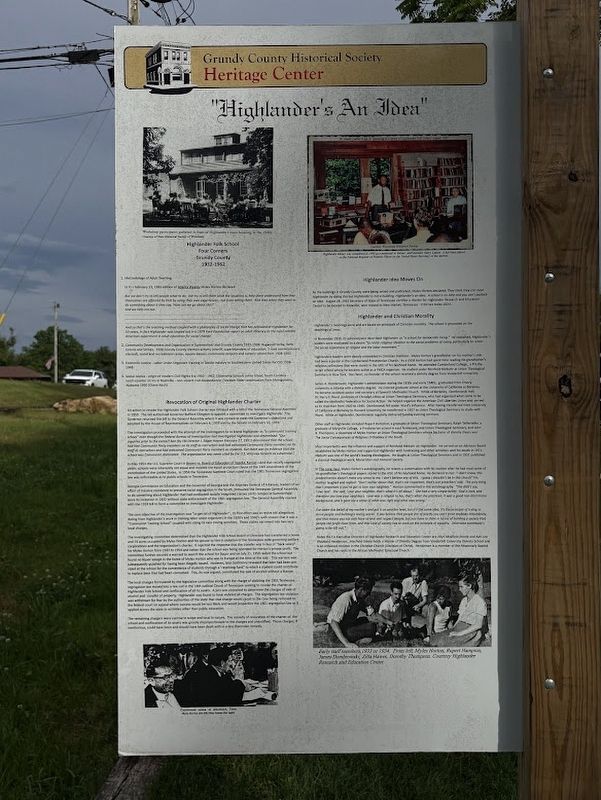
Highlander Folk School , Four Corners , Grundy County , 1932-1962. , 1. Methodology of Adult Teaching , In the February 13, 1983 edition of Atlanta Weekly Myles Horton declared: But we don't try to tell people what to do. We try to tell them what the situation is, help them understand how they themselves are affected by that by using their own experiences - not from telling them. And then when they want to do something about it they say, 'How can we go about this?" And we help em out. And so that's the teaching method coupled with a philosophy of social change that has prevailed at Highlander for 50 years. In fact Highlander was singled out in a 1979 Ford Foundation report on adult illiteracy as the most notable American experiment in adult education for social change. , 2. Community Development and Organization in Summerfield and Grundy County 1932-1938-Bugwood Strike, WPA Unions and Strikes, 1938 Grundy County election activity (sheriff, superintendent of education, 3 road commissioners elected), social and recreational center, square dances, community projects and nursery school from 1938-1943. , 3. Economic Justice - Labor Union Organizer Training in Textile Industry in Southeastern United States for CIO 1938-1948 , 4. Social Justice-origin of modern Civil Rights Era 1950-1962; Citizenship Schools Johns Island, South Carolina lunch counter sit ins in Nashville - non-violent civil disobedience; Freedom Rider continuation from Montgomery, Alabama 1960 (Diane Nash),
Revocation of Original Highlander Charter. An action to revoke the Highlander Folk School charter was initiated with a bill of the Tennessee General Assembly in 1959. The bill authorized Governor Bufford Ellington to appoint a committee to investigate Highlander. The Governor returned the bill to the General Assembly where it was revised to meet the Governor's objections and adopted by the House of Representatives on February 4, 1959 and by the Senate on February 10, 1959., The investigation proceeded with the attempt of the investigators to to brand Highlander as "a communist training school" even though the Federal Bureau of Investigation had investigated Highlander and determined: "Our inquiries prior to the contact ban (by FBI Director J. Edgar Hoover February 27, 1951) determined that the school had had Communist Party members on its staff as instructors and had welcomed Communist Party members on its staff as instructors and had welcomed Communist Party members as students, but there was no evidence that the school was Communist dominated. The organization was never cited by the U.S. Attorney General as subversive.", In May 1954 the U.S. Supreme Court in Brown vs. Board of Education of Topeka, Kansas ruled that racially segregated public schools were inherently not equal and violated the equal protection clause of the 14th amendment of the constitution of the United States. In 1956 the Tennessee Supreme Court ruled that the 1901 Tennessee segregation law was enforceable as to public schools in Tennessee., Georgia Commission on Education and the Governor of Georgia and the Attorney General of Arkansas, leaders of an effort of massive resistance to preserve racial segregation in the South, pressured the Tennessee General Assembly to do something about Highlander that had conducted racially integrated classes on its campus at Summerfield since its inception in 1932 without state enforcement of the 1901 segregation law. The General Assembly reacted with the 1959 bill to form a committee to investigate Highlander., The core objective of the investigation was "to get rid of Highlander". Its first effort was to revive old allegations dating from Highlander's work in training labor union organizers in the 1930's and 1940's with smears that it was a "Communist Training School" coupled with citing its race mixing activities. These claims narrowed into two very local charges., The investigating committee determined that the Highlander Folk School Board of Directors had transferred a home and 76 acres occupied by Myles Horton and his spouse to him in violation of the Tennessee code governing welfare corporations and the organization's charter. It rejected the response that the transfer was in lieu of "back salary" for Myles Horton from 1932 to 1954 and rather that the school was being operated for Horton's private profit. The committee further secured a warrant to search the school for liquor and on July 31, 1959 raided the school but found no liquor except in the home of Myles Horton who was in Europe at the time of the raid. This warrant was subsequently quashed for having been illegally issued. However, later testimony revealed that beer had been provided at the school for the convenience of students through a "revolving fund" to which a student could contribute to replace beer that had been consumed. This, its was argued, constituted the sale of alcohol without a license., The local charges formulated by the legislative committee along with the charge of violating the 1901 Tennessee segregation law moved into a law suit in the 18th Judicial Circuit of Tennessee seeking to revoke the charter of Highlander Folk School and confiscation of all its assets. A jury was convened to determine the charges of sale of alcohol and transfer of property. Highlander was found to have violated all charges. The segregation law violation was withdrawn for fear by the authorities of the state that that charge would result in the case being removed to the federal court on appeal where success would be less likely and would jeopardize the 1901 segregation law as it applied across the state to activities other than public education., The remaining chargers were narrow in scope and local in nature. The remedy of revocation of the charter of the school and confiscation of its assets was grossly disproportionate to the charges and unjustified. Those charges, if meritorious, could have been and should have been dealt with in a less draconian remedy.,
Highlander Idea Moves On. As the buildings in Grundy County were being seized and padlocked, Myles Horton declared: They think they can erase Highlander by doing this but Highlander is not a building, Highlander's an idea. A school is an idea and you can't padlock an idea. August 28, 1961 Secretary of State of Tennessee certifies a charter for Highlander Research and Education Center to be located in Knoxville, later moved to New Market, Tennessee. It thrives today 2024.,
Highlander and Christian Morality. Highlander's moorings were and are based on principals of Christian morality. The school is grounded on the teachings of Jesus., In November 1939, its administrator described Highlander as "a school for democratic living." He explained, Highlander's leaders were motivated by a desire "to relate religious idealism to the social problems of today, particularly to relate the social aspirations of religion and the labor movement.", Highlanders leaders were deeply embedded in Christian tradition. Myles Horton's grandfather on his mother's side had been a pastor in the Cumberland Presbyterian Church. As a child Horton had spent time reading his grandfather's religious collections that were stored in the attic of his boyhood home. He attended Cumberland College, a Presbyterian school where he became active as a YMCA organizer. He studied under Reinhold Niebuhr at Union Theological Seminary in New York. Don West, co-founder of the school received a divinity degree from Vanderbilt University., James A. Dombrowski, Highlander's administrator during the 1930s and early 1940s, graduated from Emory University in Atlanta with a divinity degree. He entered graduate school at the University of California at Berkeley. He became assistant pastor and secretary at Epworth Methodist Church. While at Berkeley, Dombrowski met Dr. Harry F. Ward, professor of Christian ethics at Union Theological Seminary, who had organized what came to be called the Methodist Federation for Social Action. He helped organize the American Civil Liberties Union and served as its chairman from 1920 to 1940. Dombrowski fell under Ward's Influence. After having transferred from University of California at Berkeley to Harvard University, he transferred in 1927 to Union Theological Seminary to study with Ward. While at Highlander, Dombrowski regularly delivered Sunday evening sermons., Other staff at Highlander included Rupert Hampton, a graduate of Union Theological Seminary, Ralph Tefferteller, a graduate of Maryville College, a Presbyterian school in east Tennessee, and Union Theological Seminary, and John B. Thompson, a classmate of Myles Horton at Union Theological Seminary whose bachelor of divinity thesis was The Social Consequences of Religious Orthodoxy in the South., Most importantly was the influence and support of Reinhold Niebuhr on Highlander. He served on an Advisory Board established by Myles Horton and supported Highlander with fundraising and other activities until his death in 1971. Niebuhr was one of the world's leading theologians. He taught at Union Theological Seminary and in 1931 published a classical theological work, Moral Man and Immoral Society., In The Long Haul, Myles Horton's autobiography, he relates a conversation with his mother after he had read some of his grandfather's theological papers stored in the attic of his boyhood home. He declared to her: "I don't know, this predestination doesn't make any sense to me, I don't believe any of this. I guess I shouldn't be in this church" His mother laughed and replied: "Don't bother about that, that's not important, that's just preachers' talk. The only thing that's important is you've got to love your neighbor." Horton commented in the autobiography: "She didn't say, Love God. She said, 'Love your neighbor, that's what it's all about. She had a very simple belief: God is love, and therefore you love your neighbors. Love was a religion to her, that's what she practiced. It was a good non-doctrinaire background, and it gave me a sense of what was right and what was wrong., I've taken this belief of my mother's and put it on another level, but it's the same idea. It's the principle of trying to serve people and building a loving world. If you believe that people are of worth, you can't treat anybody inhumanely, and that means you not only have to love and respect people, but you have to think in terms of building a society that people con profit most from, and that kind of society has to work on the principle of equality. Otherwise somebody's going to be left out.", Today the Co-Executive Directors of Highlander Research and Education Center are Allyn Maxfield-Steele and Ash-Lee Woodard Henderson, Maxfield-Steele holds a Master of Divinity Degree from Vanderbilt University Divinity School and is an ordained minister in the Christian Church (Disciples of Christ). Henderson is a member of the Missionary Baptist Church and has roots in the African Methodist Episcopal Church.
Lilian Wyckoff Johnson viewed agricultural cooperatives as a means for farmers to achieve economic freedom. In 1915 she moved to Grundy County with a dream of establishing a cooperative which would lead to independence and sustainability for local farmers while stimulating growth in schools, health care, and transportation systems.
Johnson's economic theories were based in progressive education and personal experience. Her parents, John Cumming Johnson and Elizabeth Fisher Johnson, valued education as the key to social and personal change. Lilian was sent to Wellesley College at the age of 15 to escape the yellow fever epidemic, as well as to prepare for a life of public service. She returned to Memphis to teach at Hope Night School, established by her father for boys orphaned by the epidemic. In 1891 she earned her A.B. from the University of Michigan. She taught history at Vassar, earned a doctorate from Cornell in 1902, and taught at the University of Tennessee. From 1904-1907 Dr. Johnson served as President of Western College for Women in Oxford, Ohio. Her mission was to gather knowledge and information for founding a women's college in the South equal to Vassar. From 1908-1912 she played a pivotal role in garnering support for West Tennessee Normal School, a proposed college for training teachers in Memphis. But her life
Click or scan to see this page online
was about to change.
In 1912 Johnson learned of the work of David Lubin, founder of the International Institute of Agriculture in Rome, Italy. After several weeks of study at the institute, Johnson was persuaded by Lubin to return to the United States to organize a commission to study agricultural cooperatives. She presented this proposal at the White House to a meeting of governors before setting out to raise funds for the venture. Financial support was given by department store giants, Julius Rosenwald of Sears and Roebuck and Edwin A. Filene.
In 1913 President Woodrow Wilson created an American commission to study agricultural cooperatives in Europe: Johnson was named as an assistant. Members from 33 states surveyed cooperatives in nineteen countries. The next year Johnson toured the country giving speeches about the value of cooperatives. She decided it was time to put her ideas into practice. Johnson held fond memories of Grundy County. Her father, a former member of the Board of Trustees of Monteagle Sunday School Assembly, was instrumental in developing Memphis Home for teachers. The support of her sister-in-law, Eva, led to the purchase of 35 acres in Summerfield.
KinCo, described by Johnson as "a co-operative association of city and mountain folk with a kindred purpose," was formed in 1915. Shares could be purchased by cash or through labor.
Photographed by Darren Jefferson Clay, June 18, 2025
2. Dr. Lilian W. Johnson (1864-1956), Advocate for Agricultural Cooperatives / "Highlander's An Idea" M
Johnson designed a home, KinCorner, and used her three acres for an orchard, a garden, a poultry yard and a flower bed. Her objective was to demonstrate that small tracts of land could support a family and produce crops for cooperative marketing. As she waited for her ideas to take root, she focused on being a good neighbor and friend. She opened her home to the community for cultural and social events.
Johnson's greatest concern was the school system which was in session only three months a year. She succeeded in bringing a Smith-Hughes agricultural teacher, remodeling the school, and eventually convincing May Justus and Vera McCampbell to move to Grundy County to teach. Justus, a poet, storyteller and author of children's books brought wisdom from life in the mountains. She helped the local community understand the ways of Lilian Johnson. This came too late for KinCo.
In 1921 the agricultural cooperative was dissolved and all investments (cash and labor) were reimbursed with interest. Although the concept of the cooperative was not accepted, Johnson's garden flourished. She started a community fair which after three years was moved to Tracy City. She was proud of her prizewinning vegetables.
At the age of sixty-eight Johnson wanted someone to come forward with a plan for community development. Myles Horton and Don West heard of this from Reverend Abram
Photographed by Darren Jefferson Clay, June 18, 2025
3. Dr. Lilian W. Johnson (1864-1956), Advocate for Agricultural Cooperatives / "Highlander's An Idea" M
Nightingale, a Congregationalist minister in Crossville, Tennessee who had been an early mentor of Myles Horton. In 1932 Johnson agreed to a one year experiment which allowed the men to open a folk school designed to preserve the culture and improve economic conditions in Appalachia. Although Johnson disagreed with the Highlander Folk School's (HFS) emphasis on labor unions, she handed over the keys to her home, KinCorner. She followed the work of HFPS closely and in 1935 returned to Grundy County to determine if HFS staff had made a difference in the lives of her neighbors. Satisfied, she deeded her property to HFS and joined the Board of Directors. Johnson continued her involvement and support of Highlander until her death in 1956.
Acknowledgements: Author, M. Sharon Herbers, Ed.D; Photographs, Western Reserve Historical Society, Ann K. Sindelar, Reference Supervisor Library/Archives and Genealogy Center
Backside of the marker
Highlander Folk School
Four Corners
Grundy County
1932-1962
1. Methodology of Adult Teaching
In the February 13, 1983 edition of Atlanta Weekly Myles Horton declared:
But we don't try to tell people what to do. We try to tell them what the situation is, help them understand how they themselves are affected by that by using their own experiences
- not from telling them. And then when they want to do something about it they say, 'How can we go about this?" And we help em out.
And so that's the teaching method coupled with a philosophy of social change that has prevailed at Highlander for 50 years. In fact Highlander was singled out in a 1979 Ford Foundation report on adult illiteracy as the most notable American experiment in adult education for social change.
2. Community Development and Organization in Summerfield and Grundy County 1932-1938-Bugwood Strike, WPA Unions and Strikes, 1938 Grundy County election activity (sheriff, superintendent of education, 3 road commissioners elected), social and recreational center, square dances, community projects and nursery school from 1938-1943.
3. Economic Justice - Labor Union Organizer Training in Textile Industry in Southeastern United States for CIO 1938-1948
4. Social Justice-origin of modern Civil Rights Era 1950-1962; Citizenship Schools Johns Island, South Carolina lunch counter sit ins in Nashville - non-violent civil disobedience; Freedom Rider continuation from Montgomery, Alabama 1960 (Diane Nash)
Revocation of Original Highlander Charter
An action to revoke the Highlander Folk School charter was initiated with a bill of the Tennessee General Assembly in 1959. The bill authorized Governor Bufford Ellington to appoint a committee to investigate Highlander. The Governor returned the bill to the General Assembly where it was revised to meet the Governor's objections and adopted by the House of Representatives on February 4, 1959 and by the Senate on February 10, 1959.
The investigation proceeded with the attempt of the investigators to to brand Highlander as "a communist training school" even though the Federal Bureau of Investigation had investigated Highlander and determined: "Our inquiries prior to the contact ban (by FBI Director J. Edgar Hoover February 27, 1951) determined that the school had had Communist Party members on its staff as instructors and had welcomed Communist Party members on its staff as instructors and had welcomed Communist Party members as students, but there was no evidence that the school was Communist dominated. The organization was never cited by the U.S. Attorney General as subversive."
In May 1954 the U.S. Supreme Court in Brown vs. Board of Education of Topeka, Kansas ruled that racially segregated public schools were inherently not equal and violated the equal protection clause of the 14th amendment of the constitution of the United States. In 1956 the Tennessee Supreme Court ruled that the 1901 Tennessee segregation law was enforceable as to public schools in Tennessee.
Georgia Commission on Education and the Governor of Georgia and the Attorney General of Arkansas, leaders of an effort of massive resistance to preserve racial segregation in the South, pressured the Tennessee General Assembly to do something about Highlander that had conducted racially integrated classes on its campus at Summerfield since its inception in 1932 without state enforcement of the 1901 segregation law. The General Assembly reacted with the 1959 bill to form a committee to investigate Highlander.
The core objective of the investigation was "to get rid of Highlander". Its first effort was to revive old allegations dating from Highlander's work in training labor union organizers in the 1930's and 1940's with smears that it was a "Communist Training School" coupled with citing its race mixing activities. These claims narrowed into two very local charges.
The investigating committee determined that the Highlander Folk School Board of Directors had transferred a home and 76 acres occupied by Myles Horton and his spouse to him in violation of the Tennessee code governing welfare corporations and the organization's charter. It rejected the response that the transfer was in lieu of "back salary" for Myles Horton from 1932 to 1954 and rather that the school was being operated for Horton's private profit. The committee further secured a warrant to search the school for liquor and on July 31, 1959 raided the school but found no liquor except in the home of Myles Horton who was in Europe at the time of the raid. This warrant was subsequently quashed for having been illegally issued. However, later testimony revealed that beer had been provided at the school for the convenience of students through a "revolving fund" to which a student could contribute to replace beer that had been consumed. This, its was argued, constituted the sale of alcohol without a license.
The local charges formulated by the legislative committee along with the charge of violating the 1901 Tennessee segregation law moved into a law suit in the 18th Judicial Circuit of Tennessee seeking to revoke the charter of Highlander Folk School and confiscation of all its assets. A jury was convened to determine the charges of sale of alcohol and transfer of property. Highlander was found to have violated all charges. The segregation law violation was withdrawn for fear by the authorities of the state that that charge would result in the case being removed to the federal court on appeal where success would be less likely and would jeopardize the 1901 segregation law as it applied across the state to activities other than public education.
The remaining chargers were narrow in scope and local in nature. The remedy of revocation of the charter of the school and confiscation of its assets was grossly disproportionate to the charges and unjustified. Those charges, if meritorious, could have been and should have been dealt with in a less draconian remedy.
Highlander Idea Moves On
As the buildings in Grundy County were being seized and padlocked, Myles Horton declared: They think they can erase Highlander by doing this but Highlander is not a building, Highlander's an idea. A school is an idea and you can't padlock an idea. August 28, 1961 Secretary of State of Tennessee certifies a charter for Highlander Research and Education Center to be located in Knoxville, later moved to New Market, Tennessee. It thrives today 2024.
Highlander and Christian Morality
Highlander's moorings were and are based on principals of Christian morality. The school is grounded on the teachings of Jesus.
In November 1939, its administrator described Highlander as "a school for democratic living." He explained, Highlander's leaders were motivated by a desire "to relate religious idealism to the social problems of today, particularly to relate the social aspirations of religion and the labor movement."
Highlanders leaders were deeply embedded in Christian tradition. Myles Horton's grandfather on his mother's side had been a pastor in the Cumberland Presbyterian Church. As a child Horton had spent time reading his grandfather's religious collections that were stored in the attic of his boyhood home. He attended Cumberland College, a Presbyterian school where he became active as a YMCA organizer. He studied under Reinhold Niebuhr at Union Theological Seminary in New York. Don West, co-founder of the school received a divinity degree from Vanderbilt University.
James A. Dombrowski, Highlander's administrator during the 1930s and early 1940s, graduated from Emory University in Atlanta with a divinity degree. He entered graduate school at the University of California at Berkeley. He became assistant pastor and secretary at Epworth Methodist Church. While at Berkeley, Dombrowski met Dr. Harry F. Ward, professor of Christian ethics at Union Theological Seminary, who had organized what came to be called the Methodist Federation for Social Action. He helped organize the American Civil Liberties Union and served as its chairman from 1920 to 1940. Dombrowski fell under Ward's Influence. After having transferred from University of California at Berkeley to Harvard University, he transferred in 1927 to Union Theological Seminary to study with Ward. While at Highlander, Dombrowski regularly delivered Sunday evening sermons.
Other staff at Highlander included Rupert Hampton, a graduate of Union Theological Seminary, Ralph Tefferteller, a graduate of Maryville College, a Presbyterian school in east Tennessee, and Union Theological Seminary, and John B. Thompson, a classmate of Myles Horton at Union Theological Seminary whose bachelor of divinity thesis was The Social Consequences of Religious Orthodoxy in the South.
Most importantly was the influence and support of Reinhold Niebuhr on Highlander. He served on an Advisory Board established by Myles Horton and supported Highlander with fundraising and other activities until his death in 1971. Niebuhr was one of the world's leading theologians. He taught at Union Theological Seminary and in 1931 published a classical theological work, Moral Man and Immoral Society.
In The Long Haul, Myles Horton's autobiography, he relates a conversation with his mother after he had read some of his grandfather's theological papers stored in the attic of his boyhood home. He declared to her: "I don't know, this predestination doesn't make any sense to me, I don't believe any of this. I guess I shouldn't be in this church" His mother laughed and replied: "Don't bother about that, that's not important, that's just preachers' talk. The only thing that's important is you've got to love your neighbor." Horton commented in the autobiography: "She didn't say, Love God. She said, 'Love your neighbor, that's what it's all about. She had a very simple belief: God is love, and therefore you love your neighbors. Love was a religion to her, that's what she practiced. It was a good non-doctrinaire background, and it gave me a sense of what was right and what was wrong.
I've taken this belief of my mother's and put it on another level, but it's the same idea. It's the principle of trying to serve people and building a loving world. If you believe that people are of worth, you can't treat anybody inhumanely, and that means you not only have to love and respect people, but you have to think in terms of building a society that people con profit most from, and that kind of society has to work on the principle of equality. Otherwise somebody's going to be left out."
Today the Co-Executive Directors of Highlander Research and Education Center are Allyn Maxfield-Steele and Ash-Lee Woodard Henderson, Maxfield-Steele holds a Master of Divinity Degree from Vanderbilt University Divinity School and is an ordained minister in the Christian Church (Disciples of Christ). Henderson is a member of the Missionary Baptist Church and has roots in the African Methodist Episcopal Church.
Location. 35° 15.618′ N, 85° 44.278′ W. Marker is in Tracy City, Tennessee, in Grundy County. It is on Railroad Avenue west of Depot St. Touch for map. Marker is at or near this postal address: 345 Railroad Ave, Tracy City TN 37387, United States of America. Touch for directions.

Regionally, this marker is in Tennessee’s Cumberland Plateau and in the Highland Rim. It is also in the American South, specifically in the Upper South, in Appalachia, and specifically in Southern Appalachia. Globally, it is in North America, the Western Hemisphere, the Western World, and the Anglosphere. Historically, it finds itself in what was once the territory of the Mississippian Culture, one of the Confederate States of America, and the Antebellum South.
Credits. This page was last revised on July 3, 2025. It was originally submitted on June 30, 2025, by Darren Jefferson Clay of Duluth, Georgia. This page has been viewed 194 times since then and 50 times this year. Photos:1, 2, 3. submitted on June 30, 2025, by Darren Jefferson Clay of Duluth, Georgia. • James Hulse was the editor who published this page.
