Norman in Cleveland County, Oklahoma — The American South (West South Central)
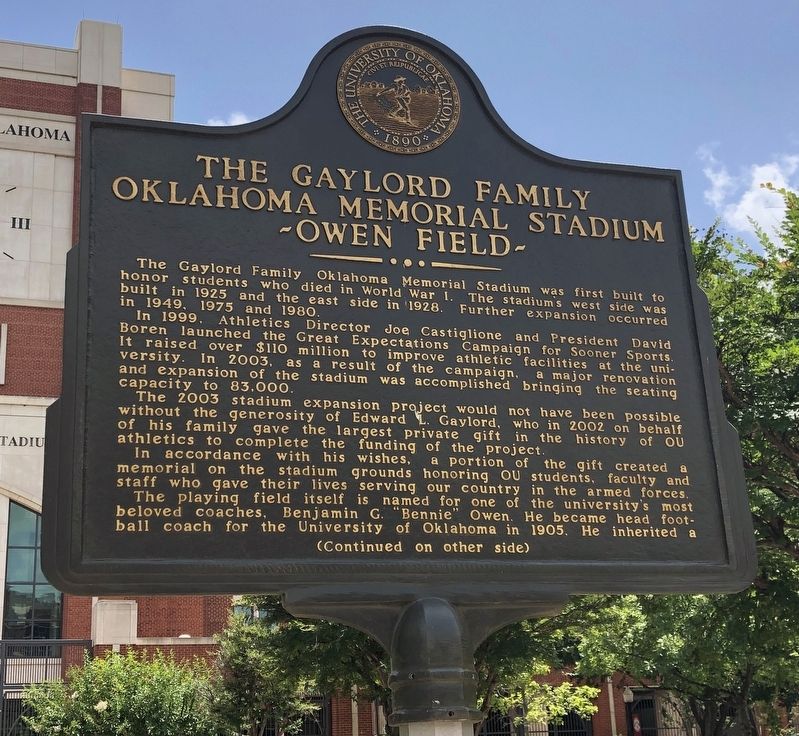
The Gaylord Family Oklahoma Memorial Stadium
Owen Field
Photographed by Duane and Tracy Marsteller, June 19, 2025
1. The Gaylord Family Oklahoma Memorial Stadium Marker, Side One
In 1999, Athletics Director Joe Castiglione and President David Boren launched the Great Expectations Campaign for Sooner Sports. It raised over $110 million to improve athletic facilities at the university. In 2003, as a result of the campaign, a major renovation and expansion of the stadium was accomplished bringing the seating capacity to 83,000.
The 2003 stadium expansion project would not have been possible without the generosity of Edward L. Gaylord, who in 2002 on behalf of his family gave the largest private gift in the history of OU athletics to complete the funding of the project.
In accordance with his wishes, a portion of the gift created a memorial on the stadium grounds honoring OU students, faculty and staff who gave their lives serving our country in the armed forces.
The playing field itself is named for one of the university's most beloved coaches, Benjamin G. “Bennie” Owen.
this page online
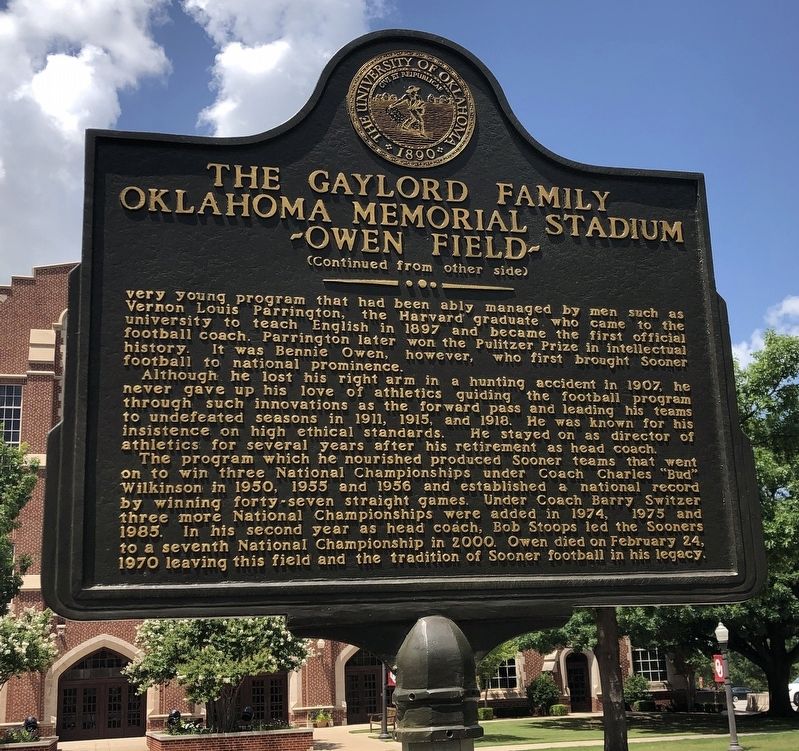
Although he lost his right arm in a hunting accident in 1907, he never gave up his love of athletics guiding the football program through such innovations as the forward pass and leading his teams to undefeated seasons in 1911, 1915, and 1918. He was known for his insistence on high ethical standards. He stayed on as director of athletics for several years after his retirement as head coach.
The program which he nourished produced Sooner teams that went on to win three national championships under Coach Charles “Bud” Wilkinson in 1950, 1955 and 1956 and established a national record by winning forty-seven straight games. Under Coach Barry Switzer three more national championships were added in
Photographed by Duane and Tracy Marsteller, June 19, 2025
2. The Gaylord Family Oklahoma Memorial Stadium Marker, Side Two
Erected by The University of Oklahoma.
Topics and series. This historical marker is listed in these topic lists: Parks & Recreational Areas • Sports. In addition, it is included in the University of Oklahoma series list. A significant historical year for this entry is 1925.
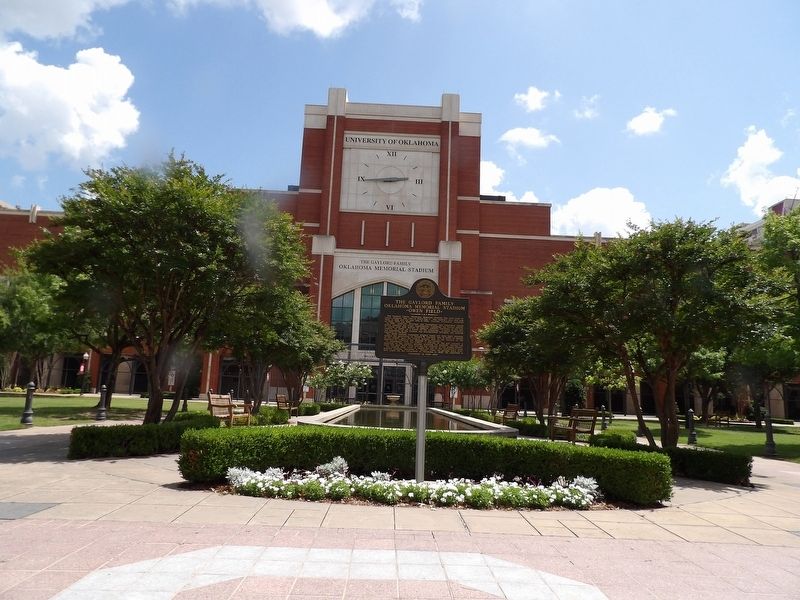
Location. 35° 12.436′ N, 97° 26.54′ W. Marker is in Norman, Oklahoma, in Cleveland County. It is on West Brooks Street west of South Jenkins Avenue, on the left when traveling west. Marker is in the plaza in front of Gate 6 at the stadium's north entrance. Touch for map. Marker is in this post office area: Norman OK 73019, United States of America. Touch for directions.

Regionally, this marker is in Central Oklahoma—Frontier Country and in Greater Oklahoma City. It is also in the American South, specifically on the prairies, and on the Southern Plains. Globally, it is in North America, the Western Hemisphere, the Western
Photographed by Duane and Tracy Marsteller, June 19, 2025
3. The Gaylord Family Oklahoma Memorial Stadium Marker
Other nearby markers. At least 8 other markers are within walking distance of this marker: The Roy T. Oliver Walk and Gardens (within shouting distance of this marker); a different marker also named The Roy T. Oliver Walk and Gardens (about 300 feet away, measured in a direct line); Schusterman Park (about 400 feet away); Brooks Street (about 400 feet away); Lissa and Cy Wagner Student Academic Services Center (about 400 feet away); Michael F. Price Hall (about 400 feet away); The Armory (about 500 feet away); a different marker also named Michael F. Price Hall (about 600 feet away). Touch for a list and map of all markers in Norman.
Another marker is no longer nearby. The OU Field House (was within shouting distance of this marker but has been confirmed missing).
More about this marker. This section of West Brooks Street is normally closed to vehicles.
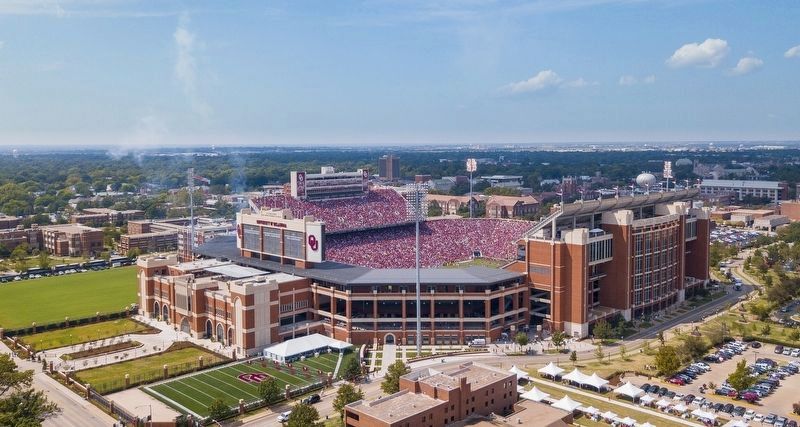
Regarding The Gaylord Family Oklahoma Memorial Stadium. Another renovation/expansion in 2016 enclosed the south
Toni Klemm via Wikimedia Commons (CC BY-SA 4.0), September 2, 2017
4. The Gaylord Family-Oklahoma Memorial Stadium
The stadium is shown after the south end zone (foreground) was enclosed.
Also see . . . Stadium History. The original University football field was located on the prairie north of the present Holmberg Hall. OU's first game in 1895 was played there against the Oklahoma City Town Team. (University of Oklahoma Athletics) (Submitted on July 2, 2025, by Duane and Tracy Marsteller of Murfreesboro, Tennessee.)
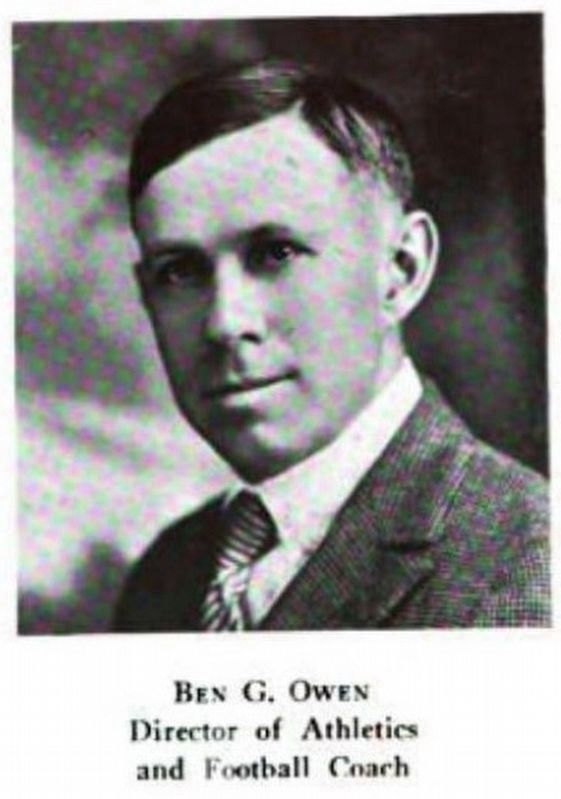
The Sooner (yearbook) via Google Books (Public Domain), circa 1922
5. Benjamin Gilbert “Bennie” Owen (1875-1970)
He compiled a 122–54–16 record over 22 seasons as Oklahoma's football coach. He also coached the university's baseball and men's basketball teams.
Credits. This page was last revised on July 2, 2025. It was originally submitted on July 2, 2025, by Duane and Tracy Marsteller of Murfreesboro, Tennessee. This page has been viewed 412 times since then and 129 times this year. Photos: 1, 2, 3, 4, 5. submitted on July 2, 2025, by Duane and Tracy Marsteller of Murfreesboro, Tennessee.
