Near Keystone in Pennington County, South Dakota — The American Midwest (Upper Plains)
Celestial and Earthly Locations
| — | Mount Rushmore National Memorial | — |

Photographed by Mark Parker, June 30, 2025
1. Celestial and Earthly Locations Marker
For Native Peoples in the Black Hills region, celestial and earthly locations are inextricably intertwined. Every year, from the Vernal Equinox to the Summer Solstice, spiritual leaders follow a map of the Black Hills located amongst the stars, where constellations correspond with significant earthly locations. The passage of the sun through these constellations mirrors this spiritual journey.
Sidebar
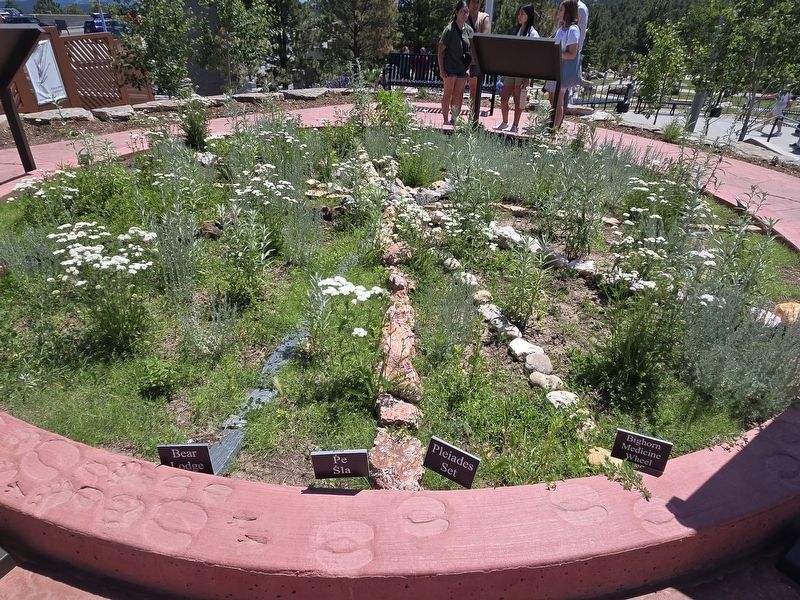
The spokes on this sculpture denote both astronomical events and culturally significant sites.
The Lakota refer to the Axial Precession movement as the "Kapemni" (twisting motion). The above/below reflection in the image is a philosophical foundation in Lakota culture.
The Kapemni design is frequently seen in Lakota and other Northern Plains artwork.
The Kapemni is also found in the conical shape of the tiphestola (home). As a place of nurturing, learning, and growth, the home is considered a foundation of Lakota life.
Erected by National Park Service, U.S. Department of the Interior.
Topics. This historical marker is listed in this topic list: Indigenous Peoples and Communities.
Location. 43° 52.546′ N,
this page online

Regionally, this marker is in West River, in the Badlands, and in Greater Rapid City. It is also in the American Black Hills, in the Lewis & Clark Corridor, on the prairies, and on the Northern Plains. Globally, it is in North America, the Western Hemisphere, the Western World, and the Anglosphere. Historically, it finds itself in what was once Rupert’s Land and also the Louisiana Purchase.
Other nearby markers. At least 8 other markers are within walking distance of this marker: Ancient Stone Circles (here, next to this marker); "We Are Still Here" (here, next to this marker); Traditional Ecological Knowledge (here, next to this marker); Significant Black Hills Native American Sites (here, next to this marker); Rushmore Workers (about 500 feet away, measured in a direct line); History of the United States of America
Photographed by Mark Parker, June 30, 2025
2. Replica Stone Circle
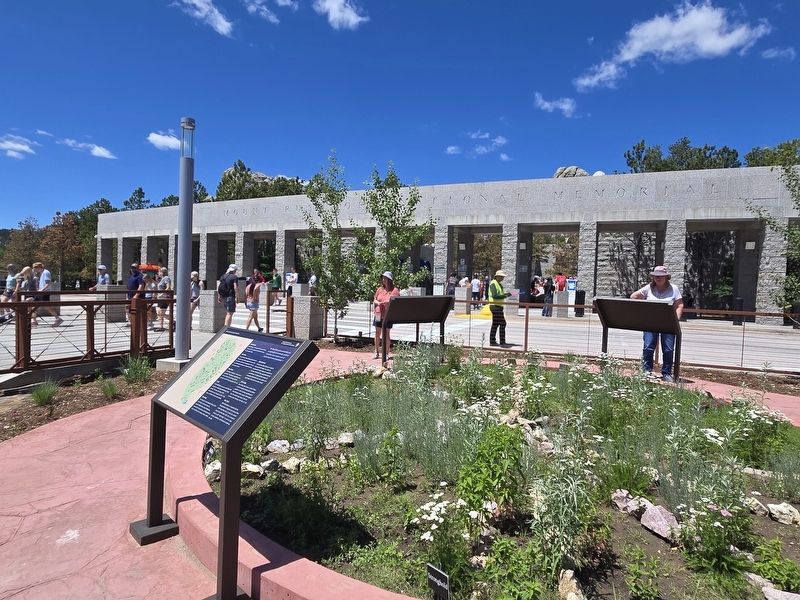
More about this marker. The marker is at Mt. Rushmore National Memorial. It is located between the parking decks and the entrance to the park.
Also see . . . Stone Hoop and Ethnobotanical Garden.
The design is based on ancient stone circles scattered throughout the Americas. The stone spokes laid out in the garden and extending from a center rock cairn will point in the direction of Tribally significant locations in the Black Hills of South Dakota and beyond. Spokes will also reflect the cardinal directions, alignment with solstices and equinoxes, and will incorporate celestial connections and alignments for a Star Knowledge component.(Submitted on July 2, 2025, by Mark Parker of Hickory, North Carolina.)
Photographed by Mark Parker, June 30, 2025
3. Celestial and Earthly Locations Marker with other markers at the Mt. Rushmore Park entrance
Credits. This page was last revised on July 5, 2025. It was originally submitted on July 2, 2025, by Mark Parker of Hickory, North Carolina. This page has been viewed 151 times since then and 33 times this year. Photos: 1, 2, 3. submitted on July 2, 2025, by Mark Parker of Hickory, North Carolina. • J. Makali Bruton was the editor who published this page.
