Norman in Cleveland County, Oklahoma — The American South (West South Central)
Brooks Street
Photographed by Duane and Tracy Marsteller, June 19, 2025
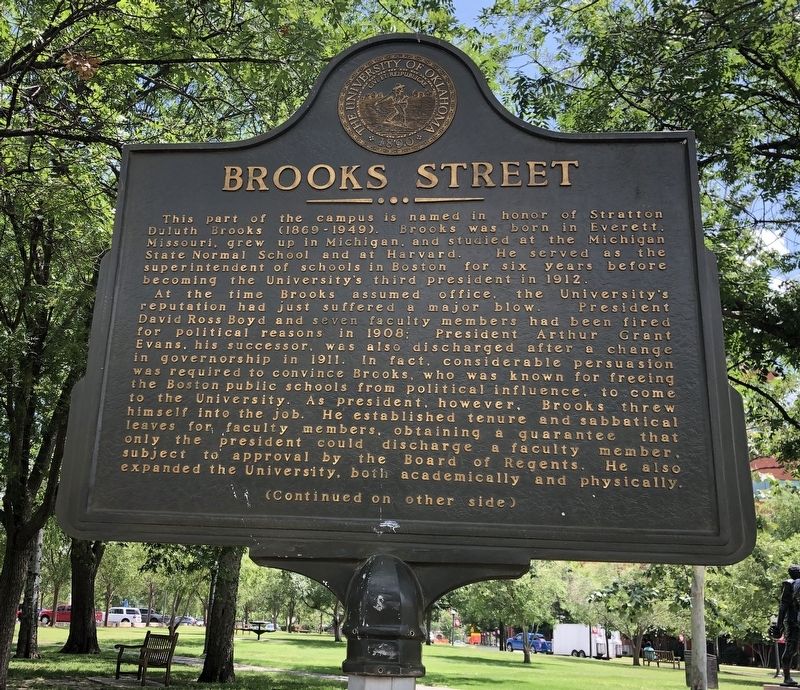
1. Brooks Street Marker, Side One
At the time Brooks assumed office, the University's reputation had just suffered a major blow. President David Ross Boyd and seven faculty members had been fired for political reasons in 1908. President Arthur Grant Evans, his successor, was also discharged after a change in governorship in 1911. In fact, considerable persuasion was required to convince Brooks, who was known for freeing the Boston public schools from political influence, to come to the University. As president, however, Brooks threw himself into the job. He established tenure and sabbatical leaves for faculty members, obtaining a guarantee that only the president could discharge a faculty member, subject to approval by the Board of Regents. He also expanded the University, both academically and physically.
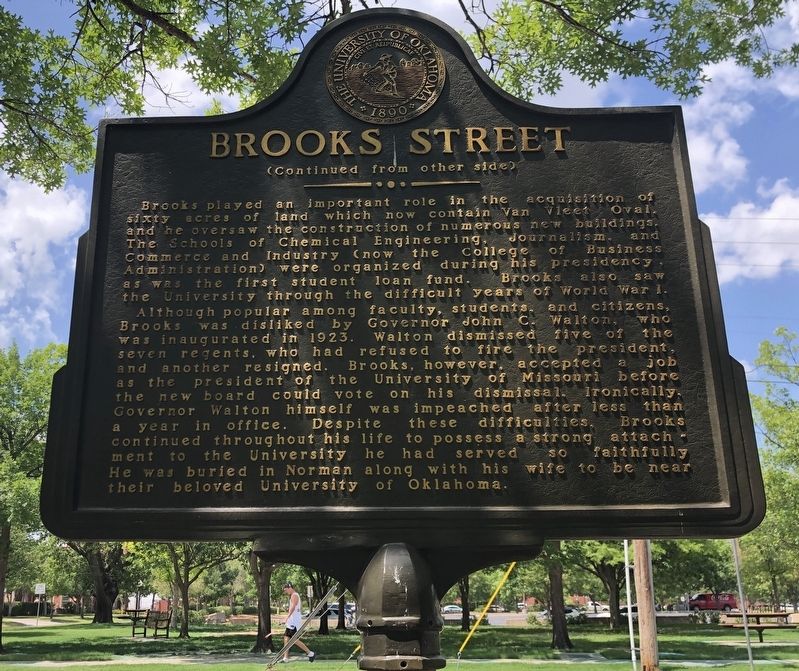
Brooks played an important
this page online
Although popular among faculty, students, and citizens, Brooks was disliked by Governor John C. Walton, who was inaugurated in 1923. Walton dismissed five of the seven regents, who had refused to fire the president, and another resigned. Brooks, however, accepted a job as the president of the University of Missouri before the new board could vote on his dismissal. Ironically, Governor Walton himself was impeached after less than a year in office. Despite these difficulties, Brooks continued throughout his life to possess a strong attachment to the university he had served so faithfully. He was buried in Norman along with his wife to be near their beloved University of Oklahoma.
Erected by The University of Oklahoma.
Topics and series.
Photographed by Duane and Tracy Marsteller, June 19, 2025
2. Brooks Street Marker, Side Two
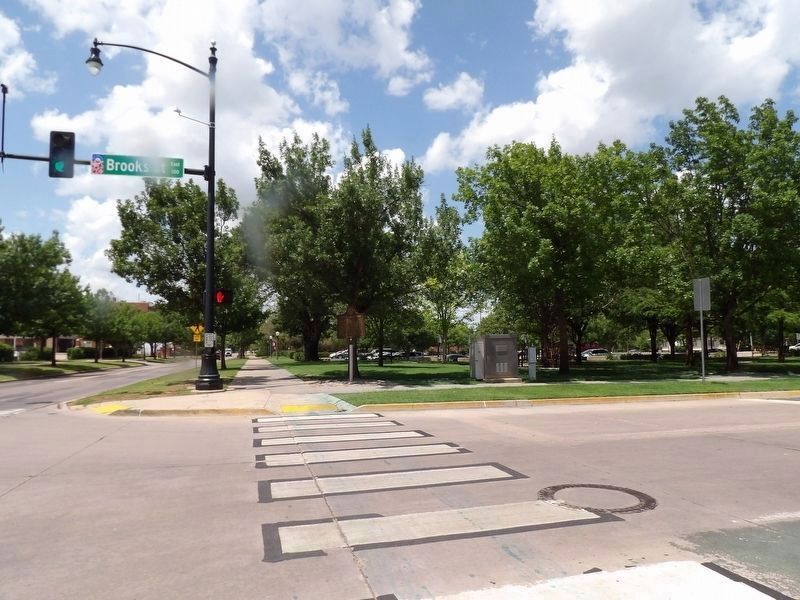
Location. 35° 12.442′ N, 97° 26.458′ W. Marker is in Norman, Oklahoma, in Cleveland County. It is at the intersection of East Brooks Street and South Jenkins Avenue, on the right when traveling east on East Brooks Street. Touch for map. Marker is in this post office area: Norman OK 73069, United States of America. Touch for directions.

Regionally, this marker is in Central Oklahoma—Frontier Country and in Greater Oklahoma City. It is also in the American South, specifically on the prairies, and on the Southern Plains. Globally, it is in North America, the Western Hemisphere, the Western World, and the Anglosphere. Historically, it finds itself in what was once the territory of the Mississippian Culture and also the Louisiana Purchase.
Other nearby markers. At least 8 other markers are within walking distance of this marker: Schusterman Park (within shouting distance of this marker); The Roy T. Oliver Walk and Gardens
Photographed by Duane and Tracy Marsteller, June 18, 2025
3. Brooks Street Marker
Another marker is no longer nearby. The OU Field House (was about 500 feet away but has been confirmed missing).
The Michigan Alumnus, May 1912; via Google Books (Public Domain), circa 1910
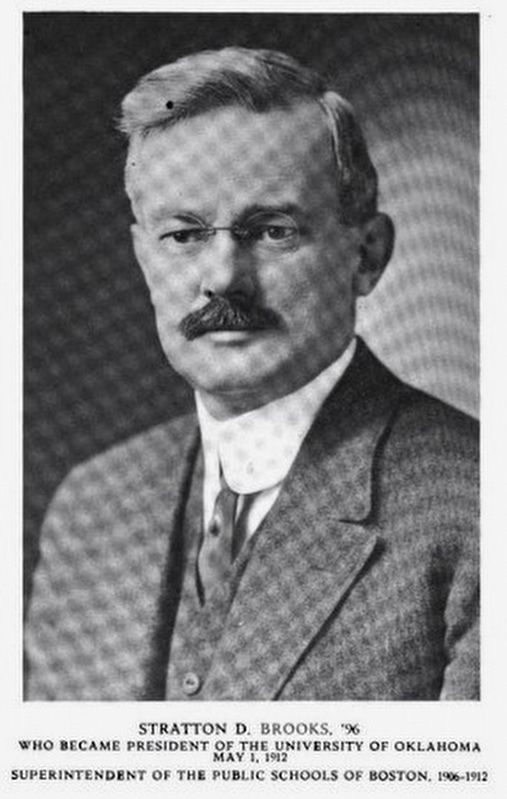
4. Stratton Duluth Brooks
He was president of the University of Missouri from 1923 to 1930, when he was dismissed over a "sex survey" issued by two sociology professors without his knowledge. (The survey was about families, but included three questions on students' attitudes about extramarital sex). The State Board of Curators fired one of the professors and suspended the other for a year, only to fire him after he criticized his suspension upon his return. The board, embarrassed by the resulting controversy over the survey and firings, partly blamed Brooks and dismissed him. Brooks finished his educational career as president of the Order of DeMolay, a Masonic institution for young men in Kansas City, Mo.
Credits. This page was last revised on July 3, 2025. It was originally submitted on July 2, 2025, by Duane and Tracy Marsteller of Murfreesboro, Tennessee. This page has been viewed 84 times since then and 12 times this year. Photos: 1, 2, 3. submitted on July 2, 2025, by Duane and Tracy Marsteller of Murfreesboro, Tennessee. 4. submitted on July 3, 2025, by Duane and Tracy Marsteller of Murfreesboro, Tennessee.
