Custer in Custer County, South Dakota — The American Midwest (Upper Plains)
Way Park
Photographed by Mark Parker, June 30, 2025
1. Way Park Marker
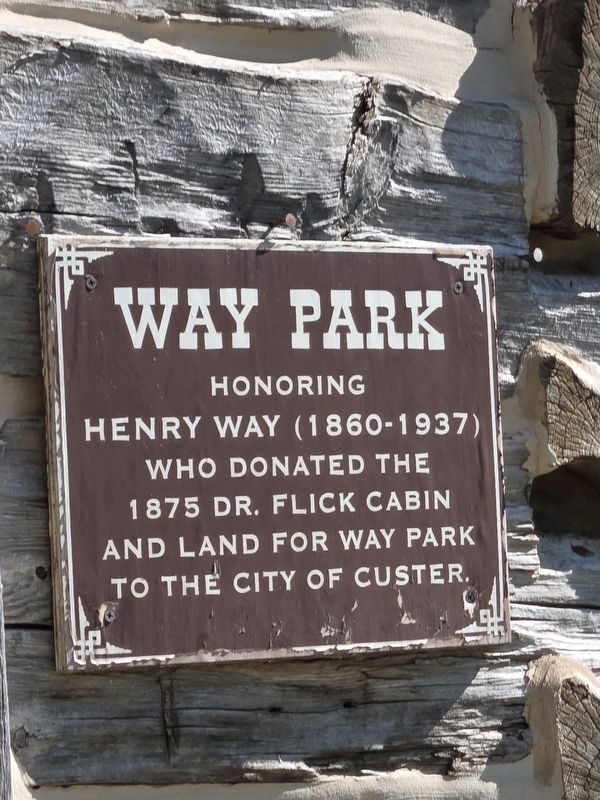
Honoring Henry Way (1860-1937) who donated the 1875 Dr. Flick cabin and land for Way Park to the city of Custer.
Topics. This historical marker is listed in these topic lists: Charity & Public Work • Parks & Recreational Areas. A significant historical year for this entry is 1875.
Location. 43° 45.94′ N, 103° 36.062′ W. Marker is in Custer, South Dakota, in Custer County. It is on Mount Rushmore Road (U.S. 16/385) east of South 4th Street, on the right when traveling east. Touch for map. Marker is at or near this postal address: 424 Mt Rushmore Rd, Custer SD 57730, United States of America. Touch for directions.

Regionally, this marker is in West River and in Greater Rapid City. It is also in the American Black Hills, in the Lewis & Clark Corridor, on the prairies, and on the Northern Plains. Globally, it is in North America, the Western Hemisphere, the Western World, and the Anglosphere. Historically, it finds itself in what was once Rupert’s Land and also the Louisiana Purchase.
Other nearby markers. At least 8 other markers are within walking distance of this marker: Dedicated to All Veterans (here,
this page online
Photographed by Mark Parker, June 30, 2025
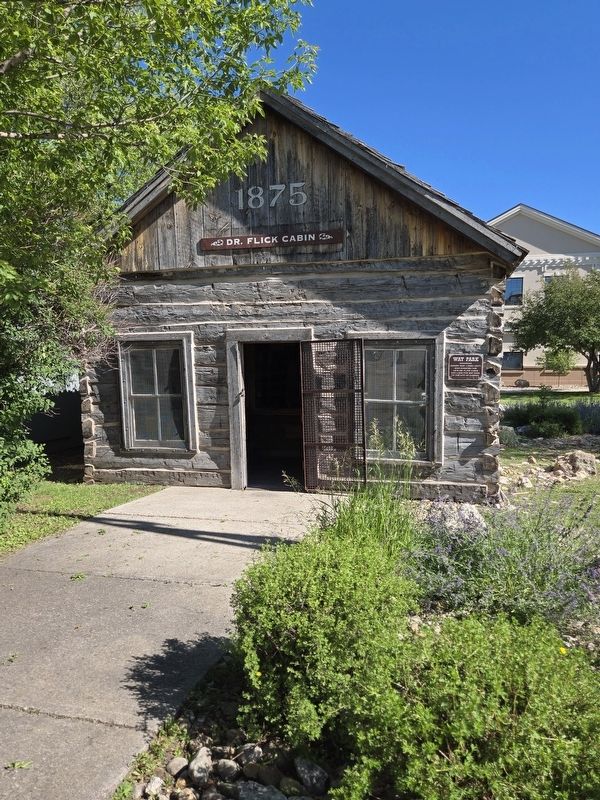
2. The 1875 Dr. Flick cabin. Way Park Marker as at the front right corner of the cabin
Photographed by Mark Parker, June 30, 2025
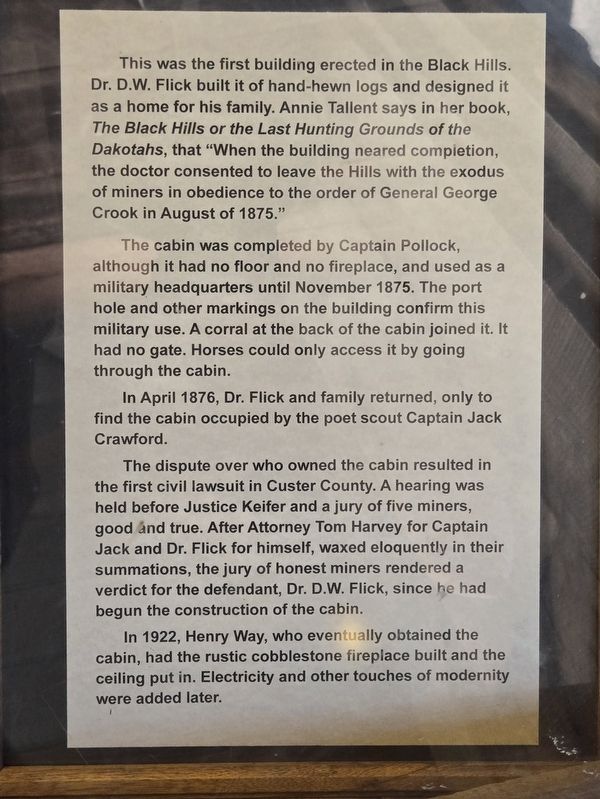
3. A history of Dr. Flick Cabin inside the structure
This was the first building erected in the Black Hills.
Dr. D.W. Flick built it of hand-hewn logs and designed it as a home for his family. Annie Tallent says in her book, The Black Hills or the Last Hunting Grounds of the
Dakotahs, that "When the building neared compietion, the doctor consented to leave the Hills with the exodus of miners in obedience to the order of General George
Crook in August of 1875."
The cabin was completed by Captain Pollock, although it had no floor and no fireplace, and used as a military headquarters until November 1875. The port hole and other markings on the building confirm this military use. A corral at the back of the cabin joined it. It had no gate. Horses could only access it by going through the cabin.
In April 1876, Dr. Flick and family returned, only to find the cabin occupied by the poet scout Captain Jack Crawford.
The dispute over who owned the cabin resulted in the first civil lawsuit in Custer County. A hearing was held before Justice Keifer and a jury of five miners, good and true. After Attorney Tom Harvey for Captain Jack and Dr. Flick for himself, waxed eloquently in their summations, the jury of honest miners rendered a verdict for the defendant, Dr. D.W. Flick, since he had begun the construction of the cabin.
In 1922, Henry Way, who eventually obtained the cabin, had the rustic cobblestone fireplace built and the ceiling put in. Electricity and other touches of modernity were added later.
The cabin was completed by Captain Pollock, although it had no floor and no fireplace, and used as a military headquarters until November 1875. The port hole and other markings on the building confirm this military use. A corral at the back of the cabin joined it. It had no gate. Horses could only access it by going through the cabin.
In April 1876, Dr. Flick and family returned, only to find the cabin occupied by the poet scout Captain Jack Crawford.
The dispute over who owned the cabin resulted in the first civil lawsuit in Custer County. A hearing was held before Justice Keifer and a jury of five miners, good and true. After Attorney Tom Harvey for Captain Jack and Dr. Flick for himself, waxed eloquently in their summations, the jury of honest miners rendered a verdict for the defendant, Dr. D.W. Flick, since he had begun the construction of the cabin.
In 1922, Henry Way, who eventually obtained the cabin, had the rustic cobblestone fireplace built and the ceiling put in. Electricity and other touches of modernity were added later.
Credits. This page was last revised on July 5, 2025. It was originally submitted on July 2, 2025, by Mark Parker of Hickory, North Carolina. This page has been viewed 127 times since then and 28 times this year. Photos: 1, 2, 3. submitted on July 2, 2025, by Mark Parker of Hickory, North Carolina. • J. Makali Bruton was the editor who published this page.
