
Tracy City in Grundy County, Tennessee — The American South (East South Central)
Who are the Tourists?
From the Heritage Center
| — | Oliver W. Jervis, Grundy County Historical Society | — |
Photographed by Darren Jefferson Clay, June 18, 2025
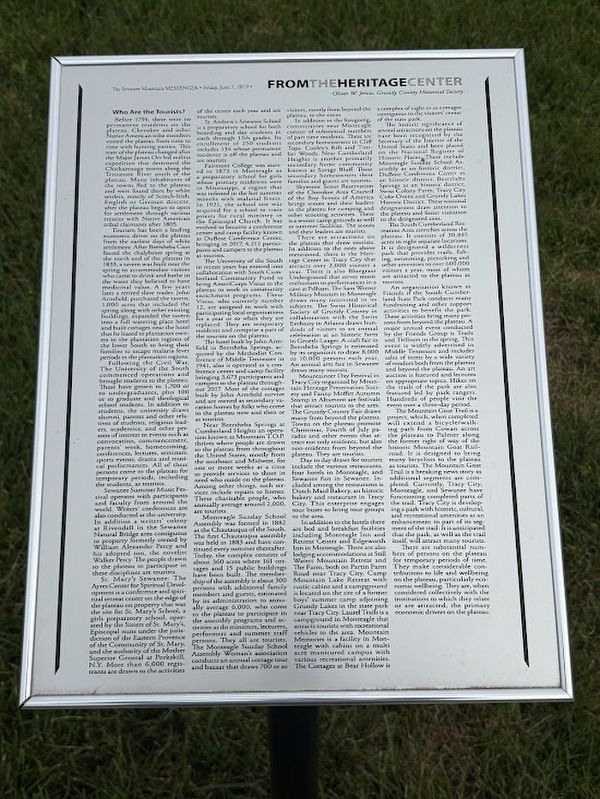
1. Who are the Tourists? Marker
Tourism has been a leading economic driver on the plateau from the earliest days of white settlement. After Beersheba Cain found the chalybeate spring at the north end of the plateau in 1833, a tavern was built near the spring to accommodate visitors who came to drink and bathe in the water they believed to have medicinal value. A few years later a retired slave trader, John Armfield, purchased the tavern, 1,000 acres that included the spring along with other existing buildings, expanded the tavern into a full watering place
this page online
Following the Civil War, The University of the South commenced operations and brought students to the plateau. These have grown to 1,700 ог so undergraduates, plus 100 or so graduate and theological school students. In addition to students, the university draws alumni, parents and other relatives of students, religious leaders, academics, and other persons of interest to events such as convocation, commencement, parents' week, homecoming, conferences, lectures, seminars, sports events, drama and musical performances. All of these persons come to the plateau for temporary periods, including the students, as tourists.
Sewanee Summer Music Festival operates with participants and faculty from around the world. Writers' conferences are also conducted at the university. In addition a writers' colony at Rivendell in the Sewanee Natural Bridge area contiguous to property formerly owned by William Alexander Percy and his
Photographed by Darren Jefferson Clay, June 18, 2025
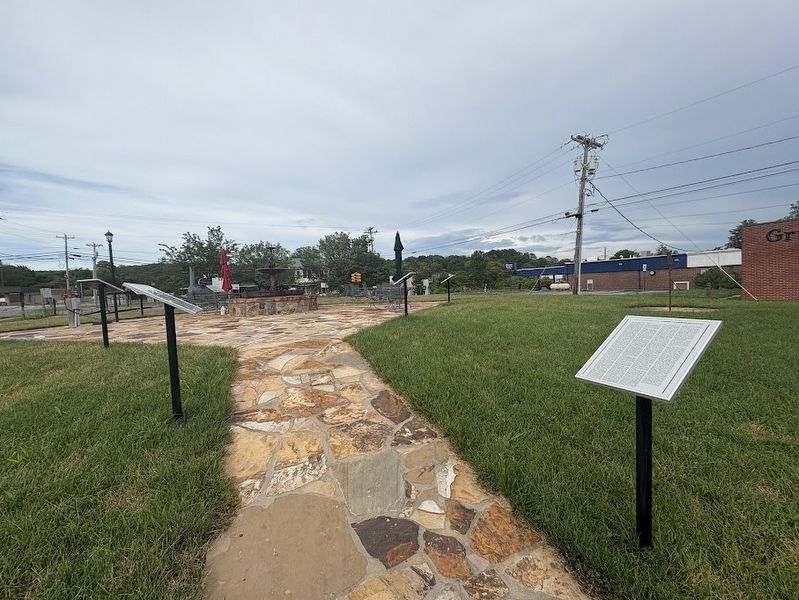
2. Who are the Tourists? Marker (on right)
St. Mary's Sewanee: The Ayres Center for Spiritual Development is a conference and spiritual retreat center on the edge of the plateau on property that was the site for St. Mary's School, a girls preparatory school, operated by the Sisters of St. Mary's, Episcopal nuns under the jurisdiction of the Eastern Provence of the Community of St. Mary, and the authority of the Mother Superior General at Peekskill, N.Y. More than 6,000 registrants are drawn to the activities of the center each year and are tourists.
St. Andrew's-Sewanee School is a preparatory school for both boarding and day students in sixth through 12th grades. Its enrollment of 250 students includes 134 whose permanent residence is off the plateau and are tourists.
Fairmont College was started in 1873 in Monteagle as a preparatory school for girls whose primary residences were in Mississippi, a region that was infested in the hot summer months with malarial fevers. In 1921, the school site was acquired for a school to train priests for rural ministry in the Episcopal Church. It has evolved to become a conference center and camp facility known as DuBose Conference Center, bringing in 2017, 4,212 participants and campers to the plateau as tourists.
The University of the South in recent years has entered into collaboration with South Cumberland Community Fund to bring AmeriCorps Vistas to the plateau to work in community enrichment programs. These Vistas, who currently number 12, are assigned to work with participating local organizations for a year or so when they are replaced. They are temporary residents and comprise a part of the tourists on the plateau.
The hotel built by John Armfield in Beersheba Springs, acquired by the Methodist Conference of Middle Tennessee in 1941, also is operated as a conference center and camp facility bringing 3,673 participants and campers to the plateau through-out 2017. Most of the cottages built by John Armfield survive and are owned as secondary vacation homes by folks who come to the plateau now and then or as tourists.
Near Beersheba Springs at Cumberland Heights an operation known as Mountain T.O.P. thrives where people are drawn to the plateau from throughout the United States, mostly from the southeast and Midwest, for one or more weeks at a time to provide services to those in need who reside on the plateau. Among other things, such services include repairs to homes. These charitable people, who annually average around 2,000, are tourists.
Monteagle Sunday School Assembly was formed in 1882 as the Chautauqua of the South. The first Chautauqua assembly was held in 1883 and have continued every summer thereafter. Today, the complex consists of about 360 acres where 161 cottages and 15 public buildings have been built. The membership of the assembly is about 300 persons with additional family members and guests, estimated by its administration to annually average 6,000, who come to the plateau to participate in the assembly programs and activities as do ministers, lecturers, performers and summer staff persons. They all are tourists. The Monteagle Sunday School Assembly Woman's association conducts an annual cottage tour and bazaar that draws 700 or so visitors, mostly from beyond the plateau, to the event.
In addition to the foregoing, communities near Monteagle consist of substantial numbers of part time residents. These are secondary homeowners in Cliff Tops. Cooley's Rift and Timber Woods. Near Cumberland Heights is another primarily secondary home community known as Savage Bluff. These secondary homeowners their families and guests are tourists.
Skymont Scout Reservation of the Cherokee Area Council of the Boy Scouts of America brings scouts and their leaders to the plateau for camping and other scouting activities. There is a winter camp grounds as well as summer facilities. The scouts and their leaders are tourists.
There are attractions on the plateau that draw tourists. In addition to the ones above mentioned, there is the Heritage Center in Tracy City that attracts over 2,000 visitors a year. There is also Bluegrass Underground that serves music enthusiasts to performances in a cave at Pelham. The Sam Werner Military Museum in Monteagle draws many interested in its subjects. The Swiss Historical Society of Grundy County in collaboration with the Swiss Embassy in Atlanta draws hundreds of visitors to an annual celebration at an historic farm in Gruetli-Laager. A craft fair in Beersheba Springs is estimated by its organizers to draw 8,000 to 10,000 persons each year. An annual arts fair in Sewanee draws many tourists.
Mountaineer Day Festival in Tracy City organized by Mountain Heritage Preservation Society and Fanny Moffitt Autumn Stomp in Altamont are festivals that attract tourists to the area. The Grundy County Fair draws many from beyond the plateau. Towns on the plateau promote Christmas, Fourth of July parades and other events that attract not only residents, but also non-residents from beyond the plateau. They are tourists.
Day to day draws for tourists include the various restaurants, four hotels in Monteagle, and Sewance fun in Sewanee. Included among the restaurants is Dutch Maid Bakery, an historic bakery and restaurant in Tracy City. This enterprise engages tour buses to bring tour groups to the area.
In addition to the hotels there are bed and breakfast facilities including Monteagle Inn and Retreat Center and Edgeworth Inn in Monteagle. There are also lodging accommodations at Still Waters Mountain Retreat and The Farm, both on Partin Farm Road near Tracy City. Camp Mountain Lake Retreat with rustic cabins and a campground is located on the site of a former boys' summer camp adjoining Grundy Lakes in the state park near Tracy City. Laurel Trails is a campground in Monteagle that attracts tourists with recreational vehicles to the area. Mountain Memories is a facility in Monteagle with cabins on a multi acre manicured campus with various recreational amenities. The Cottages at Bear Hollow is a complex of eight or so cottages contiguous to the visitors' center of the state park.
The historic significance of several attractions on the plateau have been recognized by the Secretary of the Interior of the United States and been placed on the National Register of Historic Places. These include Monteagle Sunday School Assembly as an historic district, DuBose Conference Center as an historic district, Beersheba Springs as an historic district, Swiss Colony Farm, Tracy City Coke Ovens and Grundy Lakes Historic District. These national designations draw attention to the plateau and foster visitation to the designated sites. The South Cumberland Recreation Area stretches across the plateau. It consists of 30,845 acres in eight separate locations. It is designated a wilderness park that provides trails, fishing, swimming, picnicking and other amenities to over 600,000 visitors a year, most of whom are attracted to the plateau as tourists.
An organization known as Friends of the South Cumberland State Park conducts many fundraising and other support activities to benefit the park. These activities bring many persons from beyond the plateau. A major annual event conducted by the Friends Group is Trails and Trillium in the spring. This event is widely advertised in Middle Tennessee and includes sales of items by a wide variety of vendors both from the plateau and beyond the plateau. An art auction is featured and lectures on appropriate topics. Hikes on the trails of the park are also featured led by park rangers. Hundreds of people visit the event over a three-day period.
The Mountain Goat Trail is a project, which, when completed will extend a bicycle/walking path from Cowan across the plateau to Palmer along the former right of way of the historic Mountain Goat Railroad. It is designed to bring many bicyclists to the plateau as tourists. The Mountain Goat Trail is a breaking news story as additional segments are completed. Currently. Tracy City, Monteagle, and Sewanee have functioning completed parts of the trail. Tracy City is developing a park with historic, cultural, and recreational amenities as an enhancement to part of its segment of the trail. It is anticipated that the park, as well as the trail itself, will attract many tourists.
There are substantial numbers of persons on the plateau for temporary periods of time. They make considerable contributions to life and wellbeing on the plateau, particularly economic wellbeing. They are, when considered collectively with the institutions to which they relate or are attracted, the primary economic drivers on the plateau.
Topics. This historical marker is listed in these topic lists: Education • Indigenous Peoples and Communities • Settlements & Settlers.
Location. 35° 15.654′ N, 85° 44.239′ W. Marker is in Tracy City, Tennessee, in Grundy County. It is at the intersection of Laurel Street and Main Street (Scenic U.S. 41), on the right when traveling north on Laurel Street. Touch for map. Marker is at or near this postal address: 14 Laurel St, Tracy City TN 37387, United States of America. Touch for directions.

Regionally, this marker is in Tennessee’s Cumberland Plateau and in the Highland Rim. It is also in the American South, specifically in the Upper South, in Appalachia, and specifically in Southern Appalachia. Globally, it is in North America, the Western Hemisphere, the Western World, and the Anglosphere. Historically, it finds itself in what was once the territory of the Mississippian Culture, one of the Confederate States of America, and the Antebellum South.
Other nearby markers. At least 8 other markers are within walking distance of this marker: Warren Memorial Cumberland Presbyterian Church of Tracy City (here, next to this marker); Charley's Camp in the Horseshoe (here, next to this marker); The Chickamauga Story (a few steps from this marker); Mountain Goat (a few steps from this marker); WPA in Grundy County and Highlander Folk School - Part 1 (a few steps from this marker); WPA in Grundy County and Highlander Folk School - Part 2 (a few steps from this marker); Beersheba Springs Hotel (a few steps from this marker); Mary Noailles Murfree (a few steps from this marker). Touch for a list and map of all markers in Tracy City.
Credits. This page was last revised on July 9, 2025. It was originally submitted on July 2, 2025, by Darren Jefferson Clay of Duluth, Georgia. This page has been viewed 111 times since then and 13 times this year. Photos: 1, 2. submitted on July 6, 2025, by Darren Jefferson Clay of Duluth, Georgia. • James Hulse was the editor who published this page.
