
Tracy City in Grundy County, Tennessee — The American South (East South Central)
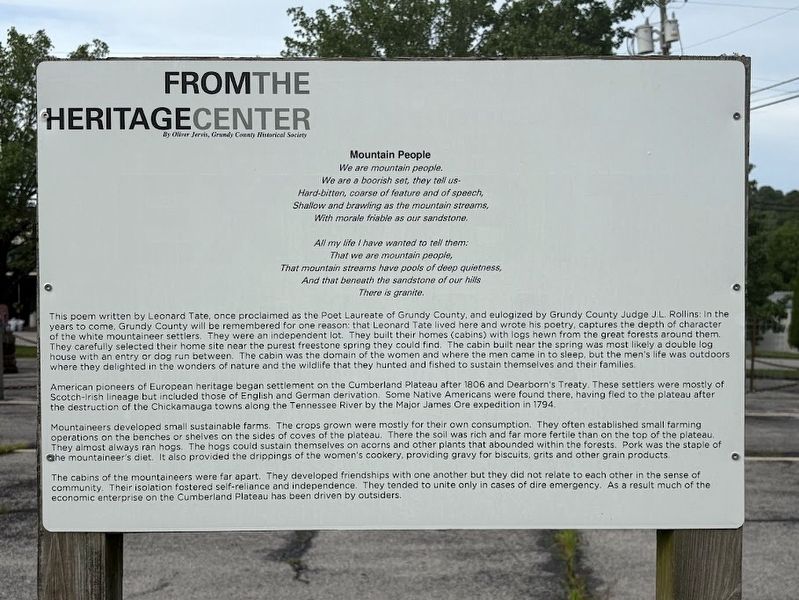
Mountain People
From the Heritage Center
| — | By Oliver W. Jervis, Grundy County Historical Society | — |
Photographed by Darren Jefferson Clay, June 18, 2025
1. Mountain People Marker
We are a boorish set, they tell us
Hard-bitten, coarse of feature and of speech,
Shallow and brawling as the mountain streams,
With morale friable as our sandstone
All my life I have wanted to tell them:
That we are mountain people,
That mountain streams have pools of deep quietness,
And that beneath the sandstone of our hills
There is granite.
This poem written by Leonard Tate, once proclaimed as the Poet Laureate of Grundy County, and eulogized by Grundy County Judge J.L Rollins: In the years to come, Grundy County will be remembered for one reason: that Leonard Tate lived here and wrote his poetry, captures the depth of character of the white mountaineer settlers. They were an independent lot. They built their homes (cabins) with logs hewn from the great forests around them. They carefully selected their home site near the purest freestone spring they could find. The cabin built near the spring was most likely a double log house with an entry or dog run between. The cabin was the domain of the women and where the men came in to sleep, but the men's life was outdoors where they delighted
this page online
American pioneers of European heritage began settlement on the Cumberland Plateau after 1806 and Dearborn's Treaty. These settlers were mostly of Scotch-Irish lineage but included those of English and German derivation. Some Native Americans were found there, having fled to the plateau after the destruction of the Chickamauga towns along the Tennessee River by the Major James Ore expedition in 1794.
Mountaineers developed small sustainable farms. The crops grown were mostly for their own consumption. They often established small farming operations on the benches or shelves on the sides of coves of the plateau. There the soil was rich and far more fertile than on the top of the plateau. They almost always ran hogs. The hogs could sustain themselves on acorns and other plants that abounded within the forests. Pork was the staple of the mountaineer's diet. It also provided the drippings of the women's cookery, providing gravy for biscuits, grits and other grain products.
The cabins of the mountaineers were far apart. They
Photographed by Darren Jefferson Clay, June 18, 2025
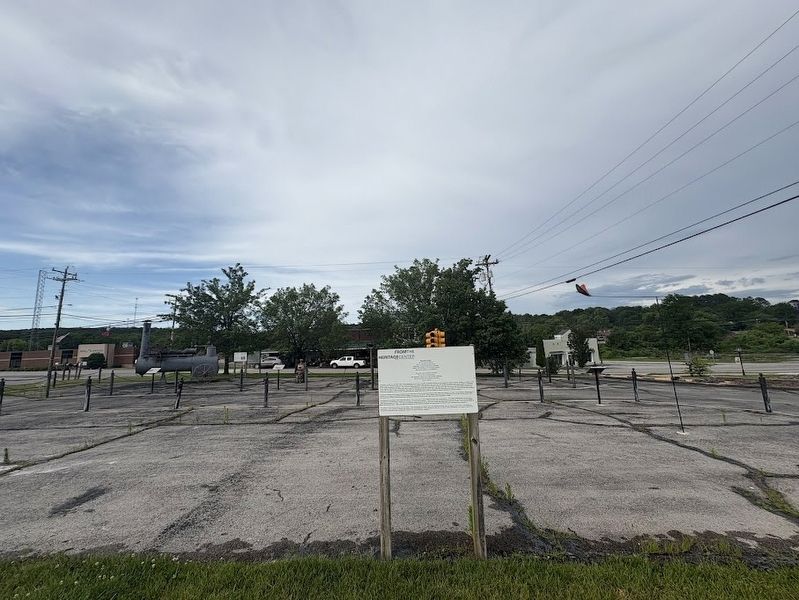
2. Mountain People Marker
Topics. This historical marker is listed in these topic lists: Arts, Letters, Music • Indigenous Peoples and Communities • Settlements & Settlers.
Location. 35° 15.662′ N, 85° 44.226′ W. Marker is in Tracy City, Tennessee, in Grundy County. It can be reached from the intersection of Laurel Street and Main Street (Scenic U.S. 41), on the right when traveling north. Touch for map. Marker is at or near this postal address: 14 Laurel St, Tracy City TN 37387, United States of America. Touch for directions.

Regionally, this marker is in Tennessee’s Cumberland Plateau and in the Highland Rim. It is also in the American South, specifically in the Upper South, in Appalachia, and specifically in Southern Appalachia. Globally, it is in North America, the Western Hemisphere, the Western World, and the Anglosphere. Historically, it finds itself in what was once the territory of the Mississippian Culture, one of the Confederate States of America, and the Antebellum South.
Other nearby markers. At least 8 other markers are within walking distance of this marker: The Formation of Coal on the Plateau (here, next to this marker); Leonard L. Tate (here, next to this marker); Wooten Mine (a few steps from this marker); Golden's No. 1 New Model Sorghum Mill (a few steps from this marker); Artifacts in the Exhibit Area (a few steps from this marker); Farquhar Steam Engine and Boiler (a few steps from this marker); Mountain Goat (a few steps from this marker); WPA in Grundy County and Highlander Folk School - Part 2 (a few steps from this marker). Touch for a list and map of all markers in Tracy City.
Credits. This page was last revised on July 9, 2025. It was originally submitted on July 2, 2025, by Darren Jefferson Clay of Duluth, Georgia. This page has been viewed 119 times since then and 19 times this year. Photos: 1, 2. submitted on July 6, 2025, by Darren Jefferson Clay of Duluth, Georgia. • James Hulse was the editor who published this page.
