
Woodbine Township near Elizabeth in Jo Daviess County, Illinois — The American Midwest (Great Lakes)
Voices of the Past
Photographed by Duane and Tracy Marsteller, July 7, 2024
1. Voices of the Past Marker
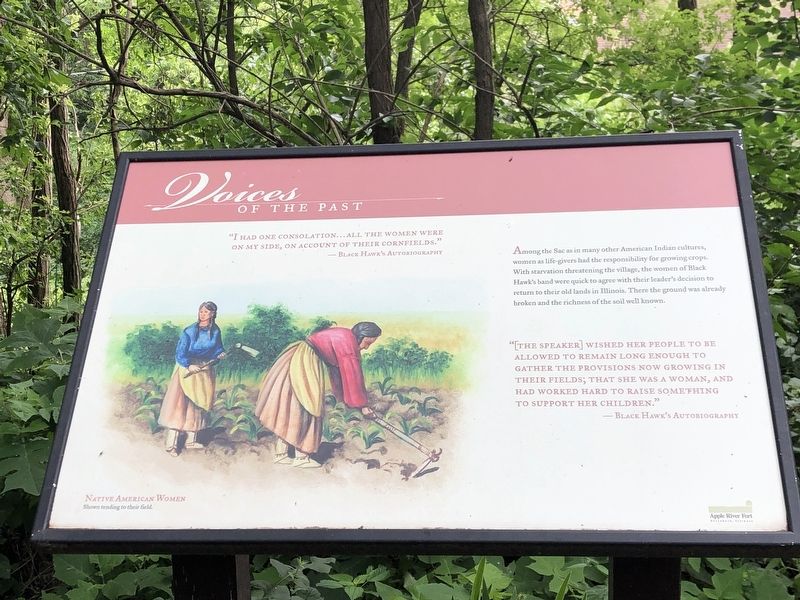
“I had one consolation … all the women were on my side, on account of their cornfields.” – Black Hawk's autobiography
Among the Sac as in many other American Indian cultures, women as life-givers had the responsibility for growing crops. With starvation threatening the village, the women of Black Hawk's band were quick to agree with their leader's decision to return to their old lands in Illinois. There the ground was already broken and the richness of the soil well known.
“[The speaker] wished her people to be allowed to remain long enough to gather the provisions now growing in their fields; that she was a woman, and had worked hard to raise something to support her children.” – Black Hawk's autobiography
[Caption]
Native American women shown tending to their field.
Topics and series. This historical marker is listed in this topic list: Indigenous Peoples and Communities. In addition, it is included in the Black Hawk War series list. A significant historical year for this entry is 1832.
Location. 42° 19.116′ N, 90° 13.077′ W. Marker is near Elizabeth, Illinois, in Jo Daviess County. It is in Woodbine Township.
this page online

Regionally, this marker is in the American Midwest, in the Corn Belt, in the Driftless Area — Bluff Country, and in the Great River Road Region. Globally, it is in North America, the Western Hemisphere, the Western World, and the Anglosphere. Historically, it finds itself in what was once the territory of the Mississippian Culture and also the Northwest Territory.
Other nearby markers. At least 8 other markers are within walking distance of this marker: A different marker also named Voices of the Past (a few steps from this marker); a different marker also named Voices of the Past (a few steps from this marker); a different marker also named Voices of the Past (within shouting distance of this marker); a different marker also named Voices of the Past (within shouting distance of this marker); a different marker also named Voices of the Past (within shouting
Photographed by Duane and Tracy Marsteller, July 7, 2024
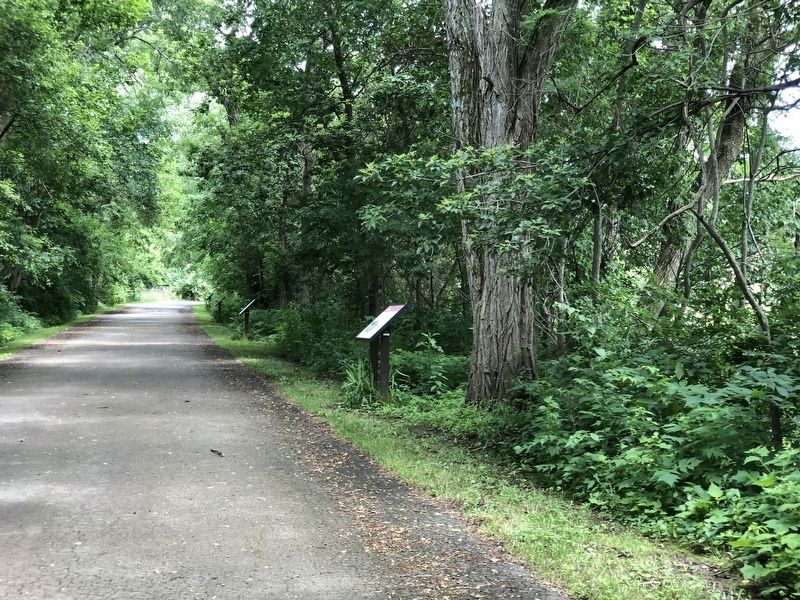
2. Voices of the Past Marker
Regarding Voices of the Past. The webpage mentions that the Sac and Fox are matriarchal. This information is incorrect: Also see . . . Sac and Fox Nation. The Sac and Fox people traditionally lived in a matriarchal society, where women played a central role in the social, economic, and spiritual life of the community. This matriarchal system was based on a clan structure, where descent was matrilineal, meaning that children were considered members of their mother’s clan. (Ahote Cooper, americanindiancoc.org) Voices of the Past Marker image. Click for full size. Photographed by Duane and Tracy Marsteller, July 7, 2024 2. Voices of the Past Marker Several sources document the Sac and Fox as patrilineal. See "12/31/75 HR4016 Sac and Fox Indians Judgement Funds Distribution Act” of the White House Records Office: Legislation Case Files at the Gerald R. Ford Presidential Library" See Also Jones, William. Ethnography of the Fox Indians. Washington, DC: Government Printing Office, 1939, p. 72. "The Foxes are divided into exogamous gentes in which descent is reckoned through the male line. With few exceptions individuals are given names belonging to the gens of the father." (Submitted on August 4, 2024, by Duane and Tracy Marsteller of Murfreesboro, Tennessee.)
Also see . . . Sac and Fox Nation. The Sac and Fox people traditionally lived in a matriarchal society, where women played a central role in the social, economic, and spiritual life of the community. This matriarchal system was based on a clan structure, where descent was matrilineal, meaning that children were considered members of their mother’s clan. (Ahote Cooper, americanindiancoc.org) (Submitted on August 4, 2024, by Duane and Tracy Marsteller of Murfreesboro, Tennessee.)
Credits. This page was last revised on July 8, 2025. It was originally submitted on August 4, 2024. This page has been viewed 216 times since then and 30 times this year. Last updated on July 3, 2025. Photos: 1, 2. submitted on August 4, 2024, by Duane and Tracy Marsteller of Murfreesboro, Tennessee. • Devry Becker Jones was the editor who published this page.
