
Tracy City in Grundy County, Tennessee — The American South (East South Central)
WPA in Grundy County and Highlander Folk School - Part 1
Photographed by Darren Jefferson Clay, June 18, 2025
1. WPA in Grundy County and Highlander Folk School - Part 1 Marker
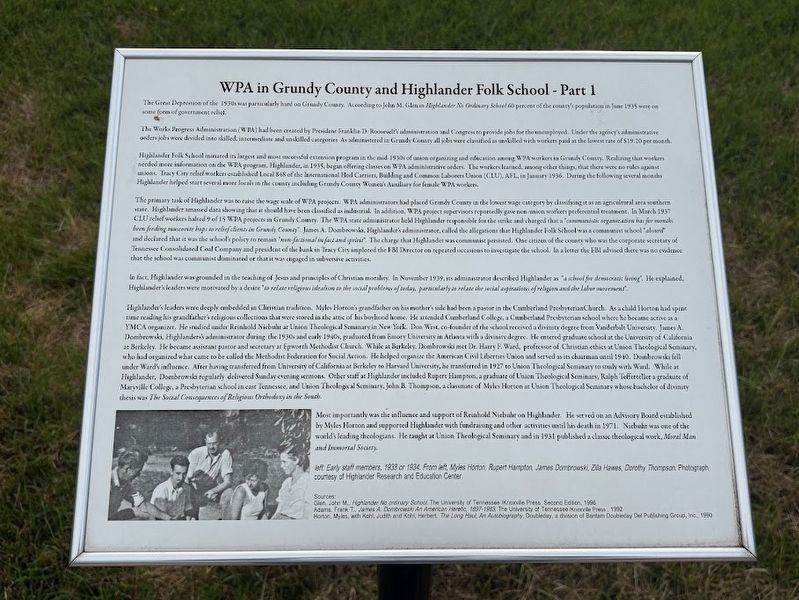
The Works Progress Administration (WPA) had been created by President Franklin D. Roosevelt's administration and Congress to provide jobs for the unemployed. Under the agency's administrative orders jobs were divided into skilled, intermediate and unskilled categories. As administered in Grundy County all jobs were classified as unskilled with workers paid at the lowest rate of $19.20 per month.
Highlander Folk School initiated its largest and most successful extension program in the mid-1930s of union organizing and education among WPA workers in Grundy County. Realizing that workers needed more information on the WPA program, Highlander, in 1935, began offering classes on WPA administrative orders. The workers learned, among other things, that there were no rules against unions. Tracy City relief workers established Local 848 of the International Hod Carriers, Building and Common Laborers Union (CLU),
this page online
The primary task of Highlander was to raise the wage scale of WPA projects. WPA administrators had placed Grundy County in the lowest wage category by classifying it as an agricultural area southern state. Highlander amassed data showing that it should have been classified as industrial. In addition, WPA project supervisors reportedly gave non-union workers preferential treatment. In March 1937 CLU relief workers halted 9 of 15 WPA projects in Grundy County. The WPA state administrator held Highlander responsible for the strike and charged that a "communistic organization has for months been feeding muscovite hops to relief clients in Grundy County. James A. Dombrowski, Highlander's administrator, called the allegations that Highlander Folk School was a communist school "absurd" and declared that it was the school's policy to remain "non factional in fact and spirit". The charge that Highlander was communist persisted. One citizen of the county who was the
Photographed by Darren Jefferson Clay, June 18, 2025
2. WPA in Grundy County and Highlander Folk School - Part 1 Marker
In fact, Highlander was grounded in the teaching of Jesus and principles of Christian morality. In November 1939, its administrator described Highlander as "a school for democratic living". He explained. Highlander's leaders were motivated by a desire "to relate religious idealism to the social problems of today, particularly to relate the social aspirations of religion and the labor movement".
Highlander's leaders were deeply embedded in Christian tradition. Myles Horton's grandfather on his mother's side had been a pastor in the Cumberland Presbyterian Church. As a child Horton had spent time reading his grandfather's religious collections that were stored in the attic of his boyhood home. He attended Cumberland College, a Cumberland Presbyterian school where he became active as a YMCA organizer. He studied under Reinhold Niebuhr at Union Theological Seminary in New York. Don West, co-founder of the school received a divinity degree from Vanderbilt University. James A. Dombrowski, Highlanders's administrator during the 1930s and early 1940s, graduated from Emory University in Atlanta with a divinity degree. He entered graduate school at the University of California at Berkeley. He became assistant pastor and secretary at Epworth Methodist Church. While at Berkeley, Dombrowski met Dr. Harry F. Ward, professor of Christian ethics at Union Theological Seminary, who had organized what came to be called the Methodist Federation for Social Action. He helped organize the American Civil Liberties Union and served as its chairman until 1940. Dombrowski fell under Ward's influence. After having transferred from University of California at Berkeley to Harvard University, he transferred in 1927 to Union Theological Seminary to study with Ward. While at Highlander, Dombrowski regularly delivered Sunday evening sermons. Other staff at Highlander included Rupert Hampton, a graduate of Union Theological Seminary, Ralph Tefferteller a graduate of Maryville College, a Presbyterian school in cast Tennessee, and Union Theological Seminary, John B. Thompson, a classmate of Myles Horton at Union Theological Seminary whose bachelor of divinity thesis was The Social Consequences of Religious Orthodoxy in the South.
Most importantly was the influence and support of Reinhold Niebuhr on Highlander. He served on an Advisory Board established by Myles Horton and supported Highlander with fundraising and other activities until his death in 1971. Niebuhr was one of the world's leading theologians. He taught at Union Theological Seminary and in 1931 published a classic theological work, Moral Man and Immortal Society.
left: Early staff members, 1933 or 1934. From left, Myles Horton, Rupert Hampton, James Dombrowski, Zilla Hawes, Dorothy Thompson. Photograph courtesy of Highlander Research and Education Center.
Sources:
Glen, John M. Highlander No ordinary School. The University of Tennessee /Knoxville Press, Second Edition, 1996
Adams, Frank T., James A. Dombrowski An American Heretic, 1897-1983, The University of Tennessee/Knoxville Press, 1992
Horton, Myles, with Kohl, Judith and Kohl, Herbert, The Long Haul, An Autobiography, Doubleday, a division of Bantam Doubleday Del Publishing Group, Inc., 1990
Topics and series. This historical marker is listed in these topic lists: Charity & Public Work • Education • Labor Unions • Religion & Religious Structures. In addition, it is included in the Works Progress Administration (WPA) projects series list.
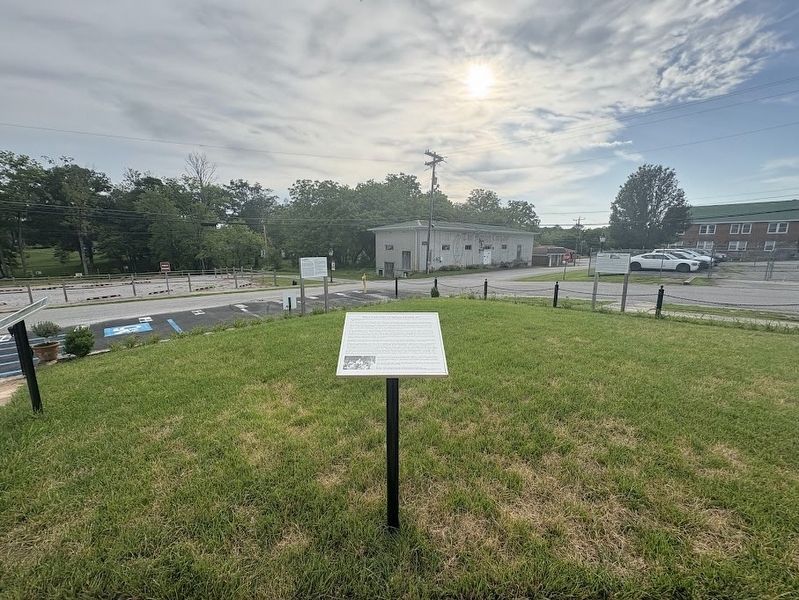
Location. 35° 15.659′ N, 85° 44.237′ W. Marker is in Tracy City, Tennessee, in Grundy County. It is on Laurel Street, on the right when traveling north. Touch for map. Marker is at or near this postal address: 14 Laurel Street, Tracy City TN 37387, United States of America. Touch for directions.

Regionally, this marker is in Tennessee’s Cumberland Plateau and in the Highland Rim. It is also in the American South, specifically in the Upper South, in Appalachia, and specifically in Southern Appalachia. Globally, it is in North America, the Western Hemisphere, the Western World, and the Anglosphere. Historically, it finds itself in what was once the territory of the Mississippian Culture, one of the Confederate States of America, and the Antebellum South.
Other nearby markers. At least 8 other markers are within walking distance of this marker: Warren Memorial Cumberland Presbyterian Church of Tracy City (here, next to this marker); WPA in Grundy County and Highlander Folk School - Part 2 (here, next to this marker); Mountain Goat (here, next to this marker); Charley's Camp in the Horseshoe (a few steps from this marker); Who are the Tourists? (a few steps from this marker); Beersheba Springs Hotel (a few steps from this marker); Mary Noailles Murfree (a few steps from this marker); The Chickamauga Story (a few steps from this marker). Touch for a list and map of all markers in Tracy City.
Credits. This page was last revised on July 10, 2025. It was originally submitted on July 3, 2025, by Darren Jefferson Clay of Duluth, Georgia. This page has been viewed 110 times since then and 34 times this year. Photos: 1, 2. submitted on July 6, 2025, by Darren Jefferson Clay of Duluth, Georgia. • Andrew Ruppenstein was the editor who published this page.
