Aylett in King William County, Virginia — The American South (Mid-Atlantic)
Montville
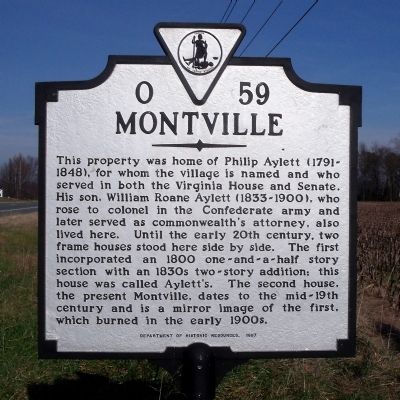
Photographed by Bernard Fisher, December 6, 2009
1. Montville Marker
Erected 1997 by Department of Historic Resources. (Marker Number O-59.)
Topics and series. This historical marker is listed in these topic lists: Government & Politics • Settlements & Settlers • War, US Civil. In addition, it is included in the Virginia Department of Historic Resources (DHR) series list. A significant historical year for this entry is 1800.
Location. 37° 46.307′ N, 77° 6.747′ W. Marker is in Aylett, Virginia, in King William County. It is on Richmond Tappahannock Highway (U.S. 360)
this page online

Regionally, this marker is on the Middle Peninsula. It is also in the American South, specifically in the Upper South, in the Tidewater, in the Chesapeake Bay Region, and on the Eastern Seaboard. Globally, it is in the North Atlantic Region, North America, the Western Hemisphere, the Western World, and the Anglosphere. Historically, it finds itself in what was once the territory of the Mississippian Culture, one of the original Thirteen Colonies, one of the Confederate States of America, and the Antebellum South.
Other nearby markers. At least 8 other markers are within 5 miles of this marker, measured as the crow flies: Cavalry Raids (approx. 0.8 miles away); Rumford Academy (approx. 2.1 miles away); The Sharon Indian School (approx. 2.6 miles away); a different marker also named Sharon Indian School (approx. 2.6 miles away); Clark Home (approx. 4.1 miles away); Apple Tree Church (approx. 4.2 miles
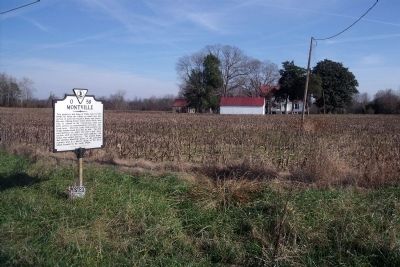
Photographed by Bernard Fisher, December 6, 2009
2. Montville Marker
Another marker is no longer nearby. Sharon Indian School (was approx. 2.6 miles away but has been replaced with another marker now near it).
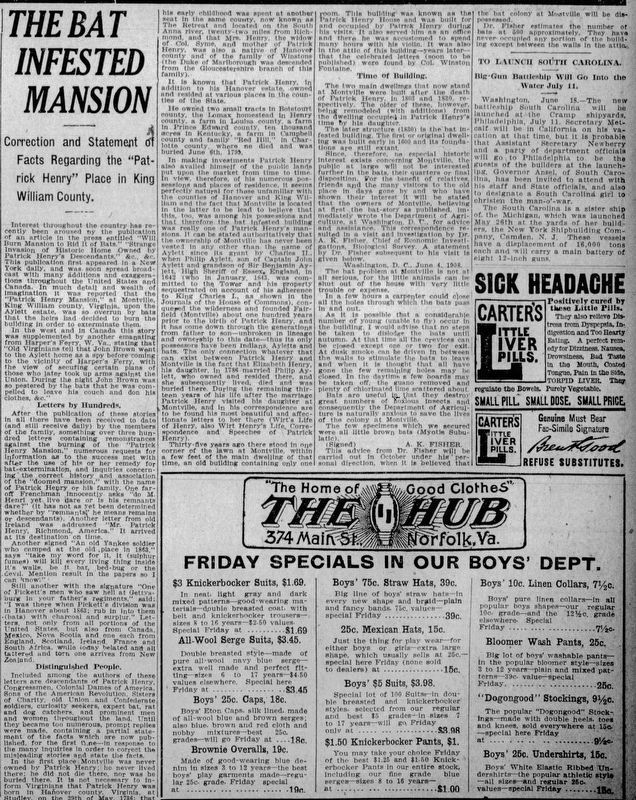
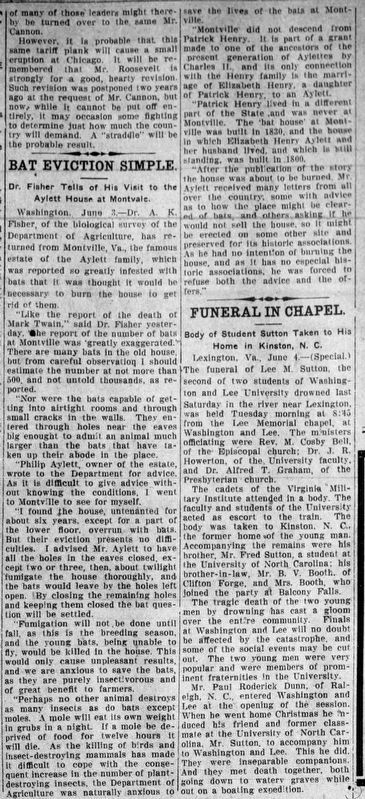
Regarding Montville. The two Montville houses, built in 1803 and 1830 respectively, were nearly identical and stood side-by-side until the "Ayletts" house reportedly burned in 1908. The "Montville" house, predating the Civil War, still stands. Union soldiers camped on the property during the Civil War, and Patrick Henry's daughter, who married into the Aylett family, resided there. Despite a state marker claiming a 1908 fire, no newspaper reports confirm this. Instead, a 1908 article mentions a bat infestation in one of the houses, with a federal inspector reporting approximately 500 bats in the attic of a long-unoccupied house. This account, however, was exaggerated; Patrick Henry never owned the property, and subsequent reports of the house being "burned" lack corroboration. The Richmond News Leader reported on June 16, 1908, that the house would be fumigated in October. Corrective
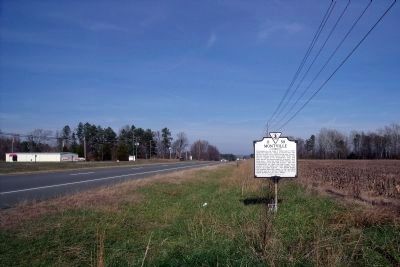
Photographed by Bernard Fisher, December 6, 2009
3. Richmond Tappahannock Highway (facing east)
Also see . . . L'Abeille de la Nouvelle D'Orleans (pdf file). An article published in 1908 discusses why the first Montville was burned. Apparently, bats had infested the historic home and the only recourse was to destroy the colonial mansion. (Submitted on January 9, 2010.)
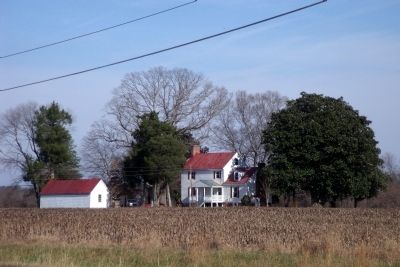
Photographed by Bernard Fisher, December 6, 2009
4. Montville
Photographed by Evan Dwyer
5. Montville Bat Story
This article, from Norfolk's Ledger-Dispatch published on 18 June 1908, corrects the errant information in the articles about bat infestation that are often associated with this house (and, at this time, is linked to the house in an article under the "also see" section elsewhere on this marker's HMDB page).
Photographed by Evan Dwyer
6. Montville Bat Story
This article, from the Lynchburg News and Advance, published 5 June 1908, is not as detailed as the later Norfolk Ledger-Dispatch article included as a photo immediately before this article snip. However, the reader can notice several important themes - the notion of burning the house is dismissed, the basic article (in the "Also See" section of this marker's HMDB page) announcing the house as Patrick Henry's is completely denounced, and the 'infestation' is put in proper context without exaggerated stories of bat killing competitions and other nonsense.
Credits. This page was last revised on July 4, 2025. It was originally submitted on December 8, 2009, by Bernard Fisher of Richmond, Virginia. This page has been viewed 2,833 times since then and 139 times this year. Last updated on July 3, 2025, by Evan Dwyer of Richmond, Virginia. Photos: 1, 2, 3, 4. submitted on December 8, 2009, by Bernard Fisher of Richmond, Virginia. 5, 6. submitted on July 3, 2025, by Evan Dwyer of Richmond, Virginia.
