
Tracy City in Grundy County, Tennessee — The American South (East South Central)
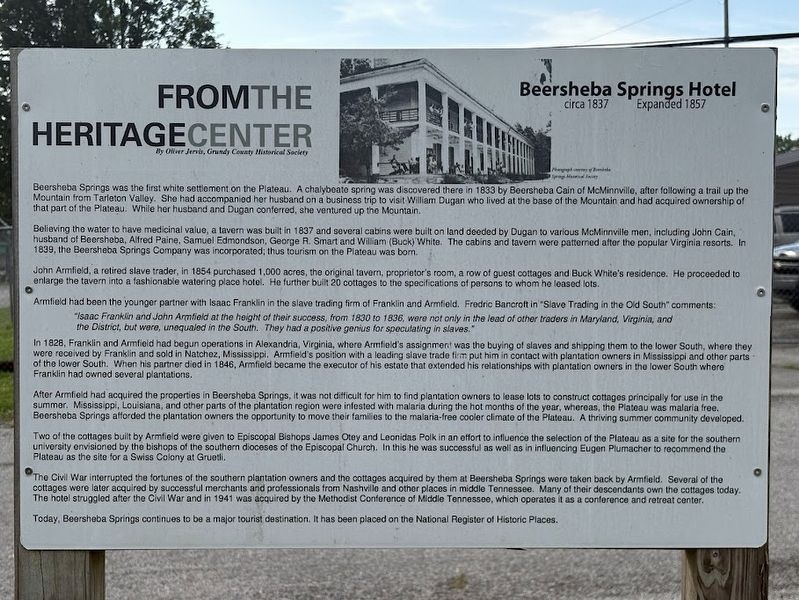
Beersheba Springs Hotel
Circa 1837 - Expanded 1857
| — | By Oliver W. Jervis, Grundy County Historical Society | — |
Photographed by Darren Jefferson Clay, June 18, 2025
1. Beersheba Springs Hotel Marker
Believing the water to have medicinal value, a tavern was built in 1837 and several cabins were built on land deeded by Dugan to various McMinnville men, including John Cain, husband of Beersheba, Alfred Paine, Samuel Edmondson, George R. Smart and William (Buck) White. The cabins and tavern were patterned after the popular Virginia resorts. In 1839, the Beersheba Springs Company was incorporated, thus tourism on the Plateau was born.
John Armfield, a retired slave trader, in 1854 purchased 1,000 acres, the original tavern, proprietor's room, a row of guest cottages and Buck White's residence. He proceeded to enlarge the tavern into a fashionable watering place hotel. He further
this page online
Armfield had been the younger partner with Isaac Franklin in the slave trading firm of Franklin and Armfield. Fredric Bancroft in "Slave Trading in the Old South" comments:
"Isaac Franklin and John Armfield at the height of their success, from 1830 to 1836, were not only in the lead of other traders in Maryland, Virginia, and the District, but were, unequaled in the South. They had a positive genius for speculating in slaves."
In 1828, Franklin and Armfield had begun operations in Alexandria, Virginia, where Armfield's assignment was the buying of slaves and shipping them to the lower South, where they were received by Franklin and sold in Natchez, Mississippi. Armfield's position with a leading slave trade firm put him in contact with plantation owners in Mississippi and other parts of the lower South. When his partner died in 1846, Armfield became the executor of his estate that extended his relationships with plantation owners in the lower South where Franklin had owned several plantations.
After Armfield had acquired the properties in Beersheba Springs,
Photographed by Darren Jefferson Clay, June 18, 2025
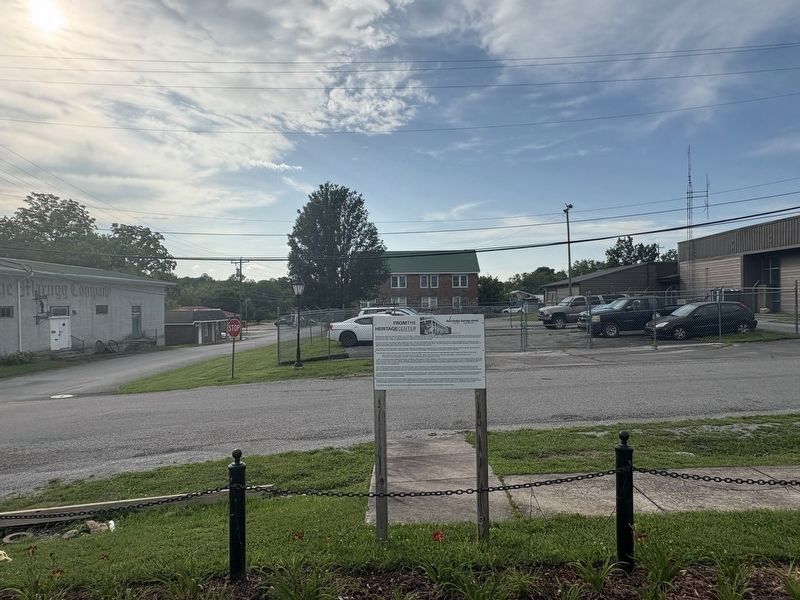
2. Beersheba Springs Hotel Marker
Two of the cottages built by Armfield were given to Episcopal Bishops James Otey and Leonidas Polk in an effort to influence the selection of the Plateau as a site for the southern university envisioned by the bishops of the southern dioceses of the Episcopal Church. In this he was successful as well as in influencing Eugen Plumacher to recommend the Plateau as the site for a Swiss Colony at Gruetli.
The Civil War interrupted the fortunes of the southern plantation owners and the cottages acquired by them at Beersheba Springs were taken back by Armfield. Several of the cottages were later acquired by successful merchants and professionals from Nashville and other places in middle Tennessee. Many of their descendants own the cottages today. The hotel struggled after the Civil War and in 1941 was acquired by the Methodist Conference of Middle Tennessee, which operates it as a conference and retreat center.
Today, Beersheba Springs continues to be a major tourist destination. It has been placed on the National Register of Historic Places.
Topics. This historical marker is listed in these topic lists: African Americans • Industry & Commerce • Settlements & Settlers • War, US Civil.
Location. 35° 15.662′ N, 85° 44.243′ W. Marker is in Tracy City, Tennessee, in Grundy County. It can be reached from the intersection of Laurel Street and Main Street (Scenic U.S. 41), on the right when traveling north. Touch for map. Marker is at or near this postal address: 14 Laurel St, Tracy City TN 37387, United States of America. Touch for directions.

Regionally, this marker is in Tennessee’s Cumberland Plateau and in the Highland Rim. It is also in the American South, specifically in the Upper South, in Appalachia, and specifically in Southern Appalachia. Globally, it is in North America, the Western Hemisphere, the Western World, and the Anglosphere. Historically, it finds itself in what was once the territory of the Mississippian Culture, one of the Confederate States of America, and the Antebellum South.
Other nearby markers. At least 8 other markers are within walking distance of this marker: WPA in Grundy County and Highlander Folk School - Part 2 (a few steps from this marker); Charley's Camp in the Horseshoe (a few steps from this marker); WPA in Grundy County and Highlander Folk School - Part 1 (a few steps from this marker); Warren Memorial Cumberland Presbyterian Church of Tracy City (a few steps from this marker); Mary Noailles Murfree (a few steps from this marker); Who are the Tourists? (a few steps from this marker); Mountain Goat (a few steps from this marker); The Formation of Coal on the Plateau (a few steps from this marker). Touch for a list and map of all markers in Tracy City.
Credits. This page was last revised on July 13, 2025. It was originally submitted on July 3, 2025, by Darren Jefferson Clay of Duluth, Georgia. This page has been viewed 316 times since then and 115 times this year. Photos: 1. submitted on July 6, 2025, by Darren Jefferson Clay of Duluth, Georgia. 2. submitted on July 13, 2025, by Darren Jefferson Clay of Duluth, Georgia. • James Hulse was the editor who published this page.
