Tracy City in Grundy County, Tennessee — The American South (East South Central)
Tracy City
Photographed by Darren Jefferson Clay, June 18, 2025
1. Tracy City Marker
Inscription.
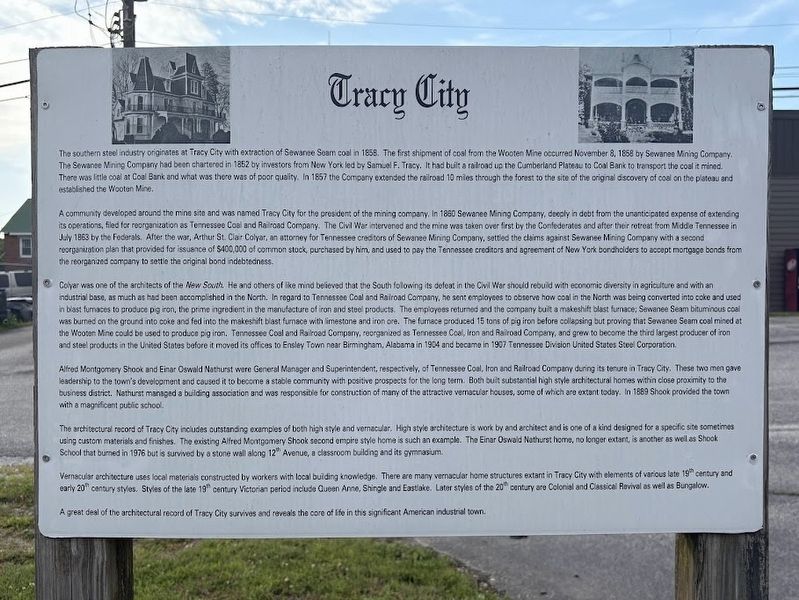
Tracy City. . The southern steel industry originates at Tracy City with extraction of Sewanee Seam coal in 1858. The first shipment of coal from the Wooten Mine occurred November 8, 1858 by Sewanee Mining Company. The Sewanee Mining Company had been chartered in 1852 by investors from New York led by Samuel F. Tracy. It had built a railroad up the Cumberland Plateau to Coal Bank to transport the coal it mined. There was little coal at Coal Bank and what was there was of poor quality. In 1857 the Company extended the railroad 10 miles through the forest to the site of the original discovery of coal on the plateau and established the Wooten Mine., A community developed around the mine site and was named Tracy City for the president of the mining company. In 1860 Sewanee Mining Company, deeply in debt from the unanticipated expense of extending its operations, filed for reorganization as Tennessee Coal and Railroad Company. The Civil War intervened and the mine was taken over first by the Confederates and after their retreat from Middle Tennessee in July 1863 by the Federals. After the war, Arthur St. Clair Colyar, an attorney for Tennessee creditors of Sewanee Mining Company, settled the claims against Sewanee Mining Company with a second reorganization plan that provided for issuance of $400,000 of common stock, purchased by him, and used to pay the Tennessee creditors and agreement of New York bondholders to accept mortgage bonds from the reorganized company to settle the original bond indebtedness., Colyar was one of the architects of the New South. He and others of like mind believed that the South following its defeat in the Civil War should rebuild with economic diversity in agriculture and with an industrial base, as much as had been accomplished in the North. In regard to Tennessee Coal and Railroad Company, he sent employees to observe how coal in the North was being converted into coke and used in blast furnaces to produce pig iron, the prime ingredient in the manufacture of iron and steel products. The employees returned and the company built a makeshift blast furnace; Sewanee Seam bituminous coal was burned on the ground into coke and fed into the makeshift blast furnace with limestone and iron ore. The furnace produced 15 tons of pig iron before collapsing but proving that Sewanee Seam coal mined at the Wooten Mine could be used to produce pig iron. Tennessee Coal and Railroad Company, reorganized as Tennessee Coal, iron and Railroad Company, and grew to become the third largest producer of iron and steel products in the United States before it moved its offices to Ensley Town near Birmingham, Alabama in 1904 and became in 1907 Tennessee Division United States Steel Corporation., Alfred Montgomery Shook and Einar Oswald Nathurst were General Manager and Superintendent, respectively, of Tennessee Coal, Iron and Railroad Company during its tenure in Tracy City. These two men gave leadership to the town's development and caused it to become a stable community with positive prospects for the long term. Both built substantial high style architectural homes within close proximity to the business district. Nathurst managed a building association and was responsible for construction of many of the attractive vernacular houses, some of which are extant today. In 1889 Shook provided the town with a magnificent public school., The architectural record of Tracy City includes outstanding examples of both high style and vernacular. High style architecture is work by and architect and is one of a kind designed for a specific site sometimes using custom materials and finishes. The existing Alfred Montgomery Shook second empire style home is such an example. The Einar Oswald Nathurst home, no longer extant, is another as well as Shook School that burned in 1976 but is survived by a stone wall along 12 Avenue, a classroom building and its gymnasium., Vernacular architecture uses local materials constructed by workers with local building knowledge. There are many vernacular home structures extant in Tracy City with elements of various late 19th century and early 20th century styles. Styles of the late 19th century Victorian period include Queen Anne, Shingle and Eastlake. Later styles of the 20th century are Colonial and Classical Revival as well as Bungalow., A great deal of the architectural record of Tracy City survives and reveals the core of life in this significant American industrial town.
The southern steel industry originates at Tracy City with extraction of Sewanee Seam coal in 1858. The first shipment of coal from the Wooten Mine occurred November 8, 1858 by Sewanee Mining Company. The Sewanee Mining Company had been chartered in 1852 by investors from New York led by Samuel F. Tracy. It had built a railroad up the Cumberland Plateau to Coal Bank to transport the coal it mined. There was little coal at Coal Bank and what was there was of poor quality. In 1857 the Company extended the railroad 10 miles through the forest to the site of the original discovery of coal on the plateau and established the Wooten Mine.
A community developed around the mine site and was named Tracy City for the president of the mining company. In 1860 Sewanee Mining Company, deeply in debt from the unanticipated expense of extending its operations, filed for reorganization as Tennessee Coal and Railroad Company. The Civil War intervened and the mine was taken over first by the Confederates and after their retreat from Middle Tennessee in July 1863 by the Federals. After the war, Arthur St. Clair Colyar, an attorney for Tennessee
Click or scan to see this page online
creditors of Sewanee Mining Company, settled the claims against Sewanee Mining Company with a second reorganization plan that provided for issuance of $400,000 of common stock, purchased by him, and used to pay the Tennessee creditors and agreement of New York bondholders to accept mortgage bonds from the reorganized company to settle the original bond indebtedness.
Colyar was one of the architects of the New South. He and others of like mind believed that the South following its defeat in the Civil War should rebuild with economic diversity in agriculture and with an industrial base, as much as had been accomplished in the North. In regard to Tennessee Coal and Railroad Company, he sent employees to observe how coal in the North was being converted into coke and used in blast furnaces to produce pig iron, the prime ingredient in the manufacture of iron and steel products. The employees returned and the company built a makeshift blast furnace; Sewanee Seam bituminous coal was burned on the ground into coke and fed into the makeshift blast furnace with limestone and iron ore. The furnace produced 15 tons of pig iron before collapsing
Photographed by Darren Jefferson Clay, June 18, 2025
2. Tracy City Marker
but proving that Sewanee Seam coal mined at the Wooten Mine could be used to produce pig iron. Tennessee Coal and Railroad Company, reorganized as Tennessee Coal, iron and Railroad Company, and grew to become the third largest producer of iron and steel products in the United States before it moved its offices to Ensley Town near Birmingham, Alabama in 1904 and became in 1907 Tennessee Division United States Steel Corporation.
Alfred Montgomery Shook and Einar Oswald Nathurst were General Manager and Superintendent, respectively, of Tennessee Coal, Iron and Railroad Company during its tenure in Tracy City. These two men gave leadership to the town's development and caused it to become a stable community with positive prospects for the long term. Both built substantial high style architectural homes within close proximity to the business district. Nathurst managed a building association and was responsible for construction of many of the attractive vernacular houses, some of which are extant today. In 1889 Shook provided the town with a magnificent public school.
The architectural record of Tracy City includes outstanding examples of both high style and vernacular. High style architecture is work by and architect and is one of a kind designed for a specific site sometimes using custom materials and finishes. The existing Alfred Montgomery Shook second empire style home is such an example. The Einar Oswald Nathurst home, no longer extant, is another as well as Shook School that burned in 1976 but is survived by a stone wall along 12 Avenue, a classroom building and its gymnasium.
Vernacular architecture uses local materials constructed by workers with local building knowledge. There are many vernacular home structures extant in Tracy City with elements of various late 19th century and early 20th century styles. Styles of the late 19th century Victorian period include Queen Anne, Shingle and Eastlake. Later styles of the 20th century are Colonial and Classical Revival as well as Bungalow.
A great deal of the architectural record of Tracy City survives and reveals the core of life in this significant American industrial town.
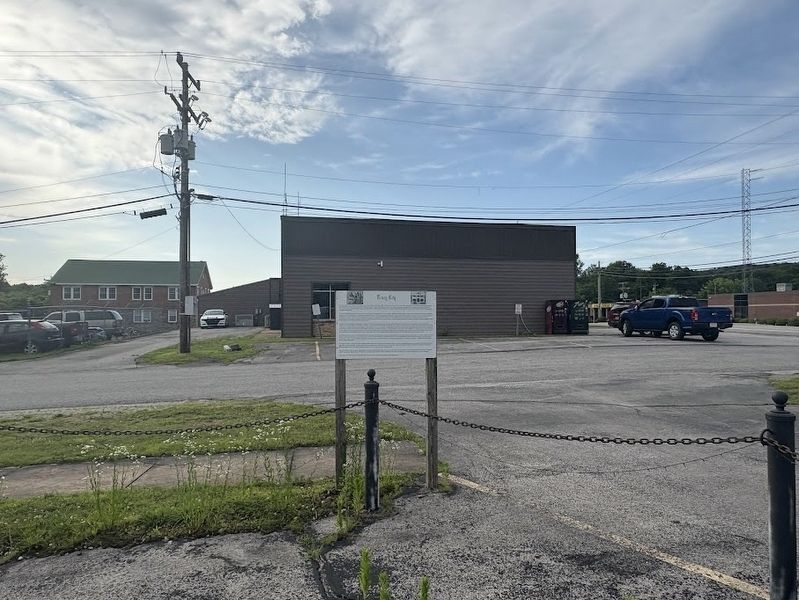
Location. 35° 15.671′ N, 85° 44.231′ W. Marker is in Tracy City, Tennessee, in Grundy County. It can be reached from the intersection of Laurel Street and Scenic U.S. 41. Touch for map. Marker is at or near this postal address: 14 Laurel St, Tracy City TN 37387, United States of America. Touch for directions.
Regionally, this marker is in Tennessee’s Cumberland Plateau and in the Highland Rim. It is also in the American South, specifically in the Upper South, in Appalachia, and specifically in Southern Appalachia. Globally, it is in North America, the Western Hemisphere, the Western World, and the Anglosphere. Historically, it finds itself in what was once the territory of the Mississippian Culture, one of the Confederate States of America, and the Antebellum South.
Credits. This page was last revised on July 9, 2025. It was originally submitted on July 3, 2025, by Darren Jefferson Clay of Duluth, Georgia. This page has been viewed 114 times since then and 28 times this year. Photos:1, 2. submitted on July 6, 2025, by Darren Jefferson Clay of Duluth, Georgia. • James Hulse was the editor who published this page.