
Innenstadt in Regensburg, Bavaria, Germany — Central Europe
Die Salzlände
⎯⎯⎯
The Salt Landing
Photographed by James Hulse, June 25, 2025
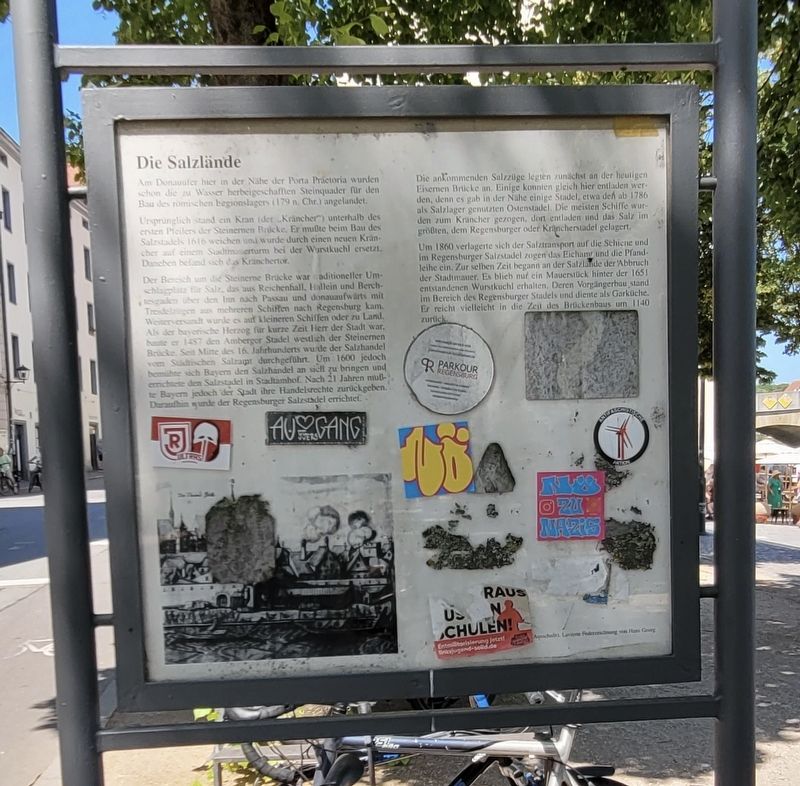
1. Die Salzlände / The Salt Landing Marker

Am Donauufer hier in der Nähe der Porta Praetoria wurden schon die zu Wasser herbeigeschafften Steinquader für den Bau des römischen Legionslagers (179 n. Chr.) angelandet.
Ursprünglich stand ein Kran (der „Kräncher") unterhalb des ersten Pfeilers der Steinernen Brücke. Er mußte beim Bau des Salzstadels 1616 weichen und wurde durch einen neuen Kräncher auf einem Stadtmauerturm bei der Wurstkuchl ersetzt. Daneben befand sich das Kränchertor.
Der Bereich um die Steinerne Brücke war traditioneller Umschlagplatz für Salz, das aus Reichenhall, Hallein und Berchtesgaden über den Inn nach Passau und donauaufwärts mit Treidelzügen aus mehreren Schiffen nach Regensburg kam. Weiterversandt wurde es auf kleineren Schiffen oder zu Land. Als der bayerische Herzog für kurze Zeit Herr der Stadt war, baute er 1487 den Amberger Stadel westlich der Steinernen Brücke. Seit Mitte des 16. Jahrhunderts wurde der Salzhandel vom Städtischen Salzamt durchgeführt. Um 1600 jedoch bemühte sich Bayern den Salzhandel an sich zu bringen und errichtete den Salzstadel in Stadtamhof. Nach 21 Jahren mußte Bayern jedoch der Stadt ihre Handelsrechte zurückgeben. Daraufhin wurde der Regensburger Salzstadel errichtet.
Die ankommenden Salzzüge legten zunächst an der heutigen Eisernen Brücke an. Einige konnten gleich hier entladen werden, denn es gab in der Nähe einige Stadel, etwa den ab 1786 als Salzlager genutzten Ostenstadel. Die meisten Schiffe wurden zum Kräncher gezogen, dort entladen und das Salz im größten, dem Regensburger oder Kräncherstadel gelagert.
Um 1860 verlagerte sich der Salztransport auf die Schiene und im Regensburger Salzstadel zogen das Eichamt und die Pfandleihe ein. Zur selben Zeit begann an der Salzlande der Abbruch der Stadtmauer. Es blieb nur ein Mauerstück hinter der 1651 entstandenen Wurstkuchl erhalten. Deren Vorgängerbau stand im Bereich des Regensburger Stadels und diente als Garküche. Er reicht vielleicht in die Zeit des Brückenbaus um 1140 zurück.
On the banks of the Danube, near the Porta Praetoria, stone blocks brought in by water for the construction of the Roman legionary camp (179 AD) were already being landed.
Originally, a crane (the “Kräncher”) stood below the first pillar of the Stone Bridge. It had to make way for the construction of the Salzstadel (salt store) in 1616 and was replaced by a new “Kräncher” on a city wall tower near the Wurstkuchl. Next to it stood the Kränchertor (crane gate).
The area around the Stone Bridge was a traditional transshipment point for salt, which came from Reichenhall, Hallein, and Berchtesgaden via the Inn River to Passau, and then upriver in treidled convoys of several ships to Regensburg. From there it was transported further on smaller boats or by land. When the Bavarian Duke briefly ruled the city, he built the Amberger Stadel west of the Stone Bridge in 1487. From the mid-16th century, the municipal salt office managed the salt trade. However, around 1600, Bavaria tried to take control of the salt trade and built the Salzstadel in Stadtamhof. After 21 years, however, Bavaria was forced to return the city’s trade rights. In response, the Regensburg Salzstadel was constructed.
The arriving salt transports initially docked at what is now the Iron Bridge. Some could be unloaded right there, as there were several storehouses nearby — for example, the Ostenstadel, which had been used as a salt store since 1786. Most of the ships, however, were hauled to the "Kräncher," unloaded there, and the salt was stored in the largest warehouse, the Regensburg, or Kräncherstadel.
Around 1860, salt transport shifted to the railways, and the Regensburg Salzstadel was taken over by the office of weights and measures and the municipal pawnshop. At the same time, demolition of the city wall began at the Salzlände. Only a section of wall behind the Wurstkuchl, built in 1651, remained. Its predecessor stood in the area of the Regensburg Stadel and served as a cookshop. It perhaps dates back to the time of the bridge’s construction around 1140.
Topics.
this page online
Location. 49° 1.254′ N, 12° 5.881′ E. Marker is in Regensburg, Bayern (Bavaria). It is in Innenstadt. It is on Thundorferstraße just east of Weiße-Hahnen-Gasse, on the right when traveling west. The marker is located along the street. Touch for map. Marker is at or near this postal address: Thundorferstraße 25, Regensburg BY 93047, Germany. Touch for directions.

Regionally, it is in Europe, the European Union, Atlantic Europe, Central Europe, the Schengen Area, Western Europe, and the Western World. Historically, it finds itself in what was once the Holy Roman Empire.
Other nearby markers. At least 8 other markers are within walking distance of this marker: UNESCO World Heritage Site Old Town of Regensburg with Stadtamhof (a few steps from this marker); Goethe (within shouting distance of this marker); Amberger Stadel / Amberg Storehouse (about 90 meters away, measured in a direct line); Steuer'sches Haus / Steuer House (about 120 meters away); Goliath-Haus / Goliath House (about 120 meters away); Dr. Johann Maier
Photographed by James Hulse, June 25, 2025
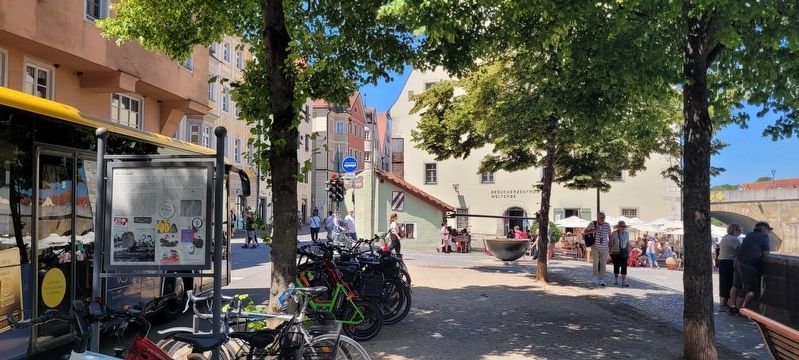
2. The view of the Salt Landing Marker along the street
Credits. This page was last revised on July 5, 2025. It was originally submitted on July 5, 2025, by James Hulse of Medina, Texas. This page has been viewed 84 times since then and 6 times this year. Photos: 1, 2. submitted on July 5, 2025, by James Hulse of Medina, Texas.
