
Manchester in Coffee County, Tennessee — The American South (East South Central)
The Wonders on the Frontier
| — | The Old Stone Fort State Archaeological Park | — |
Photographed by Darren Jefferson Clay, June 28, 2025
1. The Wonders on the Frontier Marker
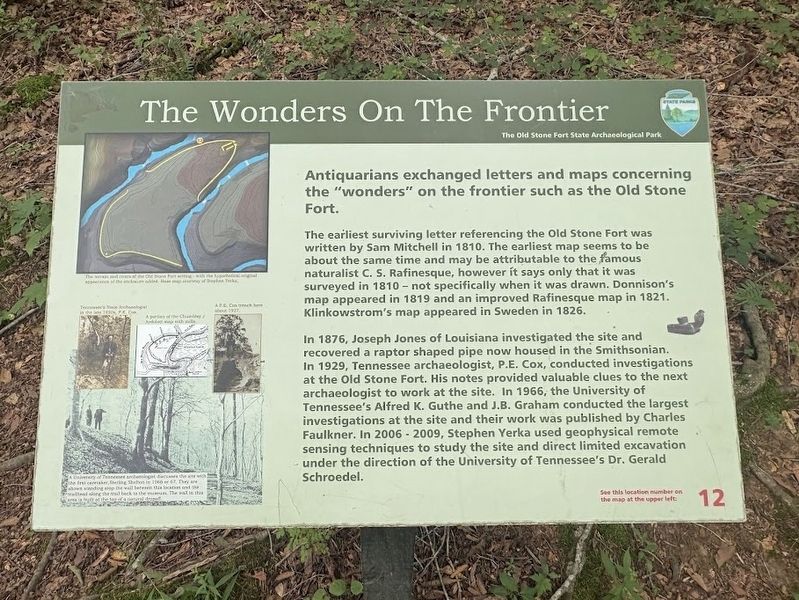
The earliest surviving letter referencing the Old Stone Fort was written by Sam Mitchell in 1810. The earliest map seems to be about the same time and may be attributable to the famous naturalist C. S. Rafinesque, however it says only that it was surveyed in 1810 - not specifically when it was drawn. Donnison's map appeared in 1819 and an improved Rafinesque map in 1821. Klinkowstrom's map appeared in Sweden in 1826.
In 1876, Joseph Jones of Louisiana investigated the site and recovered a raptor shaped pipe now housed in the Smithsonian. In 1929, Tennessee archaeologist, P.E. Cox, conducted investigations at the Old Stone Fort. His notes provided valuable clues to the next archaeologist to work at the site. In 1966, the University of Tennessee's Alfred K. Guthe and J.B. Graham conducted the largest investigations at the site and their work was published by Charles Faulkner. In 2006-2009, Stephen Yerka used geophysical remote sensing techniques to study the site and direct limited excavation under the direction
this page online
Erected by Tennessee State Parks. (Marker Number 12.)
Topics. This historical marker is listed in these topic lists: Forts and Castles • Indigenous Peoples and Communities. A significant historical year for this entry is 1810.
Location. 35° 29.163′ N, 86° 6.269′ W. Marker is in Manchester, Tennessee, in Coffee County. It can be reached from Stone Fort Dr south of U.S. 41, on the left when traveling west. Touch for map. Marker is in this post office area: Manchester TN 37355, United States of America. Touch for directions.

Regionally, this marker is in Middle Tennessee and in the Highland Rim. It is also in the American South and specifically in the Upper South. Globally, it is in North America, the Western Hemisphere, the Western World, and the Anglosphere. Historically, it finds itself in what was once the territory of the Mississippian Culture, one of the Confederate States of America, and the Antebellum South.
Other nearby markers. At least 8 other markers are within walking distance of this marker: The Eastern "Gateway" (about 300 feet away, measured

Photographed by Darren Jefferson Clay, June 28, 2025
2. The Wonders on the Frontier Marker
Credits. This page was last revised on July 8, 2025. It was originally submitted on July 6, 2025, by Darren Jefferson Clay of Duluth, Georgia. This page has been viewed 118 times since then and 31 times this year. Photos: 1, 2. submitted on July 6, 2025, by Darren Jefferson Clay of Duluth, Georgia. • James Hulse was the editor who published this page.
