
Manchester in Coffee County, Tennessee — The American South (East South Central)
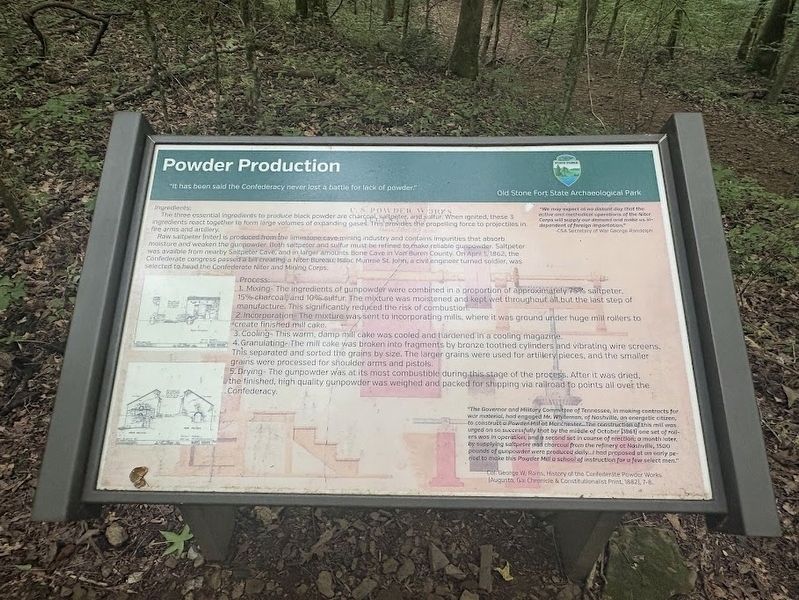
Powder Production
"It has been said the Confederacy never lost a battle for lack of powder."
| — | Old Stone Fort State Archaeological Park | — |
Photographed by Darren Jefferson Clay, June 28, 2025
1. Powder Production Marker
The three essential ingredients to produce black powder are charcoal, saltpeter, and sulfur. When ignited, these 3 ingredients react together to form large volumes of expanding gases. This provides the propelling force to projectiles in fire arms and artillery.
Raw saltpeter (niter) is produced from the limestone cave mining industry and contains impurities that absorb moisture and weaken the gunpowder. Both saltpeter and sulfur must be refined to make reliable gunpowder. Saltpeter was available from nearby Saltpeter Cave, and in larger amounts Bone Cave in Van Buren County. On April 1, 1862, the Confederate congress passed a bill creating a Niter Bureau. Isaac Munroe St. John, a civil engineer turned soldier, was selected to head the Confederate Niter and Mining Corps.
Process:
1. Mixing - The ingredients of gunpowder were combined in a proportion of approximately 75% saltpeter, 15% charcoal, and 10%-sulfur. The mixture was moistened and kept wet throughout all but the last step of manufacture. This significantly reduced the risk of combustion.
2. Incorporation - The mixture was sent to incorporating
this page online
3. Cooling - This warm, damp mill cake was cooled and hardened in a cooling magazine.
4. Granulating - The mill cake was broken into fragments by bronze toothed cylinders and vibrating wire screens. This separated and sorted the grains by size. The larger grains were used for artillery pieces, and the smaller grains were processed for shoulder arms and pistols.
5. Drying - The gunpowder was at its most combustible during this stage of the process. After it was dried, the finished, high quality gunpowder was weighed and packed for shipping via railroad to points all over the Confederacy.
"We may expect of no distant day that the active and methodical operations of the Niter Corps will supply our demand and make us in-dependent of foreign Importation."
-CSA Secretary of War George Randolph
"The Governor and Military Committee of Tennessee, in making contracts for war material, had engaged Mr. Whiteman, of Nashville, an energetic citizen, to construct a Powder Mill at Manchester... The construction of this mill was urged on so successfully that by the middle of October [1861] one set of rollers was in operation, and a second set in course of erection; a month later, by supplying saltpeter and charcoal from the refinery at Nashville, 1500 pounds of gunpowder were produced daily...I had proposed at an early period to make this Powder Mill a school of instruction for a few select men."
Col.
Photographed by Darren Jefferson Clay, June 28, 2025
2. Powder Production Marker
Topics. This historical marker is listed in these topic lists: Industry & Commerce • War, US Civil. A significant historical date for this entry is April 1, 1862.
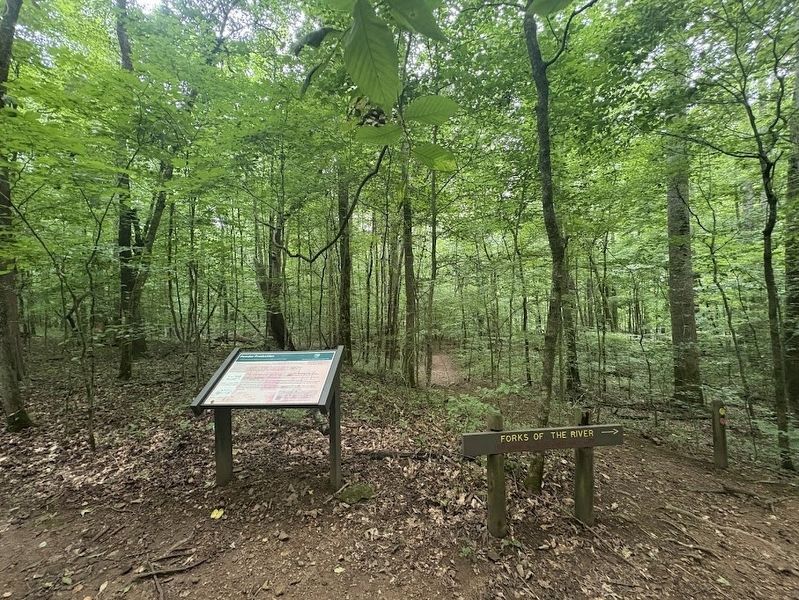
Location. 35° 28.856′ N, 86° 6.614′ W. Marker is in Manchester, Tennessee, in Coffee County. It can be reached from Stone Fort Drive 0.8 miles south of Murfreesboro Highway (Tennessee Route 2) when traveling south. Marker is located along a trail 0.7 miles south of the parking lot. Touch for map. Marker is at or near this postal address: 732 Stone Fort Dr, Manchester TN 37355, United States of America. Touch for directions.

Regionally, this marker is in Middle Tennessee and in the Highland Rim. It is also in the American South and specifically in the Upper South. Globally, it is in North America, the Western Hemisphere, the Western World, and the Anglosphere. Historically, it finds itself in what was once the territory of the Mississippian Culture, one of the Confederate States of America, and the Antebellum South.
Other nearby markers. At least 8 other markers are within walking distance of this marker: Powder Storage and Distribution (within shouting distance of this marker); Patterns in Mound Wall Construction (within shouting distance of this marker); Water: an Industrial Power Source (about 300 feet away, measured in a direct line); Mills Interrupt the Walls (about 800 feet away); The Long Back Wall (approx. ¼ mile away); The Uses of Water in Different Cultures (approx. ¼ mile away); The Mound Walls Meet the Cliffs (approx. 0.3 miles away); The Old Stone Fort and the Stone Fort Paper Co. (approx. 0.4 miles away). Touch for a list and map of all markers in Manchester.
Also see . . . Old Stone Fort State Archaeological Park. Tennessee State Parks (Submitted on July 7, 2025.)
Credits. This page was last revised on July 7, 2025. It was originally submitted on July 6, 2025, by Darren Jefferson Clay of Duluth, Georgia. This page has been viewed 149 times since then and 38 times this year. Photos: 1, 2. submitted on July 6, 2025, by Darren Jefferson Clay of Duluth, Georgia. • Bernard Fisher was the editor who published this page.
