
Manchester in Coffee County, Tennessee — The American South (East South Central)
The Old Stone Fort
A Hilltop Enclosure Mound Site
Photographed by Darren Jefferson Clay, June 28, 2025
1. The Old Stone Fort Marker
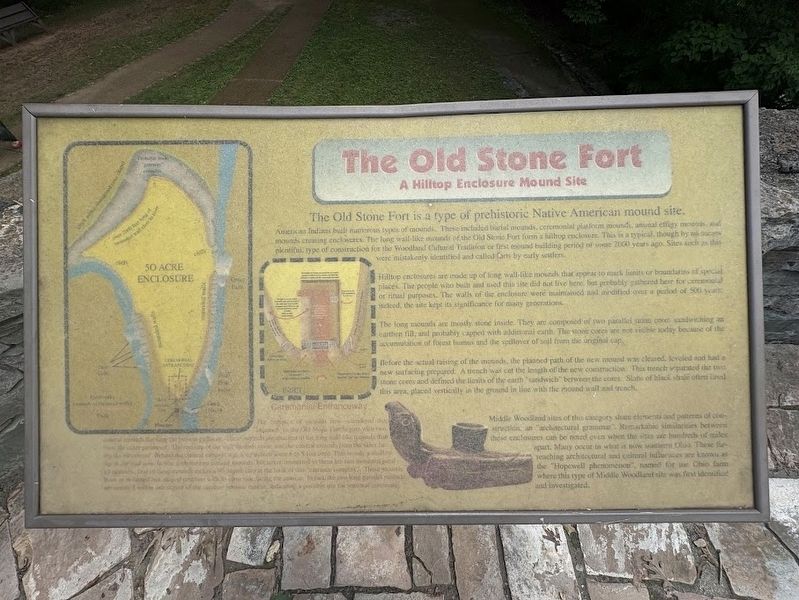
American Indians built numerous types of mounds. These included burial mounds, ceremonial platform mounds, animal effigy mounds and mounds creating enclosures. The long wall-like mounds of the Old Stone Fort form a hilltop enclosure. This is a typical, though by no means plentiful, type of construction for the Woodland Cultural Tradition or first mound building period or some 2000 years ago. Sites such as this were mistakenly identified and called forts by early settlers.
Hilltop enclosures are made up of long wall-like mounds that appear to mark limits or boundaries of special places. The people who built and used this site did not live here, but probably gathered here for ceremonial or ritual purposes. The walls of the enclosure were maintained and modified over a portion of 500 years: indeed, the site kept its significance for many generations.
The long mounds are mostly stone inside. They are composed of two parallel stone cores, sandwiching an earthen fill, and probably capped with additional earth. The stone cores are not visible today because
this page online
Before the actual raising of the mounds, the planned path of the new mound was cleared, leveled and had a new surfacing prepared. A trench was cut the length of the new construction. This trench separated the two stone cores and defined the limits of the earth "sandwich" between the cores. Slabs of black shale often lined this area, placed vertically in the ground in line with the mound wall and trench.
Middle Woodland sites of this category share elements and patterns of construction, an "architectural grammar". Remarkable similarities between these enclosures can be noted, even when the sites are hundreds of miles apart. Many occur in what is now southern Ohio. These far-reaching architectural and cultural influences are known as the "Hopewell phenomenon", named for the Ohio farm where this type of Middle Woodland site was first identifed and investigated.
Ceremonial Entranceway
The complex of mounds now considered the entrance to the Old Stone Fort begin with two conical mounds flanking the pathway. These mounds are attached to the long
Photographed by Darren Jefferson Clay, June 28, 2025
2. The Old Stone Fort Marker
Topics. This historical marker is listed in these topic lists: Forts and Castles • Indigenous Peoples and Communities.
Location. 35° 29.171′ N, 86° 6.17′ W. Marker is in Manchester, Tennessee, in Coffee County. It can be reached from Stone Fort Drive near U.S. 41, on the right when traveling south. Touch for map. Marker is at or near this postal address: 732 Stone Fort Dr, Manchester TN 37355, United States of America. Touch for directions.

Regionally, this marker is in Middle Tennessee and in the Highland Rim. It is also in the American South and specifically in the Upper South. Globally, it is in North America, the Western Hemisphere, the Western World, and the Anglosphere. Historically, it finds itself in what was once the territory of the Mississippian Culture, one of the Confederate States of America, and the Antebellum South.
Other nearby markers. At least 8 other markers are within walking distance of this marker: Geographic Setting of The Old Stone Fort (a few steps from this marker); The Eastern "Gateway" (about 300 feet away, measured in a direct line); Manchester Powder Mill (about 300 feet away); The Enclosed Grounds (about 400 feet away); The Wonders on the Frontier (about 500 feet away); The Bark Camp Fork or Little Duck River (about 700 feet away); The Old Stone Fort and the Stone Fort Paper Co. (approx. 0.2 miles away); The Mound Walls Meet the Cliffs (approx. ¼ mile away). Touch for a list and map of all markers in Manchester.
Credits. This page was last revised on July 8, 2025. It was originally submitted on July 6, 2025, by Darren Jefferson Clay of Duluth, Georgia. This page has been viewed 105 times since then and 18 times this year. Photos: 1, 2. submitted on July 6, 2025, by Darren Jefferson Clay of Duluth, Georgia. • James Hulse was the editor who published this page.
