Huntsville in Madison County, Alabama — The American South (East South Central)
Edmonton Heights Historic District
Established June 6, 2021
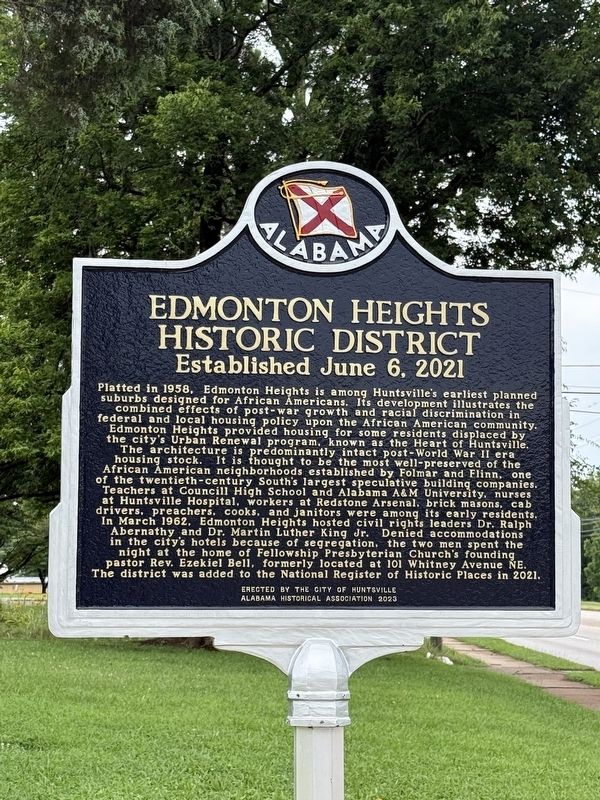
Photographed by Deborah Spencer, June 29, 2025
1. Edmonton Heights Historic District Marker
this page online
Erected 2023 by The City of Huntsville and Alabama Historical Assocaition.
Topics. This historical marker is listed in these topic lists: African Americans • Civil Rights. A significant historical month for this entry is March 1962.
Location. 34° 46.527′ N, 86° 34.333′ W. Marker is in Huntsville, Alabama, in Madison County. It is at the intersection of Meridian Street and Wilkenson Drive, on the right when traveling north on Meridian Street. Located on the SE Corner of Meridian Street and Wilkenson Drive. Touch for map. Marker is in this post office area: Huntsville AL 35811, United States of America. Touch for directions.

Regionally, this marker is in North Alabama. It is also in the American South, specifically in the Deep South, in Appalachia, and specifically in Southern Appalachia. Globally, it is in North America, a Gulf of Mexico state, the Western Hemisphere, the Western World, and the Anglosphere. Historically, it finds itself in what was once the original
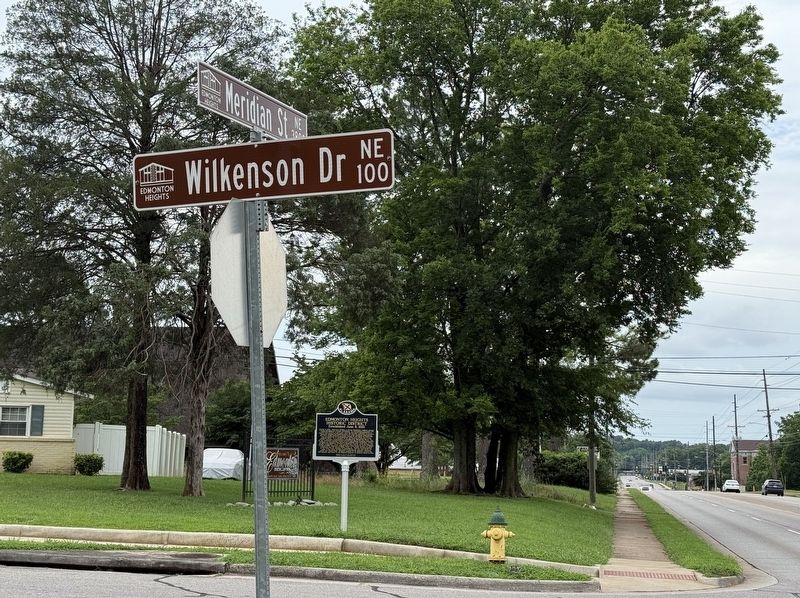
Photographed by Deborah Spencer, June 29, 2025
2. Edmonton Heights Historic District Marker
Other nearby markers. At least 8 other markers are within 3 miles of this marker, measured as the crow flies: Alabama Agricultural and Mechanical University / Alabama A&M University former names (approx. ¼ mile away); Councill Training School (approx. half a mile away); William Hooper Councill (approx. 0.6 miles away); Lynching in America / The Lynching of Robert Mosley (approx. 1.3 miles away); Dallas (Optimist) Park / (Dallas) Optimist Park (approx. 1.7 miles away); Dallas Mills and Village / Rison School (approx. 1.8 miles away); Harris Hill Cemetery (approx. 1.9 miles away); Lowry House (approx. 2.1 miles away). Touch for a list and map of all markers in Huntsville.
Credits. This page was last revised on July 8, 2025. It was originally submitted on July 6, 2025, by Deborah Spencer of Huntsville, Alabama. This page has been viewed 245 times since then and 37 times this year. Photos: 1, 2. submitted on July 6, 2025, by Deborah Spencer of Huntsville, Alabama. • James Hulse was the editor who published this page.
