Crow Wing in Crow Wing County, Minnesota — The American Midwest (Upper Plains)
Ojibwe Origins
Photographed by McGhiever, June 28, 2025
1. Ojibwe Origins Marker
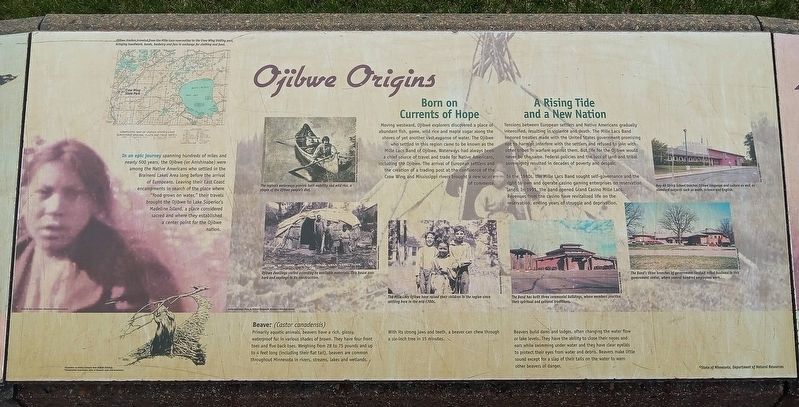
Ojibwe traders traveled from the Mille Lacs reservation to the Crow Wing trading post, bringing handiwork, beads, basketry and furs in exchange for clothing and food.
In an epic journey spanning hundreds of miles and nearly 500 years, the Ojibwe (or Anishinabe) were among the Native Americans who settled in the Brainerd Lakes Area long before the arrival of Europeans. Leaving their East Coast encampments in search of the place where "food grows on water," their travels brought the Ojibwe to Lake Superior's Madeline Island, a place considered sacred and where they established a center point for the Ojibwe nation.
The region's waterways provided both mobility and wild rice, a staple of the Ojibwe people's diet.
Ojibwe dwellings varied according to available materials. This house uses bark and saplings in its construction.
this page online
The Mille Lacs Ojibwe have raised their children in the region since settling here in the mid-1700s.
In the 1980s, the Mille Lacs Band sought self-governance and the right to own and operate casino gaming enterprises on reservation lands. In 1991, the band opened Grand Casino Mille Lacs. Revenues from the casino have revitalized life on the reservation, ending years of struggle and deprivation.
The Band has built three ceremonial buildings, where members practice their spiritual and cultural traditions.
Nay Ah Shing School teaches Ojibwe language and culture as well as standard subjects such as math, science and English.
The Band's three branches of government conduct tribal business in this government center, where several hundred employees work.
Beaver
Photographed by McGhiever, June 28, 2025
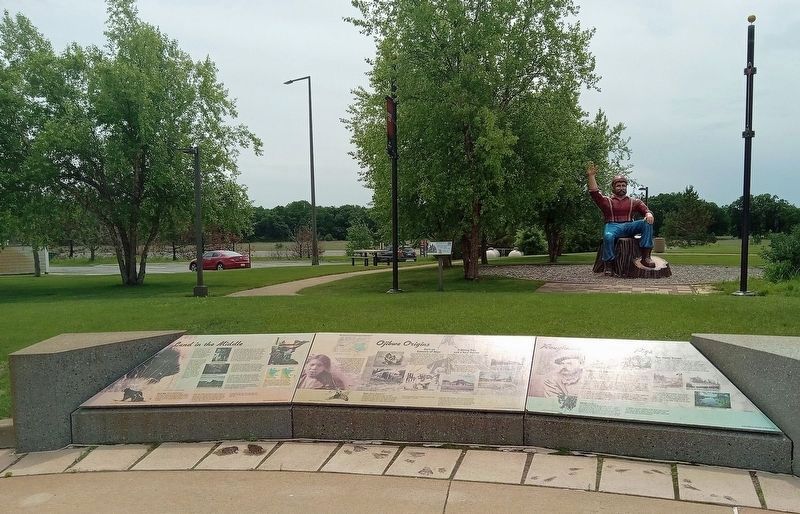
2. Ojibwe Origins Marker (center) at the Brainerd Lakes Welcome Center
Primarily aquatic animals, beavers have a rich, glossy, waterproof fur in various shades of brown. They have four front toes and five back toes. Weighing from 28 to 75 pounds and up to 4 feet long (including their flat tail), beavers are common throughout Minnesota in rivers, streams, lakes and wetlands.
With its strong jaws and teeth, a beaver can chew through a six-inch tree in 15 minutes.
Beavers build dams and lodges, often changing the water flow or lake levels. They have the ability to close their noses and ears while swimming under water and they have clear eyelids to protect their eyes from water and debris. Beavers make little sound except for a slap of their tails on the water to warn other beavers of danger.
Topics. This historical marker is listed in these topic lists: Exploration • Government & Politics • Indigenous Peoples and Communities • Industry & Commerce.
Location. 46° 15.626′ N, 94° 19.158′ W. Marker is in Crow Wing, Minnesota, in Crow Wing County. It can be reached from the intersection of N. Koering Road and Minnesota Highway 371. The marker is at the Explore Brainerd Lakes Welcome Center and Rest Area. Touch for map. Marker is at or near this postal address: 7053 N Koering Road, Brainerd MN 56401, United States of America. Touch for directions.

Regionally, this marker is in the Northland. It is also in the American Midwest, in the Corn Belt, and in the Great River Road Region. Globally, it is in North America, the Great North Woods, the Western Hemisphere, the Western World, and the Anglosphere. Historically, it finds itself in what was once Rupert’s Land, the territory of the Mississippian Culture, and the Northwest Territory.
Other nearby markers. At least 8 other markers are within walking distance of this marker: Land in the Middle (here, next to this marker); Roughnecks and River Pigs (here, next to this marker); Paul Bunyan Statue (a few steps from this marker); Lakes on the Plains (a few steps from this marker); Hunting Hospitality (a few steps from this marker); Lumberjack Legend (a few steps from this marker); Entrepreneurs and Upstarts (a few steps from this marker); Mississippi Crossings (within shouting distance of this marker). Touch for a list and map of all markers in Crow Wing.
Credits. This page was last revised on July 9, 2025. It was originally submitted on July 7, 2025, by McGhiever of Minneapolis, Minnesota. This page has been viewed 125 times since then and 34 times this year. Photos: 1. submitted on July 7, 2025, by McGhiever of Minneapolis, Minnesota. 2. submitted on July 6, 2025, by McGhiever of Minneapolis, Minnesota.
