Ste. Genevieve in Ste. Genevieve County, Missouri — The American Midwest (Upper Plains)
Memorial Cemetery
Est. 1797

Photographed by Mark Parker, July 5, 2025
1. Memorial Cemetery Marker
The name of the very first person buried here is not known, neither is the exact date of the burial, nor the location within the cemetery. The origins of the cemetery, like the beginnings of Ste. Genevieve herself, are somewhat veiled by time. Both the town and its cemetery began in the 18th Century, when Missouri and all of what we know today as the Louisiana Purchase was a possession of the French, and later, the Spanish Crown. There have been two towns of Ste. Genevieve, and two cemeteries, the first of each being a few miles southeast of here, close by the Mississippi River.
Following the great flood in 1735, the village began a slow transition from its location on the river bank to where it is today, on the higher ground between the forks of the Gabouri Creeks, as first one family, then another, made the move. At some point, the families at the new town location began to bury their dead nearby, and the old cemetery — and the old town itself — eventually fell victim to the encroaching river.
There was no one single year in which all of this occurred, although local lore has long held 1787 as the founding date
this page online
The name "Memorial Cemetery" seems to havè been applied to the cemetery only after it was closed to further burials in 1881, and it became literally a memorial. The earliest written references to the cemetery are in the records of the local Catholic Church, in French, wherein it is referred to as "the cemetery of this parish" or sometimes as the "Ste. Genevieve Cemetery."
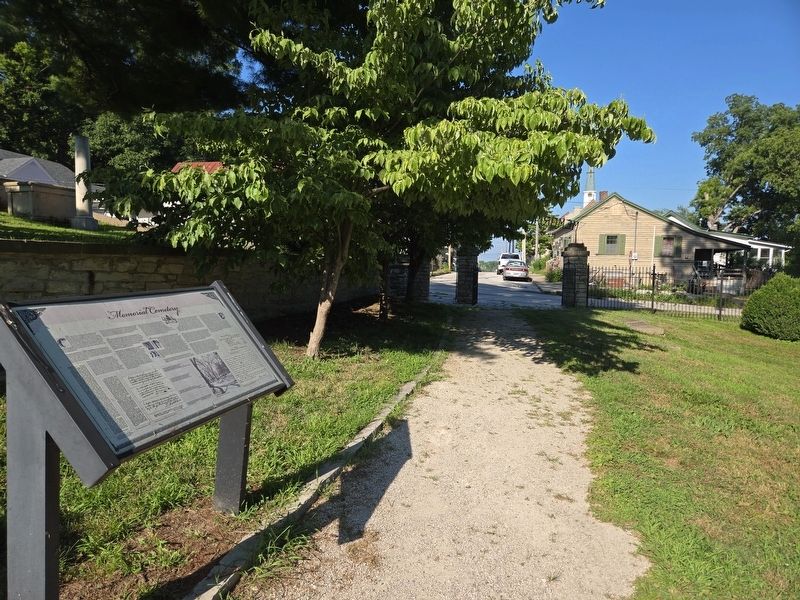
Photographed by Mark Parker, July 5, 2025
2. Memorial Cemetery Marker looking towards the main gate
Spanish Louisiana, including Ste. Genevieve, was officially and legally Catholic, although increasing numbers of Protestant Americans were relocating to the west side of the Mississippi River, both legally and illegally. At some time unknown, the northern portion of the cemetery became a burying ground for these new, non-Catholics citizens of Ste. Genevieve. Eventually, this portion of the cemetery was separated from the southern part by a wooden picket fence, and was referred to as "the public graveyard or "the Protestant Cemetery," although there is no record of any formal division of the cemetery property. An 1875 article in the local Fair Play newspaper makes it clear that no one was quite sure to whom the non-Catholic area belonged, or who was responsible for it.
Both areas of the cemetery were closed to further burials in 1881, and by the 1930s, the cemetery had become known as "Memorial Park," and was used as such by generations of Ste. Genevieve children.
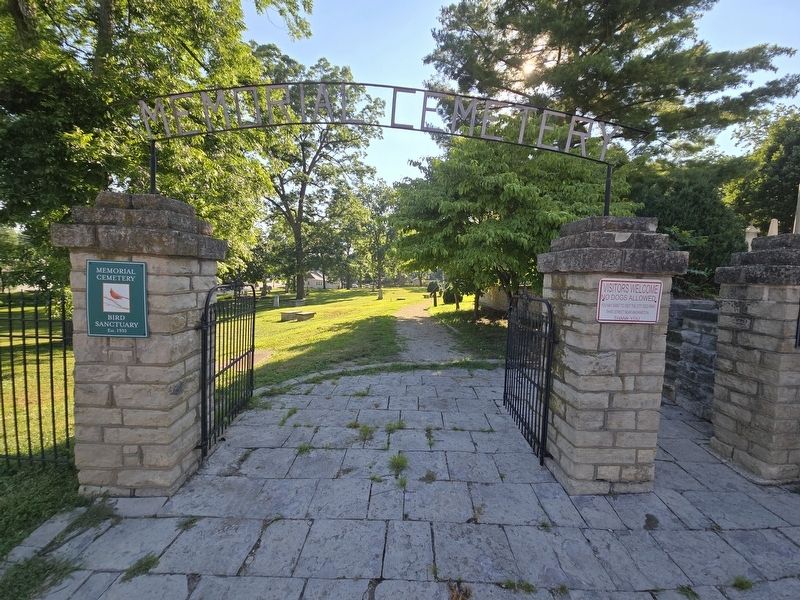
Photographed by Mark Parker, July 5, 2025
3. Memorial Cemetery gates. Marker is a short walk on the right.
Although there are only some 300 monuments and tombstones visible in the cemetery today, records maintained by the Ste. Genevieve Catholic Church suggest there are between three and four thousand persons buried in Memorial Cemetery. This uncertainty about the number of graves results from not knowing the exact date when burials here began; the fact that no one kept records of the non-Catholic burials; and the relocation of an unknown number of burials to new cemeteries after 1881. Many graves here — especially, the early ones — were marked only with wooden crosses which deteriorated rather quickly, leaving much uncertainty as to the location of graves. By the 1870s, the problem of digging into older graves when preparing new ones had become acute. In 1881 the city council closed the cemetery to further burials, and interments after that date were made in the Lutheran Cemetery or the new Catholic or City Cemeteries at Valle Spring, on the edge of town.
In the nearly one hundred years that Memorial Cemetery was in use, it provided a final resting place for the citizens of Ste. Genevieve in a curiously egalitarian manner: the rich and powerful are here —the owners of mills and mines; senators and congressmen; Spanish commandants and Creole aristocracy — but the poor and meek are here also, by the hundreds. The cemetery contains the graves many men, women and children of African descent, both slave and free; famnilies of mixed races are here; and numerous Native Americans rest here as well. About half of all the burials in the cemetery are infants and very young children; and the mothers who died in childbirth are here too. Cholera and other diseases respected no social class; neither did hunting mishaps, steamboat explosions, or mining accidents. Death is a great leveler, and the common thread here is that these are the people who made Ste. Genevieve, in all their variety and humanity.
A grant of land for the cemetery had been made by the Spanish government as a concession to the town as a whole — a Catholic whole, as required by Spanish colonial policy. Under terms of the United States law enacted to resolve ownership of land grants from the Colonial Period (which were often controversial), the Recorder of Land Titles, Theodore Hunt, confirmed that ownership of the cemetery was vested in "the Roman Catholic Citizens of Ste. Genevieve" in 1825. Thus it remained, for another century and a half, despite its northern portion being used as a public graveyard for non-Catholic burials.
Newspaper accounts indicate that by the 1870s the cemetery already had a neglected appearance. Following its closure in 1881, this decline accelerated as the community's attention became focused upon the new cemeteries at Valle Spring. It was the grand bicentennial celebration of 1935 that brought Memorial Cemetery renewed attention. The bicentennial era fueled community pride in general, and the cemetery received its share in the form of the new stone entryway gates on Fifth Street, and repairs to deteriorated monuments. Unfortunately, with the waning of bicentennial enthusiasm, and the coming of World War II, interest in the cemetery once more flagged. With lack of attention, neglect, vandalism, and decay once more beset the cemetery.
The great significance of the cemetery was advocated by local historian Lucille Basler in the late 1960s and, under her leadership, funds were raised and once again monuments were repaired, brush removed, and new shrubs and trees planted. This work has been continued and enlarged by the Foundation for Restoration of Ste. Genevieve. To further the improvement and to provide for an even more secure future, Memorial Cemetery was deeded to the City of Ste. Genevieve by the Catholic Archdiocese of St. Louis in 1995. The city in turn contracted with the Foundation to provide restoration and management of the cemetery in perpetuity. In 2004, the Foundation received a "Save America's Treasures" grant, administered through the National Park Service. These funds, matched locally, have been used to restore monuments; provide paths, benches, and landscaping; and to undertake basic research and interpretation of the history of Memorial Cemetery. Under stewardship of the Foundation for Restoration of Ste. Genevieve, Memorial Cengtery will continue indefinitely to captivate visitors and townspeople alike.
The Graveyard St. Genevieve Feb. 16,1878
Allow me the privilege of encroaching upon your valuable space in the columns of this paper for the purpose of elucidating a subject, which, in my humble opinion the public is mot fully appreciate, viz: The condition of our cemeteries. The effort made by those residing near the cemeteries to have the same closed against further burial therein, and other grounds, outside the city limits, substituted therefore, has met with ridicule at the hands of the few of the citizens of this city; by some, who, possessed of a spirit of economy, suppose his matter could be thrust further into the future, thereby delaying an expenditure. Others, who claim lots in the cemeteries for their own use, and in which they suppose there is a litte space unoccupied, think his circumstance makes their opposition valid. Even if there is a little space not yet filled in these lots, must the community suffer to see remains of corpses removed from their resting places in other parts of the cemeteries and other bodies placed therein, and the said remains unceremoniously thrown back into the excavation amongst the dirt to fill up the grave? Such proceedings have actually come to notice in the two principal cemeteries of our city. The reason of this is, the yards are too full of graves. In fact, the coffins are so mumerous that it has become an almost regular occurrence to strike them when digging graves. These occurrences are hardly thought worthy of notice by many, and yet should the graves be robbed or_ desecrated by prowlers at night, these same persons would be filled with awe and horror. Who is responsible for these occurrences? Surely not the grave-digger for he is required to dig the graves six feet deep, and how can he do so without removing remains or parts of them? There are also persons who scoff at the mere mention of the probability that our city is not secure against the ravages of contagious diseases, and therefore think there is no danger in the presence of cemeteries in the city limits. Let them remember that "an ounce of prevention is worth a pound of cure." When the grim destroyer is upon us, it will be too late. Signed: A friend of the cause.
From the Ste. Genevieve Fair Play, quoted in The District of Ste. Genevieve, 1725-1980. Basler, Lucille (1980).
One very discreditable feature of our town is the lack of care taken of some of the graveyards. It is really a shame that the Protestant or public graveyard is allow to remain in its present condition. The pailings of a large portion of them are torn off, the gates are frequently left open, and hogs and cattle are allowed to tramp around promiscuously over the last resting place is of the dead. Whose business is it to keep it in repair? If it is a public institution, is strikes us that the city should take it and hand and appoint some person to take care of it. If it belongs to any particular denomination, then let them show respect enough to keep it in order. A word in this connection would not be amiss and respect to the Catholic graveyard. We notice quite a number of Graves scattered over it above which have been erected beautiful monuments and tombs, many of which have fallen to the ground and are allowed to remain in that condition, while there are others that are on the verge of falling to the ground and being broken to pieces. Doubtless some will say it is the business of the friends of those buried there to care for the graves. This may all be true, but some that may be so unfortunate as not to have friends reciting in this vicinity. It would be but very little trouble for the sexton to watch these matchers. When the yard was once properly fixed up but little care would be required to keep it and splendid condition. We hope the matter will be attended to.
Ste. Genevieve Fair Play, May 14, 1875
(Captions)
Memorial burial records, Ste. Genevieve Catholic Church (translated from French)
On the 31st of August (1797) was buried in the cemetery of Ste. Genevieve, the body of Elisabeth Blum, wife of Berthelmi Butcher, emigrants from the United States, strengthened by the sacraments. In witness whereof I sign, Maxwell, Parish Priest
In 1787, on June 4th, was buried in the cemetery of the parish, a little negro slave, belonging to Baptiste Valle, named Baptiste, 5 years old, with the appropriate ceremonies. In witness whereof I sign, By: Louis Guignes, Parish Priest
On September 20th (1797) was buried in the cemetery of Ste. Genevieve, the body of a young Indian girl, daughter of the Great Chief of the Peorias, eight years of age. In witness whereof I sign, J. Maxwell, Parish Priest
On February 20th (1793) I raised the body of François Leclere from the cemetery of Old Sainte Genevieve and transferred it into the cemetery of New Ste. Genevieve. In witness whereof I sign, By Saintpierre, Parish Priest
Topics. This historical marker is listed in these topic lists: Cemeteries & Burial Sites • Charity & Public Work • Religion & Religious Structures • Settlements & Settlers. A significant historical year for this entry is 1787.
Location. 37° 58.746′ N, 90° 2.963′ W. Marker is in Ste. Genevieve, Missouri, in Ste. Genevieve County. It is at the intersection of North 5th Street and Merchant Street, on the left when traveling north on North 5th Street. The marker is just past the entrance gates on North Fifth Street. Touch for map. Marker is at or near this postal address: 35 N 5th St, Sainte Genevieve MO 63670, United States of America. Touch for directions.

Regionally, this marker is in Southeast Missouri. It is also in the American Ozarks, in the Lewis & Clark Corridor, in the Corn Belt, and in the Great River Road Region. Globally, it is in North America, the Western Hemisphere, the Western World, and the Anglosphere. Historically, it finds itself in what was once the Viceroyalty of New France, the territory of the Mississippian Culture, the Louisiana Purchase, and the Antebellum South.
Other nearby markers. At least 8 other markers are within walking distance of this marker: In Memory of Prospect K. Robbins, 1782-1847 (a few steps from this marker); Weeping Tree (within shouting distance of this marker); Welcome to Sainte Genevieve Parish (about 700 feet away, measured in a direct line); Revolutionary War Patriots (about 800 feet away); Ste. Genevieve Bicentennial Time Capsule (approx. 0.2 miles away); El Camino Real (approx. 0.2 miles away); In Honor of Milice de Ste. Genevieve (approx. 0.2 miles away); Liver Dumplings (approx. 0.2 miles away). Touch for a list and map of all markers in Ste. Genevieve.
More about this marker. Persons visiting should be advised that vehicle access is not available into the cemetery. Parking along 5th Street is limited due to private residents.
Credits. This page was last revised on July 27, 2025. It was originally submitted on July 9, 2025, by Mark Parker of Hickory, North Carolina. This page has been viewed 143 times since then and 40 times this year. Photos: 1, 2, 3. submitted on July 9, 2025, by Mark Parker of Hickory, North Carolina. • Devry Becker Jones was the editor who published this page.
