
New York Botanical Garden in the Bronx in Bronx County, New York — The American Northeast (Mid-Atlantic)
Coleman and Susan Burke Oak Collection
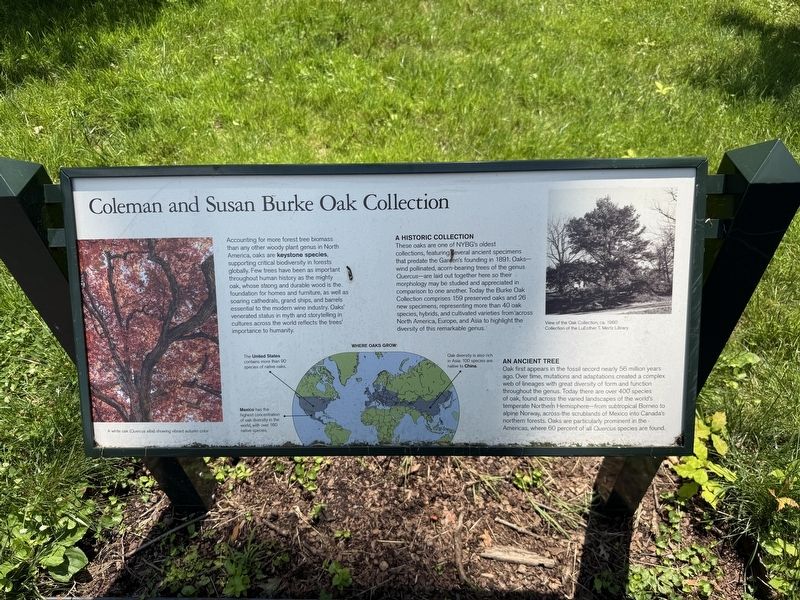
Accounting for more forest tree biomass than any other woody plant genus in North America, oaks are keystone species, supporting critical biodiversity in forests globally. Few trees have been as important throughout human history as the mighty oak, whose strong and durable wood is the foundation for homes and furniture, as well as soaring cathedrals, grand ships, and barrels essential to the modern wine industry. Oaks' venerated status in myth and storytelling in cultures across the world reflects the trees' importance to humanity.
A Historic Collection
These oaks are one of NYBG's oldest collections, featuring several ancient specimens that predate the Garden's founding in 1891. Oaks—wind pollinated, acorn-bearing trees of the genus Quercus—are laid out together here so their morphology may be studied and appreciated in comparison to one another. Today the Burke Oak Collection comprises 159 preserved oaks and 26 new specimens, representing more than 40 oak species, hybrids, and cultivated varieties from across North America, Europe, and Asia to highlight the diversity of this remarkable genus.
An Ancient Tree
Oak
this page online
[Captions:]
Mexico has the highest concentration of oak diversity in the world, with over 160 native species.
Oak diversity is also rich in Asia: 100 species are native to China.
Erected by New York Botanical Garden.
Topics. This historical marker is listed in these topic lists: Horticulture & Forestry • Parks & Recreational Areas. A significant historical year for this entry is 1891.
Location. 40° 51.858′ N, 73° 52.377′ W. Marker is in Bronx, New York, in Bronx County. It is in New York Botanical Garden. It can be reached
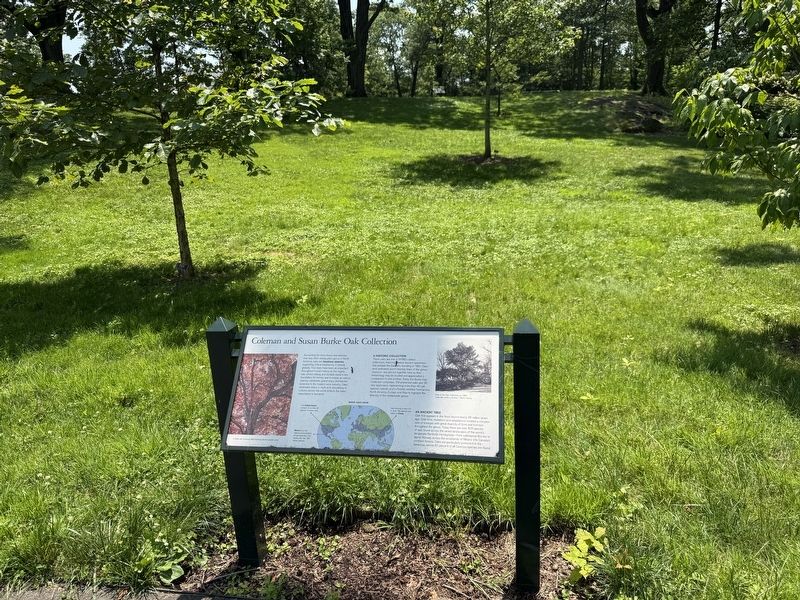

Regionally, this marker is in New York City. It is also in the American Northeast, in the Mid-Atlantic, and on the Eastern Seaboard. Globally, it is in the North Atlantic Region, North America, the Western Hemisphere, the Western World, and the Anglosphere. Historically, it finds itself in what was once New Netherland and also one of the original Thirteen Colonies.
Other nearby markers. At least 8 other markers are within walking distance of this marker: A Most Economical Tree (within shouting distance of this marker); American Elm (about 700 feet away, measured in a direct line); Old-Growth Forests: Trees of Great Age (about 700 feet away); Southern Arrowwood (about 700 feet away); River Wildlife - Spicebush Overlook (about 700 feet away); Forest Transects (about 700 feet away); Measuring the Forest (approx. 0.2 miles away); Old-Growth Forests: Snags (approx. 0.2 miles away). Touch for a list and map of all markers in Bronx.
Credits. This page was last revised on July 11, 2025. It was originally submitted on July 11, 2025, by Devry Becker Jones of Washington, District of Columbia. This page has been viewed 68 times since then and 13 times this year. Photos: 1, 2. submitted on July 11, 2025, by Devry Becker Jones of Washington, District of Columbia.
