Inwood in Manhattan in New York County, New York — The American Northeast (Mid-Atlantic)
Monsignor Kett Playground
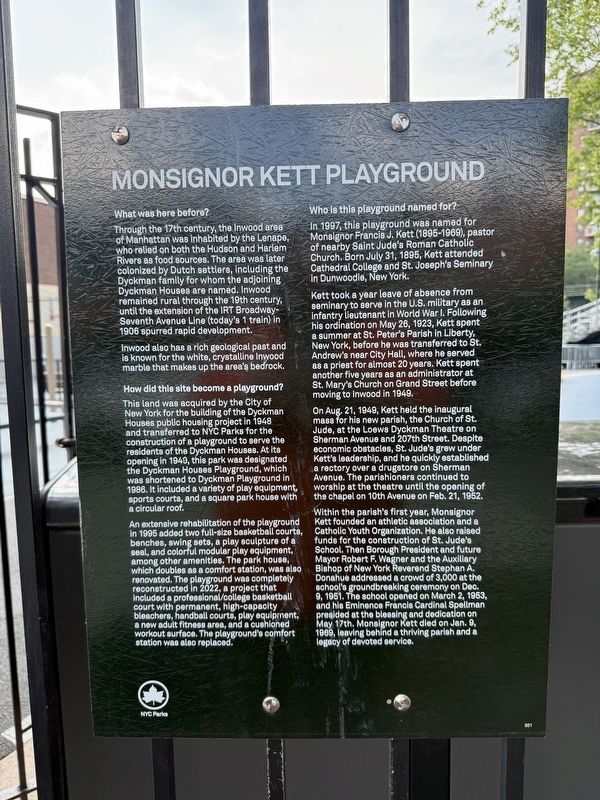
What was here before?
Through the 17th century, the Inwood area of Manhattan was inhabited by the Lenape, who relied on both the Hudson and Harlem Rivers as food sources. The area was later colonized by Dutch settlers, including the Dyckman family for whom the adjoining Dyckman Houses are named. Inwood remained rural through the 19th century, until the extension of the IRT Broadway-Seventh Avenue Line (today's 1 train) in 1906 spurred rapid development.
Inwood also has a rich geological past and is known for the white, crystalline Inwood marble that makes up the area's bedrock.
How did this site become a playground?
This land was acquired by the City of New York for the building of the Dyckman Houses public housing project in 1948 and transferred to NYC Parks for the construction of a playground to serve the residents of the Dyckman Houses. At its opening in 1940, this park was designated the Dyckman Houses Playground, which was shortened to Dyckman Playground in 1986. It included a variety of play equipment, sports courts, and a square park house with a circular roof.
An extensive rehabilitation of the playground
this page online
Who is this playground named for?
In 1997, this playground was named for Monsignor Francis J. Kett (1895-1969), pastor of nearby Saint Jude's Roman Catholic Church. Born July 31, 1895, Kett attended Cathedral College and St. Joseph's Seminary in Dunwoodie, New York.
Kett took a year leave of absence from seminary to serve in the U.S. military as an infantry lieutenant in World War I. Following his ordination on May 26, 1923, Kett spent a summer at St. Peter's Parish in Liberty, New York, before he was transferred to St. Andrew's near City Hall, where he served as a priest for almost 20 years. Kett spent another
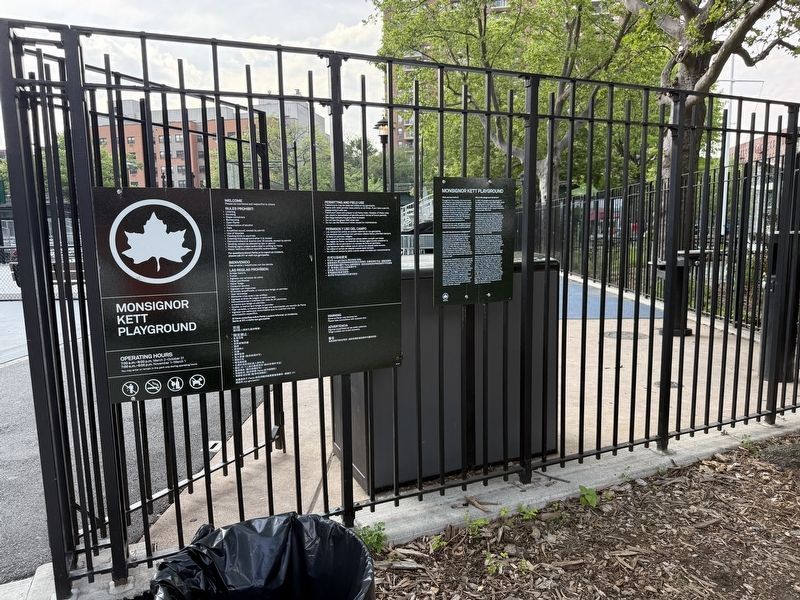
On Aug. 21, 1949, Kett held the inaugural mass for his new parish, the Church of St. Jude, at the Loews Dyckman Theatre on Sherman Avenue and 207th Street. Despite economic obstacles, St. Jude's grew under Kett's leadership, and he quickly established a rectory over a drugstore on Sherman Avenue. The parishioners continued to worship at the theatre until the opening of the chapel on 10th Avenue on Feb. 21, 1952.
Within the parish's first year, Monsignor Kett founded an athletic association and a Catholic Youth Organization. He also raised funds for the construction of St. Jude's School. Then Borough President and future Mayor Robert F. Wagner and the Auxiliary Bishop of New York Reverend Stephen A. Donahue addressed a crowd of 3,000 at the school's groundbreaking ceremony on Dec. 9, 1951. The school opened on March 2, 1953, and his Eminence Francis Cardinal Spellman presided at the blessing and dedication on May 17th. Monsignor Kett died on Jan. 9, 1969, leaving behind a thriving parish and a legacy of devoted service.
Erected by NYC Parks. (Marker Number 301.)
Topics and series. This historical marker is listed in these topic lists: Education • Parks & Recreational Areas • Religion & Religious Structures • Settlements & Settlers. In addition, it is included in the NYC Parks series list. A significant historical date for this entry is March 2, 1953.
Location. 40° 51.736′ N, 73° 55.244′ W. Marker is in Manhattan, New York, in New York County. It is in Inwood. It is on 10th Avenue south of West 204th Street, on the right when traveling south. Touch for map. Marker is at or near this postal address: 3801A 10th Ave, New York NY 10034, United States of America. Touch for directions.

Regionally, this marker is in New York City. It is also in the American Northeast, in the Mid-Atlantic, and on the Eastern Seaboard. Globally, it is in the North Atlantic Region, North America, the Western Hemisphere, the Western World, and the Anglosphere. Historically, it finds itself in what was once New Netherland and also one of the original Thirteen Colonies.
Other nearby markers. At least 8 other markers are within walking distance of this marker: Trace (approx. ¼ mile away); Dyckman Farmhouse (approx. 0.4 miles away); a different marker also named Dyckman Farmhouse Museum (approx. 0.4 miles away); The Military Hut (approx. 0.4 miles away); The Hessian Military Hut (approx. 0.4 miles away); Catholic War Veterans Memorial (approx. 0.4 miles away); Anne Loftus Playground (approx. 0.4 miles away); Cedar Playground (approx. half a mile away). Touch for a list and map of all markers in Manhattan.
Another marker is no longer nearby. Dyckman Farmhouse Museum (was approx. 0.4 miles away but has been replaced with another marker now near it).
Credits. This page was last revised on July 11, 2025. It was originally submitted on July 11, 2025, by Devry Becker Jones of Washington, District of Columbia. This page has been viewed 128 times since then and 38 times this year. Photos: 1, 2. submitted on July 11, 2025, by Devry Becker Jones of Washington, District of Columbia.
