Au Train Township in Alger County, Michigan — The American Midwest (Great Lakes)
Au Train

Photographed by Mark Parker, June 25, 2025
1. Au Train Marker
AuTrain, a French term meaning "at the shortcut or traverse" was one of the earliest sites visited by white men as they travelled along Lake Superior's south shore. The river was part of an ancient Indian route between Lakes Supurier and Michigan.
One of Alger County's oldest settlements, AuTrain was first inhabited by white men in 1856 when William Cameron began hunting and trapping here. Royal Whittlesey built a sawmill in 1862 and logging of Norway pine for dock pilings was begun. Later, choice white pine was hewed into squared timbers for shipment to England.
By 1872 the Sault Ste. Marie & Grand Island State Road Extension was completed to the village.
A number of Ojibwa Indians lived in the area, and they used the bluff just west of the village for a lookout and a fur packing station. A field of corn was planted at its base.
Tye population of AuTrain had a big increase in 1877 when a number of families moved from Bay Furnace near Munising when that iron-making community was destroyed by fire. Among the new residents were the (illegible) Doucatites, Larmonds, Carriers and Reffruschinns, who built small
this page online
Logging of pine now began in earnest, and the AuTrain River and its tribuaries were filled with the big logs bound for mills here, in Lower Michigan, Rock River, Marquette, and later, to Munising.
The Detroit, Mackinac & Marquette Rallroad reached the village in 1881. A school was built shortly which also served as the social, political and religious center of the community. In 1883 a post office was established.
A high point in AuTrain's history came in 1885 when the northern part of Schoolcraft County was organized as Alger County, with AuTrain becoming the county seat. The next year, a townsite was platted and a shingle mill was built. A business district typical of a county sest and sawmill town soon developed. There were several stores, two hotels, saloons and the AuTrain Alpha — the county's first newspaper.
Commercial fishing became an important industry and the beautiful AuTrain Lake and River attracted a growing number of toutiats after advent of the railroad in 1881.
Settlers began homesteads south of the village on AuTrain Lake,
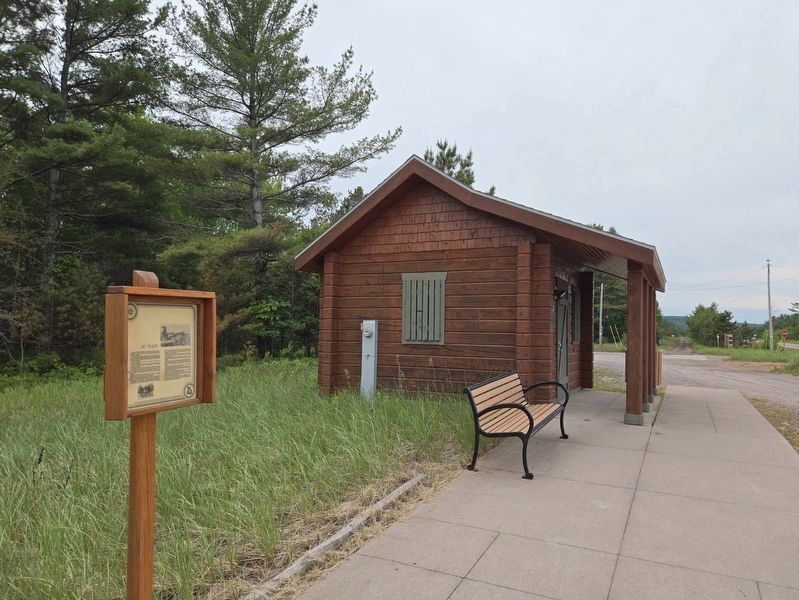
Photographed by Mark Parker, June 25, 2025
2. Au Train Marker
One of the area's prominent early developers was Charles Schaffer of Marquette who was known as the "Charcoal King" because of his extensive activities throughout the region in the manufacture of charcoal for Iron making. He platted the village and donated land for the courthouse and cemetery.
Brownstone was quarried four miles weet for builsing purposes, and it was used in construction of the county's first jail in 1890.
After the turn-of-the century, the Standard Tie Company began extensive logging operations in the area, but by 1919, the last log wars bromed on the AuTrain River, ending a colorful era.
In 1902, the county seat was moved to Munising, which was rapidly becoming the county's industrial and commercial center.
During its long history, AuTrain has been an important transit and stopover point for both Indians and white man, a sawmill town, county seat, commercial fishing port and resort center.
Tourism and recreation now give the village its livelihood, with a picturesque location on Lake Superior, flanked
Photographed by Mark Parker, June 25, 2025
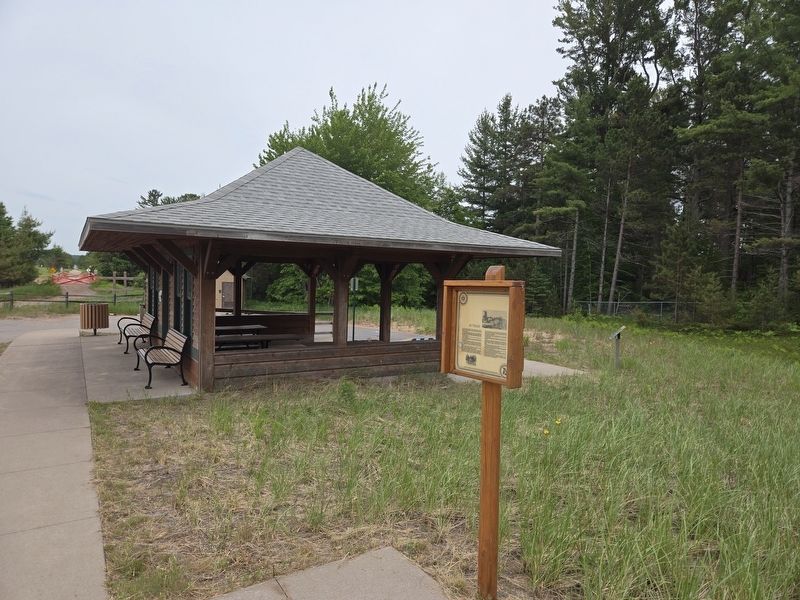
3. Au Train Marker next to the former trail depot
Erected 1976 by Michigan American Revolution Bicentennial Commission and the Alger County Bicentennial Commission.
Topics. This historical marker is listed in these topic lists: Horticulture & Forestry • Indigenous Peoples and Communities • Railroads & Streetcars • Settlements & Settlers. A significant historical year for this entry is 1856.
Location. 46° 25.959′ N, 86° 50.229′ W. Marker is in Au Train, Michigan, in Alger County. It is in Au Train Township. It is at the intersection of Arbutus Street and Michigan Route 28, on the right when traveling north on Arbutus Street. Touch for map. Marker is at or near this postal address: 7628 Arbutus St, Au Train MI 49806, United States of America. Touch for directions.

Regionally, this marker is on the Upper Peninsula. It is also in the American Midwest and on Lake Superior’s South Shore Region. Globally, it is in North America, in the Great North Woods, on the Great Lakes, in the Western Hemisphere, in the Western World, and in the Anglosphere. Historically, it finds itself in what was once the Northwest Territory.
Other nearby markers. At least 8 other markers are within 9 miles of this marker, measured as the crow flies: Lake Superior (approx. one mile away); The Grand Island Nishnaabe (approx. one mile away); Face in the Rock (approx. one mile away); Paulson House (approx. 1.9 miles away); Bay Furnace Ruins (approx. 6.3 miles away); What’s Old? What’s New? (approx. 6.3 miles away); Location is Everything! (approx. 6.3 miles away); In Memory of the Men and Women of Alger County (approx. 8.4 miles away). Touch for a list and map of all markers in Au Train.
Credits. This page was last revised on July 12, 2025. It was originally submitted on July 12, 2025, by Mark Parker of Hickory, North Carolina. This page has been viewed 375 times since then and 146 times this year. Photos: 1, 2, 3. submitted on July 12, 2025, by Mark Parker of Hickory, North Carolina. • J. Makali Bruton was the editor who published this page.
