Central Park West Historic District in Manhattan in New York County, New York — The American Northeast (Mid-Atlantic)
William Shakespeare
Central Park

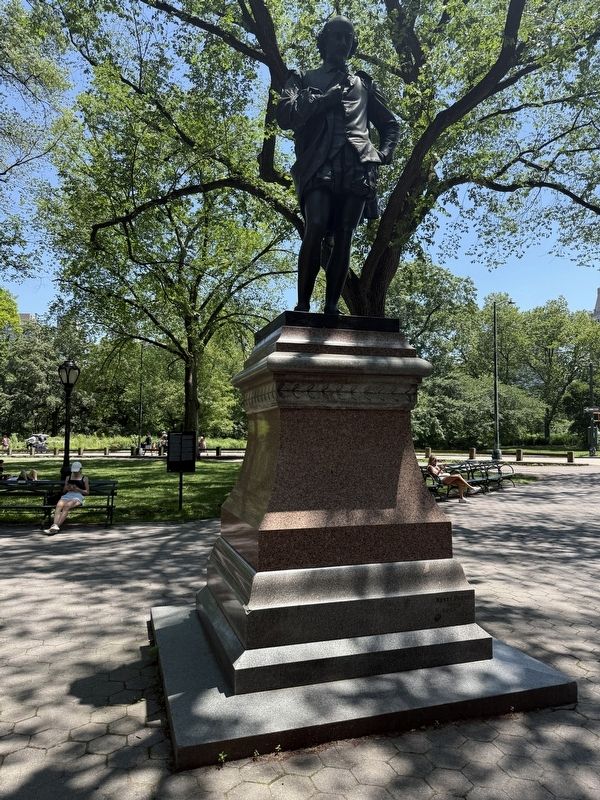
This full-standing portrait of celebrated playwright and poet William Shakespeare (1564-1616) was made by John Quincy Adams Ward (1830-1910) and unveiled here at the southern end of the Mall on May 23, 1872.
William Shakespeare was born in Stratford-on-Avon in April of 1564. His father, John Shakespeare, was a glove-maker and commodities trader who rose to become a prominent local alderman and bailiff before suffering declining fortunes. His mother, Mary Arden, was the daughter of a prosperous landowner. Little is known of Shakespeare's upbringing; he was locally schooled, likely at the King Edward VI School in Stratford, acquired a reasonable knowledge of Latin and Greek, and read the Roman dramatists.
In 1582, he married Anne Hathaway, and they had a daughter, Susanna, and twins Judith and Hamnet. Hamnet died in boyhood. The first account of Shakespeare's professional accomplishments appears in 1592, when rival playwright Robert Greene, in his book A Groats-Worth of Witte, referred to the rising actor and dramatist as "an upstart crow, beautified with our feathers…" In 1594, Shakespeare was a charter member of
this page online
Shakespeare was enormously prolific. In his relatively short career he authored 13 comedies, 13 historical dramas, 6 tragedies, 4 tragic comedies and 154 sonnets. Many of his plays have become classics of the stage, and his poems are revered for their mastery of language and verse. Thus this modestly educated man of the Elizabethan age left an indelible mark on the English language and Western culture.
In 1864, coinciding with the tri-centennial of Shakespeare's birth, a group of actors and theatre managers, among them noted Shakespearean actor Edwin Booth (1833-1893), received permission from Central Park's Board of Commissioners to lay the cornerstone for a statue at the south end of the Mall between two elms. Nothing further was done until the end of the Civil War. In 1866, a competition

Later referred to as the "Dean of American Sculptors," he contributed nine sculptures to the parks of New York-among them Roscoe Conkling (1893), Alexander Holley (1888), William Earl Dodge (1885), Horace Greeley (1890), Henry Ward Beecher (1891), The Indian Hunter (1869), The Pilgrim (1885), and the Seventh Regiment Memorial (1874). The last three can be found in Central Park.
The committee raised funds through several benefits, including a performance of Julius Caesar. Jacob Wrey Mould (1825-1886), a principal designer of the structures and ornament within Central Park, designed the elaborate pedestal for this statue. Ward combined a classical pose with many details of Elizabethan dress, and he relied on numerous images of Shakespeare, especially a bust in Stratford. The sculpture was cast in Philadelphia in 1870 at procuring and cutting the granite pedestal in Scotland, the Robert Wood & Co. foundry. Due to delays in it was unveiled on a temporary base in 1872. Some commentators found the work a noble effigy, and others derided it as a costume piece.
In 1986 a replica was cast
Central Park has other Shakespearean associations as well. In 1890, Eugene Schieffelin released 80 starlings into the park, because they were mentioned in Shakespeare's plays (there are now over 200 million of them in America). In 1915, the Shakespeare Society assumed maintenance of a rock garden, built in 1912, in the park near West 79th Street. In 1934, the Shakespeare Garden, which features particular plants named in his writings, was relocated to the hillside between Belvedere Castle and the Swedish Cottage, and in 1989, a new landscape design by Bruce Kelly and David Varnell was implemented. In 1958, after two seasons at the East River Amphitheater, Joseph Papp's Shakespeare Festival moved to Central Park. The Delacorte Theater became its permanent home, opening in 1962.
Erected by NYC Parks.
Topics and series. This historical marker is listed in these topic lists: Arts, Letters, Music • Parks & Recreational Areas. In addition, it is included in the NYC Parks series list. A significant historical month for this entry is April 1564.
Location. 40° 46.187′ N, 73° 58.337′ W. Marker is in Manhattan, New York, in New York County. It is in the Central Park West Historic District. It is at the intersection of East Drive and Center Drive, on the left when traveling north on East Drive. Touch for map. Marker is in this post office area: New York NY 10065, United States of America. Touch for directions.

Regionally, this marker is in New York City. It is also in the American Northeast, in the Mid-Atlantic, and on the Eastern Seaboard. Globally, it is in the North Atlantic Region, North America, the Western Hemisphere, the Western World, and the Anglosphere. Historically, it finds itself in what was once New Netherland and also one of the original Thirteen Colonies.
Other nearby markers. At least 8 other markers are within walking distance of this marker: A different marker also named William Shakespeare (a few steps from this marker); Columbus (within shouting distance of this marker); Sir Walter Scott (within shouting distance of this marker); Robert Burns (within shouting distance of this marker); Welcome to the Dene Slope (within shouting distance of this marker); Women's Rights Pioneers (about 300 feet away, measured in a direct line); Balto (about 400 feet away); William John Liebig (about 400 feet away). Touch for a list and map of all markers in Manhattan.
Another marker is no longer nearby. Robert Burns Statue (was within shouting distance of this marker but has been replaced with another marker now near it).
Credits. This page was last revised on July 12, 2025. It was originally submitted on July 12, 2025, by Devry Becker Jones of Washington, District of Columbia. This page has been viewed 208 times since then and 83 times this year. Photos: 1, 2, 3. submitted on July 12, 2025, by Devry Becker Jones of Washington, District of Columbia.
