
Chocolay Township in Marquette in Marquette County, Michigan — The American Midwest (Great Lakes)
Migratory Birds of the Great Lakes Region/ Restoring Critical Coastal Habitat to Benefit Birds
| — | Iron Ore Heritage Trail | — |
Photographed by Mark Parker, June 25, 2025
1. Migratory Birds of the Great Lakes Region Marker
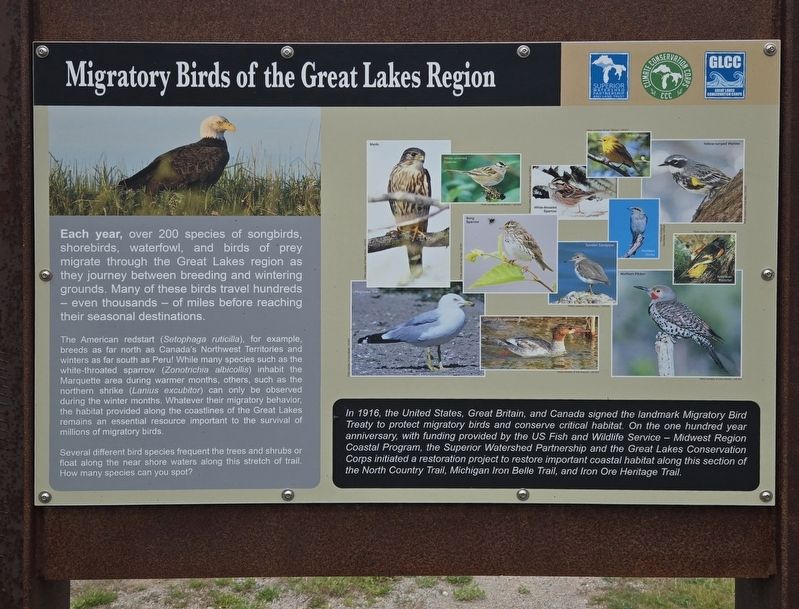
The American redstart (Setophaga ruticilla), for example, breeds as far north as Canada's Northwest Territories and winters as far south as Peru! While many species such as the white-throated sparrow (Zonotrichia albicollis) inhabit the Marquette area during warmer months, others, such as the northern shrike (Lanius excubitor) can only be observed during the winter months. Whatever their migratory behavior, the habitat provided along the coastlines of the Great Lakes remains an essential resource important to the survival of millions of migratory birds.
Several different bird species frequent the trees and shrubs or float along the near shore waters along this stretch of trail. How many species can you spot?
Sidebar
In 1916, the United States, Great Britain, and Canada signed the landmark Migratory Bird Treaty to protect migratory
this page online
Restoring Critical Coastal Habitat
The ecologically diverse coastlines common to Lake Superior and the Great Lakes region provide vital resources for millions of migratory birds as they pass through on their annual spring and fall migrations. The Great Lakes act as large ecological barriers to migrating birds. Shoreline habitat is often the first available place to land after flying over miles of open water. Coastal "stopover sites" provide shelter, resting, and feeding opportunities for songbirds, shorebirds, waterfowl, and birds of prey. Whether seeking shelter within the branches of a white spruce or feeding on serviceberries, birds and other migratory species depend upon native plant resources for survival.
Climate

Photographed by Mark Parker, June 25, 2025
2. Migratory Birds of the Great Lakes Region Marker near the parking lot on the Iron Ore Heritage Trail
Sidebar is the same text on both sides.
Erected by Superior Watershed Partnership and Land Trust, Climate Conservation Corps, Great Lakes Conservation Corps.
Topics. This historical marker is listed in these topic lists: Animals • Environment. A significant historical year for this entry is 1916.
Location. 46° 30.311′ N, 87° 21.798′ W. Marker is in Marquette, Michigan, in Marquette County. It is in Chocolay Township. It is on U.S. 41 0.2 miles north of Bayou Street, on the right when traveling north. The marker is on the Iron Ore Heritage Trail is near the parking lot for the Marquette Welcome Center. Touch for map. Marker is at or near this postal address: 2201 US-41, Marquette MI 49855, United States of America. Touch for directions.

Regionally, this marker is on Michigan’s Upper Peninsula. It is also in the American Midwest

Photographed by Mark Parker, June 25, 2025
3. Restoring Critical Coastal Habitat Marker
Other nearby markers. At least 8 other markers are within 3 miles of this marker, measured as the crow flies: A Trail to Adventure (about 500 feet away, measured in a direct line); Pioneer John Burt (approx. 1.4 miles away); Carp River Furnace (approx. 1.4 miles away); Jacques Marquette (approx. 2.8 miles away); Lake Superior Art Association (approx. 2.8 miles away); World War II "Silent Service" Memorial (approx. 2.9 miles away); Lower Harbor Ore Dock (approx. 2.9 miles away); Bishop Baraga House (approx. 2.9 miles away). Touch for a list and map of all markers in Marquette.
Credits. This page was last revised on July 14, 2025. It was originally submitted on July 13, 2025, by Mark Parker of Hickory, North Carolina. This page has been viewed 121 times since then and 19 times this year. Photos: 1, 2, 3. submitted on July 13, 2025, by Mark Parker of Hickory, North Carolina. • J. Makali Bruton was the editor who published this page.
