Kure Beach in New Hanover County, North Carolina — The American South (South Atlantic)
A Trophy of War
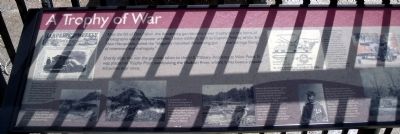
Photographed by Bernard Fisher, March 11, 2010
1. A Trophy of War Marker
After the fall of Fort Fisher, the Armstrong gun became a war trophy and the focus of photographs and newspaper articles. Union soldiers, such as Captain Trickey of the 3rd New Hampshire, noted the “elegantly mounted Armstrong gun...the carriage being of rosewood and mahogany.”
Shortly after the war the gun was taken to the U.S. Military Academy at West point. It was placed on trophy Point overlooking the Hudson River, where it has been a popular attraction ever since.
(captions)
The February 11, 1865, Harper’s Weekly confirms that the capture of the Armstrong was big news. The article reports that during the confusion attending the occupation of the works by Union troops some mischievous person stole the sights.
Federal troops looked on from Purdie Battery’s traverse as Timothy O’Sullivan photographed the Armstrong following the fall of the fort. (National Archives)
J.O. Davidson used O’Sullivan’s photograph of the captured Armstrong to create this imaginative scene. It depicts the naval assault on the Northeast Bastion during the second battle of Fort Fisher. (N.C. Office of Archives and History)
After the fall of Fort Fisher, Federal naval forces took possession of abandoned Confederate defenses protecting Old Inlet. At Fort Caswell, the U.S. Navy laid claim to the fortress’s 8 in. 150 lb. Armstrong. This sister gun to the Fort fisher Armstrong was transported to the Naval Academy at Annapolis (at left). The cannon was melted down as part of the nation’s patriotic scrap drive during World War II. (National Archives)
The gun was “built up” by a series of concentric wrought-iron tubes made from spiral coils welded together under a steam hammer. The tubes, or hoops, were then shrunk over one another so the inner tube or barrel was in a state of compression and able to resist the force of explosion. Each tube was turned on a lathe to a slightly smaller diameter than the one it was to fit over. Then it was expanded by heating and dropped in place.
Many soldiers, both North and South, mentioned the impressive Armstrong in their correspondence. Sgt. Major Christian Fleetwood, a Medal of Honor recipient with the 4th U.S. Colored troops, wrote “One gun in particular, an Armstrong gun made in England, finished with mahogany, polished steel and brass mountings, was handsome enough for a piece of parlor furniture.” (U.S. Army Military History Institute)
Once the “Pride of Fort Fisher,” the Armstrong is now the “Pride of West Point” and mounted at the U.S. Military Academy’s Trophy point. It is a long-standing tradition for cadets and graduates to be photographed with this historic war trophy. (Left: Fort Fisher Files. Below: U.S. Army Military History Institute)
Erected by Fort
this page online
Topics. This historical marker is listed in these topic lists: Forts and Castles • War, US Civil. A significant historical date for this entry is February 11, 1865.
Location. Marker has been reported missing. It was located near 33° 58.279′ N, 77° 55.082′ W. Marker was in Kure Beach, North Carolina, in New Hanover County. It could be reached from Fort Fisher Boulevard South (U.S. 421) near Battle Acre Road. This marker was located along the quarter-mile tour trail at Fort Fisher State Historic Site. It has been removed. Touch for map. Marker was at or near this postal address: 1610 Fort Fisher Boulevard South, Kure Beach NC 28449, United States of America. Touch for directions.

Regionally, this marker was in the Coastal Plain and on the Cape Fear Coast. It was also in the American South, specifically in the Upper South, in the Tidewater, and on the Eastern Seaboard. Globally, it was in the North Atlantic Region, North America, the Western Hemisphere, the Western World, and the Anglosphere. Historically, it found itself in what was once the territory of the Mississippian Culture, one of the original

Photographed by J. O. Davidson, circa 1887
2. Capture of Fort Fisher
Facsimile print by L. Prang & Co. Library of Congress [LC-DIG-ppmsca-19925]
Other nearby markers. At least 8 other markers are within walking distance of this location: 1st Battle Of Fort Fisher - December, 1864: A "Fiasco" (within shouting distance of this marker); A Desolate Spit Of Land (within shouting distance of this marker); Our Occupation Of The Fort, Was Not Equivalent To Its Possession. (about 300 feet away); Fort Fisher (about 300 feet away); Fort Fisher & the Civil War (about 300 feet away); The Whole Garrison Has Gone To Gardening (about 300 feet away); 32 Pounder Naval Cannon (about 300 feet away); a different marker also named 32 Pounder Naval Cannon (about 300 feet away). Touch for a list and map of all markers in Kure Beach.
Other markers no longer nearby. Fort Fisher’s Armstrong Cannon (was here, next to this marker but has been confirmed missing); Blockade-Running (was a few steps from this marker but has been confirmed missing); History Trail (was within shouting distance of this marker but has been confirmed missing); Growth of Fort Fisher, 1861-1862 (was within shouting distance of this
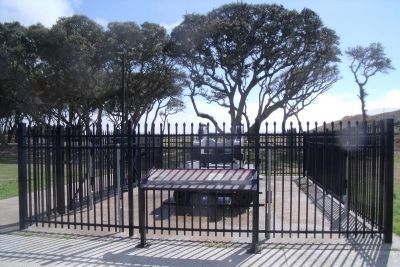
Photographed by Bernard Fisher, March 11, 2010
3. Armstrong gun carriage
Regarding A Trophy of War. The replica of the Armstrong Gun is still on the ground of Fort Fisher State Historic Site but has been relocated from this spot to a position further west, without markers.
Also see . . . Fort Fisher. North Carolina Historic Sites entry (Submitted on March 16, 2010, by Bernard Fisher of Richmond, Virginia.)

Photographed by Evan Dwyer, January 24, 2025
4. Fort Fisher's Armstrong Cannon Replica
The new position of the replica cannon, without interpretive markers.
Credits. This page was last revised on July 16, 2025. It was originally submitted on March 16, 2010, by Bernard Fisher of Richmond, Virginia. This page has been viewed 1,211 times since then and 31 times this year. Last updated on July 15, 2025, by Evan Dwyer of Richmond, Virginia. Photos: 1. submitted on March 16, 2010, by Bernard Fisher of Richmond, Virginia. 2. submitted on March 17, 2010. 3. submitted on March 16, 2010, by Bernard Fisher of Richmond, Virginia. 4. submitted on July 15, 2025, by Evan Dwyer of Richmond, Virginia.
