Kure Beach in New Hanover County, North Carolina — The American South (South Atlantic)
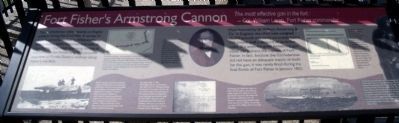
Fort Fisher’s Armstrong Cannon
Photographed by Bernard Fisher, March 11, 2010
1. Fort Fisher’s Armstrong Cannon Marker
The most effective gun in the fort. – Col. William Lamb, Fort Fisher commander
The Confederacy relied heavily on English artillery during the Civil War. A variety of English cannons, including Whitworths and Blakelys, were imported and used at Fort fisher. The most imposing cannon at the fort was the Armstrong 150-pounder mounted at Purdie battery midway along Fisher’s sea face.
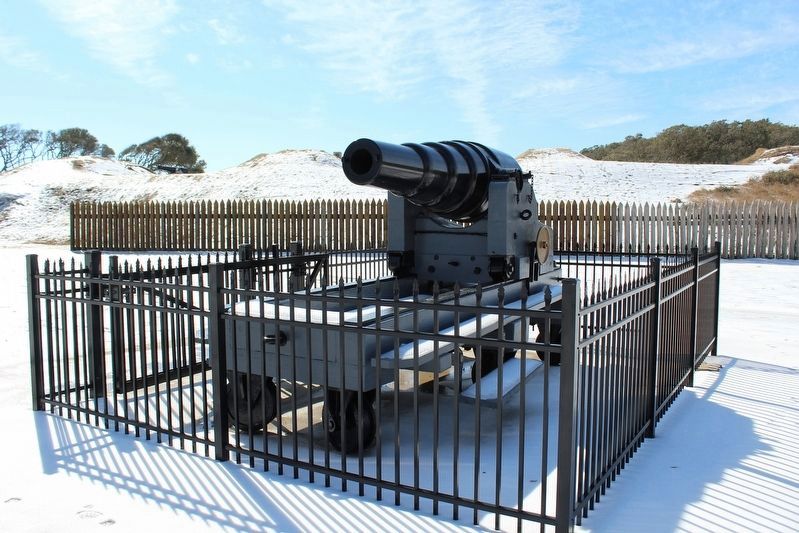
Manufactured by Sir William Armstrong & Co. in England, the rifled tube weighed 16,000 pounds and could accurately hurl a 150-pound shell a distance of up to five miles. But even the great Armstrong gun could not prevent the capture of Fort Fisher. In fact, because the Confederates did not have an adequate supply of shells for the gun, it was rarely fired during the final Battle of Fort Fisher in January 1865.
(captions)
The Armstrong gun was mounted in Purdie Battery (No. 4) located approximately mid-way along the sea face. After observing artillery practice on December 3, 1864, Colonel Lamb confirmed the gun’s accuracy in his diary entry: “1st shot struck rearmost chimney of Condor; 2nd struck her forward smoke stack; 3rd shot [illegible] struck wreck of blockader. (Library of Congress)
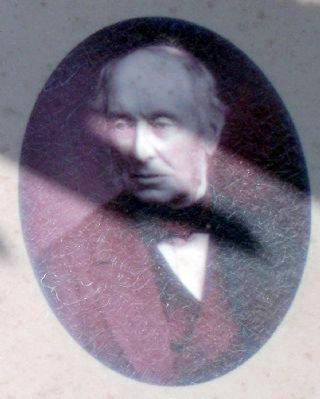
In the 1850s England’s Sir William G. Armstrong (1810-1900) produced a line of highly coveted artillery and projectiles. The British government had such great regard for these weapons that their sale to foreign countries was forbidden until the rearmament of English services was completed in 1862. (British Library)
According to Colonel Lamb, prior to the first battle “the Armstrong gun had only one dozen rounds of fixed ammunition.” Forced to save his ordnance, the gun was fired only four times on the second day of the first battle. Confederate reports indicate that one round might have struck the boiler of Admiral Porter’s flagship, the USS Malvern.
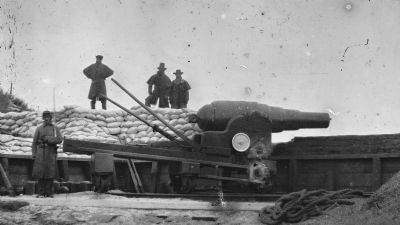
The Armstrong required a propellant charge of thirty pounds of gunpowder when fired. Local foundries attempted to manufacture two types of bolts (solid shot) for the gun. Southern factories proved incapable of replicating the sophisticated British ordnance. Colonel Lamb described the Confederate-made bolt as “useless.” (Notice the bolts on the floor of the gun pit directly behind the sentry). (National Archives)
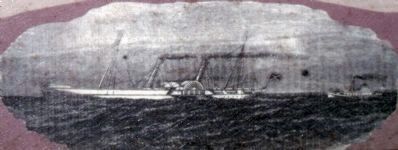
On September 7, 1864, Wilmington district commander Maj. Gen. W.H.C. Whiting notified Richmond of the Hope’s arrival. His successful request for possession of the weapons seems to dispel the myth that they were British “gifts” for Fort Fisher. The guns were divided between New Inlet and Old Inlet, with one gun going to Fort Fisher and the other to Fort Caswell. (UNC Wilmington)
On August 24, 1864, the Hope (or Hope of Wilmington), described as being “larger and superior to most [blockade-runners],” left Nassau for her maiden attempt to run the blockade. Among the valuable cargo were two 8-inch, 150-lb. Armstrong cannons. (N.C. Office of Archives and History)
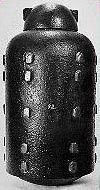
The Armstrong shell stood 16.33 inches tall and weighed 143 pounds, minus the explosive charge. The 8-inch shell featured six spiraling rows of five brass studs to correspond with the grooves in the bore of the rifle. The gun employed shunt rifling. At the muzzle of the cannon the grooves were cut deep on one side and shallow on the other. Gradually the grooves tapered to an equal depth. In loading, the studs of the projectile hugged the deep portion of the grove, but when fired the reverse rotation “shunted” the round to the shallow side, insuring a snug fit and accurate release. (West Point)
Erected by Fort
this page online
Topics. This historical marker is listed in these topic lists: Forts and Castles • War, US Civil. A significant historical month for this entry is January 1865.
Location. Marker has been reported missing. It was located near 33° 58.278′ N, 77° 55.078′ W. Marker was in Kure Beach, North Carolina, in New Hanover County. It could be reached from Fort Fisher Boulevard South (U.S. 421) near Battle Acre Road. This marker was located along the quarter-mile tour trail at Fort Fisher State Historic Site. It has been removed. Touch for map. Marker was at or near this postal address: 1610 Fort Fisher Boulevard South, Kure Beach NC 28449, United States of America. Touch for directions.

Regionally, this marker was in the Coastal Plain and on the Cape Fear Coast. It was also in the American South, specifically in the Upper South, in the Tidewater, and on the Eastern Seaboard. Globally, it was in the North Atlantic Region, North America, the Western Hemisphere, the Western World, and the Anglosphere. Historically, it found itself in what was once the territory of the Mississippian Culture, one of
Photographed by C.B. Comstock, circa 1865
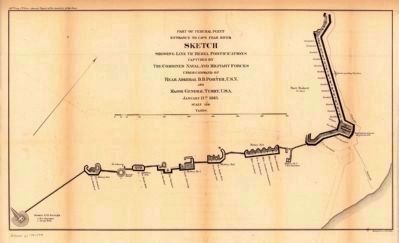
2. Plan and sections of Fort Fisher
Carried by assault by the U.S. Forces Maj. Gen. A. H. Terry, Commanding, Jan. 15th, 1865. (U.S. War Dept., Engineer Bureau) Library of Congress [G3904.F62S5 1865 .C61 CW 311]
Other nearby markers. At least 8 other markers are within walking distance of this location: 1st Battle Of Fort Fisher - December, 1864: A "Fiasco" (within shouting distance of this marker); A Desolate Spit Of Land (within shouting distance of this marker); Our Occupation Of The Fort, Was Not Equivalent To Its Possession. (about 300 feet away); Fort Fisher & the Civil War (about 300 feet away); Fort Fisher (about 300 feet away); 32 Pounder Naval Cannon (about 300 feet away); The Whole Garrison Has Gone To Gardening (about 300 feet away); a different marker also named 32 Pounder Naval Cannon (about 300 feet away). Touch for a list and map of all markers in Kure Beach.
Other markers no longer nearby. A Trophy of War (was here, next to this marker but has been confirmed missing); Blockade-Running (was a few steps from this marker but has been confirmed missing); History Trail (was within shouting distance of this marker but has been confirmed missing); Growth of Fort Fisher, 1861-1862 (was about 300 feet away, measured in a
March 11, 2010
3. Sir William G. Armstrong
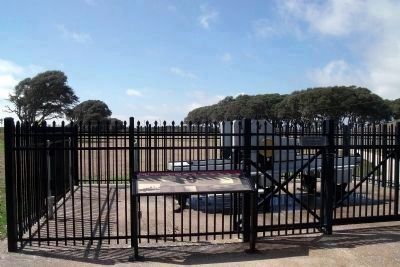
Regarding Fort Fisher’s Armstrong Cannon. The replica of the Armstrong Gun is still on the ground of Fort Fisher State Historic Site but has been relocated from this spot to a position further west, without markers.
Also see . . . Fort Fisher History. North Carolina Historic Sites entry (Submitted on March 16, 2010, by Bernard Fisher of Richmond, Virginia.)
Photographed by Timothy H. O'Sullivan, Jan 1865
4. Fort Fisher interior view. English Armstrong gun
The image on the marker is reversed. Library of Congress [LC-B811- 1234]
March 11, 2010
5. Steamship Hope of Wilmington
6. Armstrong shell
Photographed by Bernard Fisher, March 11, 2010
7. Armstrong gun carriage
Photographed by Evan Dwyer, January 24, 2025
8. Fort Fisher’s Armstrong Cannon Replica
The new position of the replica cannon, without interpretive markers.
Credits. This page was last revised on July 16, 2025. It was originally submitted on March 16, 2010, by Bernard Fisher of Richmond, Virginia. This page has been viewed 3,941 times since then and 175 times this year. Last updated on July 15, 2025, by Evan Dwyer of Richmond, Virginia. Photos: 1. submitted on March 16, 2010, by Bernard Fisher of Richmond, Virginia. 2. submitted on March 18, 2010, by Bernard Fisher of Richmond, Virginia. 3, 4, 5, 6. submitted on March 17, 2010, by Bernard Fisher of Richmond, Virginia. 7. submitted on March 16, 2010, by Bernard Fisher of Richmond, Virginia. 8. submitted on July 15, 2025, by Evan Dwyer of Richmond, Virginia.
