Lake Township in Sawyer in Berrien County, Michigan — The American Midwest (Great Lakes)
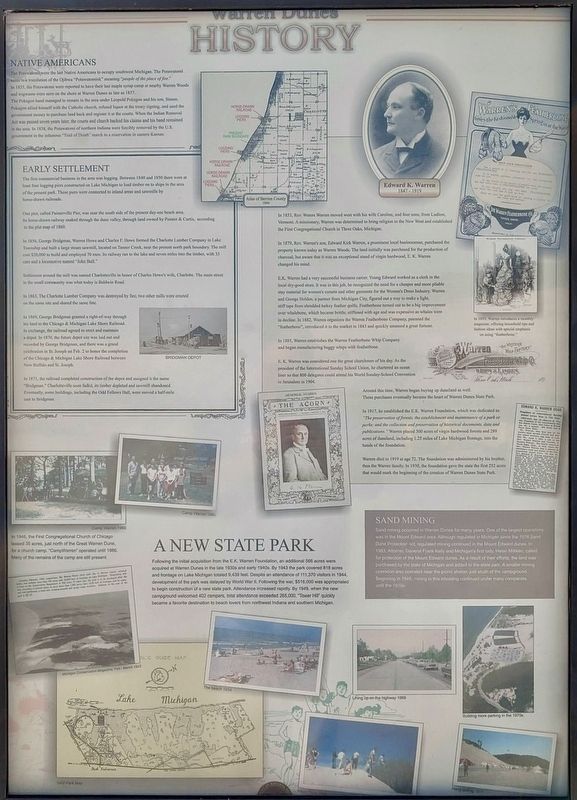
Warren Dunes History
Photographed by Daniel Barriball, July 15, 2025
1. Warren Dunes History Marker
Native Americans
The Potawatomi were the last Native Americans to occupy southwest Michigan. The Potawatomi name is a translation of the Ojibwa "Potawatomink" meaning "people of the place of fire." In 1835, the Potawatomi were reported to have their last maple syrup camp at nearby Warren Woods and wigwams were seen on the shore at Warren Dunes as late as 1837.
The Pokagon band managed to remain in the area under Leopold Pokagon and his son, Simon. Pokagon allied himself with the Catholic church, refused liquor at the treaty signing, and used the government money to purchase land back and register it at the courts. When the Indian Removal Act was passed seven years later, the courts and church backed his claims and his band remained in the area. In 1838, the Potawatomi of northern Indiana were forcibly removed by the U.S. government in the infamous "Trail of Death" march to a reservation in eastern Kansas.
Early Settlement
The first commercial business in the area was logging. Between 1840 and 1850 there were at least four logging piers constructed on Lake Michigan to load timber on to ships in the area of the present park.
this page online
One pier, called Painterville Pier, was near the south side of the present day-use beach area. Its horse-drawn railway snaked through the dune valley, through land owned by Painter & Curtis, according to the plat map of 1860.
In 1856, George Bridgman, Warren Howe and Charles F. Howe formed the Charlotte Lumber Company in Lake Township and built a large steam sawmill, located on Tanner Creek, near the present north park boundary. The mill cost $20,000 to build and employed 70 men. Its railway ran to the lake and seven miles into the timber, with 33 cars and a locomotive named "John Bull."
Settlement around the mill was named Charlotteville in honor of Charles Howe's wife, Charlotte. The main street in the small community was what today is Baldwin Road.
In 1863, The Charlotte Lumber Company was destroyed by fire; two other mills were erected on the same site and shared the same fate.
In 1869, George Bridgman granted a right-of-way through his land to the Chicago & Michigan Lake Shore Railroad. In exchange, the railroad agreed to erect and maintain a depot. In
Photographed by Daniel Barriball, July 15, 2025
2. Warren Dunes History Marker
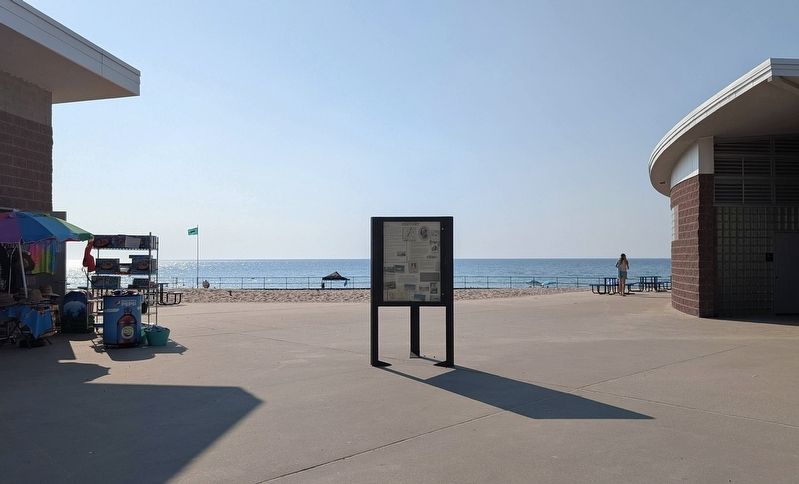
The gift shop is to the left, the restroom is to the right.
In 1871, the railroad completed construction of the depot and assigned it the name "Bridgman." Charlotteville soon faded, its timber depleted and sawmill abandoned. Eventually, some buildings, including the Odd Fellows Hall, were moved a half-mile east to Bridgman.
Photo captions: Atlas of Berrien County, 1860
Bridgman Depot
Edward K. Warren 1847-1919
In 1853, Rev. Waters Warren moved west with his wife Caroline, and four sons, from Ludlow, Vermont. A missionary, Warren was determined to bring religion to the New West and established the First Congregational Church in Three Oaks, Michigan.
In 1879, Rev. Warren's son, Edward Kirk Warren, a prominent local businessperson, purchased the property known today as Warren Woods. The land initially was purchased for the production of charcoal, but aware that it was an exceptional stand of virgin hardwood, E.K. Warren changed his mind.
E.K. Warren had a very successful
Photographed by Daniel Barriball, July 15, 2025
3. Warren Dunes State Park
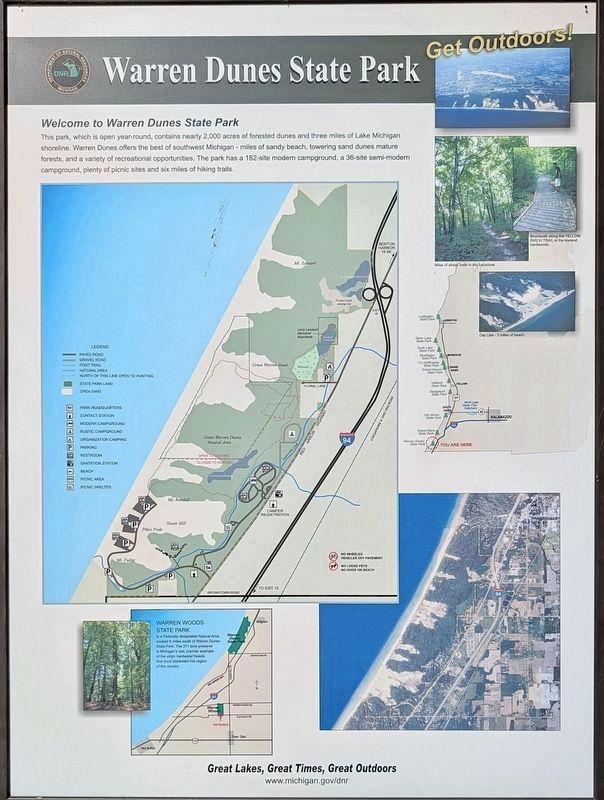
A park map and description. On the same triangle stand as the Warren Dunes History marker.
In 1885, Warren establishes the Warren Featherbone Whip Company and began manufacturing buggy whips with featherbone.
E.K. Warren was considered one of the great churchmen of his day. As the president of the International Sunday School Union, he chartered an ocean liner so that 800 delegates could attend his World Sunday-School Convention in Jerusalem in 1904.
Around this time, Warren began buying up duneland as well. These purchases eventually became the heart of Warren
Photographed by Daniel Barriball, July 15, 2025
4. Warren Dunes State Park: The Dunes
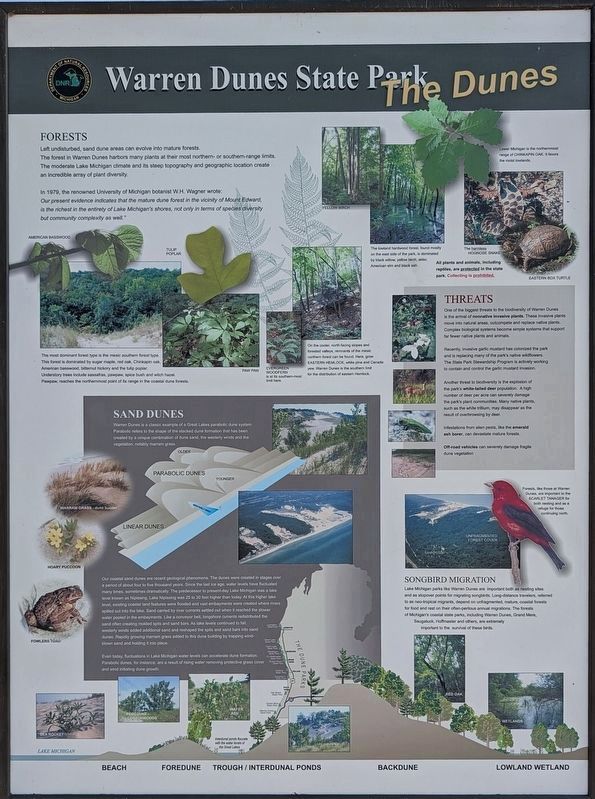
Information about the natural history of the park, including forests, birds, and the geology of the dunes. It is on the same triangle stand with the Warren Dunes History marker.
In 1917, he established the E.K. Warren Foundation, which was dedicated to: "The preservation of forests, the establishment and maintenance of a park or parks; and the collection and preservation of historical documents, data and publications." Warren placed 300 acres of virgin hardwood forests and 289 acres of duneland, including 1.25 miles of Lake Michigan frontage, into the hands of the foundation.
Warren died in 1919 at age 72. The foundation was administered by his brother, then the Warren family. In 1930, the foundation gave the state the first 252 acres that would mark the beginning of the creation of Warren Dunes State Park.
Photo caption: In 1893, Warren introduces a monthly magazine, offering household tips and fashion ideas with special emphasis on using "featherbone."
A New State Park
Following the initial acquisition from the E.K. Warren Foundation, an additional 566 acres were acquired at Warren Dunes in the late 1930s and early 1940s. By 1943 the park covered 818 acres and frontage on Lake Michigan toataled 9,439 feet. Despite an attendance of 111,370 visitors in 1944, development of the park was delayed by World War II. Following the war, $516,000 was appropriated to begin construction of a new state park. Attendance increased rapidly. By 1949, when the new campground welcomed 402 campers, total attendance exceeded 265,000. "Tower Hill" quickly became a favorite destination to beach lovers from northwest Indiana and southern Michigan.
In 1946, the First Congregational Church of Chicago leased 35 acres, just north of the Great Warren Dune, for a church camp. "CampWarren" operated until 1986. Many of the remains of the camp are still present.
Photo captions: Camp Warren 1960
Camp Warren 1986
Sand Mining
Sand mining occurred in Warren Dunes for many years. One of the largest operations was in the Mount Edward area. Although regulated in Michigan since the 1976 Sand Dune Protection Act, regulated mining continued in the Mount Edward dunes. In 1983, Attorney General Frank Kelly and Michigan's first lady, Helen Milliken, called for the protection of the Mount Edward dunes. As a result of their efforts, the land was purchased by the state of Michigan and added to the state park. A smaller mining operation also operated near the picnic shelter, just south of the campground. Beginning in 1949, mining in this inholding continued under many companies until the 1970s.
Photo captions: Including February, 1943, acquisitions, the Warren Dunes state park site in Berrien county, pictured below, now includes more than 750 acres with 10,000 feet of frontage on Lake Michigan. Originating with a lease to the Conservation Department of 250 acres 15 years ago, the park is to be developed after the war, according to present plans, to cover more than 1,200 acres, have 12,00 feet of frontage, and be equipped with bathhouses, a hotel site, camping grounds and group camp locations. Highway to the east of the park is US-12. Michigan Conservation Magazine; Feb-March 1943
1949 Park Map
The beach 1954
Lining up on the highway 1969
Building more parking in the 1970s.
Hang-gliding 1976
Erected by Michigan Department of Natural Resources.
Topics. This historical marker is listed in these topic lists: Industry & Commerce • Parks & Recreational Areas • Settlements & Settlers. A significant historical year for this entry is 1917.
Location. 41° 54.44′ N, 86° 36.385′ W. Marker is in Sawyer, Michigan, in Berrien County. It is in Lake Township. It is on River/Dunes Trail west of State Park Road, on the right when traveling west. Touch for map. Marker is at or near this postal address: 12032 Red Arrow Hwy, Sawyer MI 49125, United States of America. Touch for directions.

Regionally, this marker is in Southwest Michigan and specifically in one of the Lake Michigan Shore counties. It is also in the American Midwest. Globally, it is in North America, on the Great Lakes, in the Western Hemisphere, in the Western World, and in the Anglosphere. Historically, it finds itself in what was once the Viceroyalty of New France and also the Northwest Territory.
Other nearby markers. At least 8 other markers are within 8 miles of this marker, measured as the crow flies: Edward K. Warren / Warren Dunes State Park (approx. ¾ mile away); Michigan Natural Resources Trust Fund (approx. ¾ mile away); a different marker also named Michigan Natural Resources Trust Fund (approx. ¾ mile away); a different marker also named Michigan Natural Resources Trust Fund (approx. ¾ mile away); Carl Sandburg / Chikaming Goat Farm (approx. 2½ miles away); Warren Woods State Park (approx. 5.1 miles away); Lakeside Inn (approx. 5.8 miles away); 22 North Elm Street (approx. 7.3 miles away). Touch for a list and map of all markers in Sawyer.
More about this marker. This marker is in between the gift shop and one of the restrooms on the beach. It is located on the plaza between the second and third beach parking lots within Warren Dunes State Park.
Credits. This page was last revised on August 22, 2025. It was originally submitted on July 15, 2025, by Daniel Barriball of Chesterton, Indiana. This page has been viewed 558 times since then and 252 times this year. Photos: 1. submitted on July 15, 2025, by Daniel Barriball of Chesterton, Indiana. 2, 3, 4. submitted on July 16, 2025, by Daniel Barriball of Chesterton, Indiana. • J. Makali Bruton was the editor who published this page.
