Kure Beach in New Hanover County, North Carolina — The American South (South Atlantic)
The Whole Garrison Has Gone To Gardening
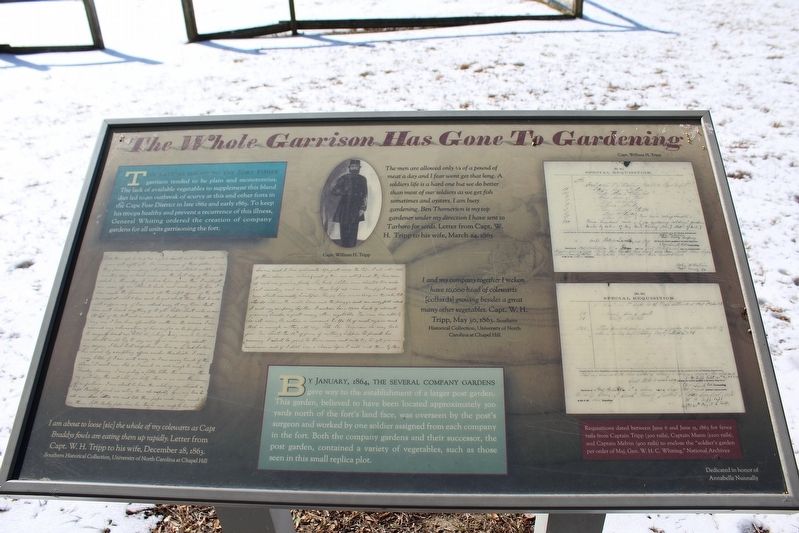
Capt. William H. Tripp
Photographed by Evan Dwyer, January 24, 2025
1. The Whole Garrison Has Gone To Gardening Marker
The rations issued to the Fort Fisher garrison tended to be plain and monotonous. The lack of available vegetables to supplement this bland diet led to an outbreak of scurvy at this and other forts in the Cape Fear District in late 1862 and early 1863. To keep his troops healthy and prevent a recurrence of this illness, General Whiting ordered the creation of company gardens for all units garrisoning the fort.
By January, 1864, the several company gardens gave way to establishment of a larger post garden. This garden, believed to have been located approximately 300 yards north of the fort's land face, was overseen by the post's surgeon and worked by one soldier assigned from each company in the fort. Both the company gardens and their successor, the post garden, contained a variety of vegetables, such as those seen in this small replica plot.
The men are allowed only ¼ of a pound of meat a day and I fear wont get that long. A soldiers life is a hard one but we do better than most of our soldiers as we get fish sometimes and oysters. I am busy gardening. Ben Thomerson is my top gardener under my direction I have sent to Tarboro for seeds.
this page online
Erected 2015.
Topics. This historical marker is listed in these topic lists: Forts and Castles • War, US Civil. A significant historical month for this entry is January 1864.
Location. 33° 58.323′ N, 77° 55.114′ W. Marker is in Kure Beach, North Carolina, in New Hanover County. It can be reached from Fort Fisher Boulevard South (U.S. 421) 0.1 miles north of Battle Acre Road, on the right when traveling south. The marker is part of the walking trail around the Land Face of Fort Fisher State Historic Site. Touch for map. Marker is at or near this postal address: 1610 Fort Fisher Boulevard South, Kure Beach NC 28449, United States of America. Touch for directions.

Regionally, this marker is in the Coastal Plain and on the Cape Fear Coast. It is also in the American South, specifically in the Upper South, in the Tidewater, and on the Eastern Seaboard. Globally, it is in the North Atlantic Region, North America, the Western Hemisphere, the Western World, and the Anglosphere. Historically, it finds itself in what was once the territory of the Mississippian Culture, one
Photographed by Evan Dwyer, January 24, 2025
2. Replica Garden
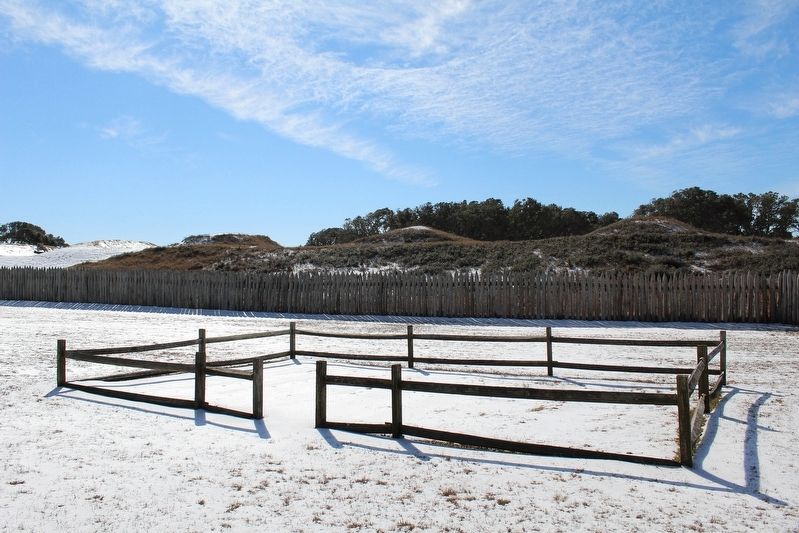
The rail fence in the immediate foreground is the replica referenced by the marker. The marker is just below the camera's field of view; the photographer was one step west of the marker when this was taken.
Other nearby markers. At least 8 other markers are within walking distance of this marker: I Knew That Desperate Work Was In Store (within shouting distance of this marker); A Desolate Spit Of Land (within shouting distance of this marker); "[We] rushed forward like tempest, through the stockade and up the parapet" (within shouting distance of this marker); 1st Battle Of Fort Fisher - December, 1864: A "Fiasco" (within shouting distance of this marker); Shepherd's Battery #1 (about 300 feet away); Fort Fisher & the Civil War (about 400 feet away); 32 Pounder Naval Cannon (about 400 feet away); After Taking Fort Fisher, I Think Our Troops Could Storm Hell Itself. (about 400 feet away). Touch for a list and map of all markers in Kure Beach.
Other markers no longer nearby. Lamb Expands the Fort, 1862-1865 (was here, next to this marker but has been confirmed missing); Growth of Fort Fisher, 1861-1862 (was a few steps from this marker but has been confirmed missing); History Trail (was within shouting distance of this marker but has been confirmed missing); Blockade-Running (was about 300 feet away, measured in a direct line but has been confirmed missing); A Trophy of War (was about 300 feet away but has been confirmed missing); Fort Fisher’s Armstrong Cannon (was about 300 feet away but has been confirmed missing); Shepherd’s Battery (was about 300 feet away but has been confirmed missing).
More about this marker. The marker includes an inset portrait of Capt. William H. Tripp as well as images of two of his letters and two selected quotes of his. In addition, on the right side of the marker are photos of two Requisitions dated between June 6 and June 15, 1863, for fence rails from Captain Tripp (300 rails), Captain Munn (1200 rails), and Captain Melvin (900 rails) to enclose the "soldier's garden per order of Maj. Gen. W.H.C. Whiting from the National Archives.
The two letter quotes are as follows:
I and my company together I reckon have 10,000 head of colewarts [collards] growing besides a great many other vegetables. Capt. W.H. Tripp, May 30, 1863. Southern Historical Collection, University of North Carolina at Chapel Hill
I am about to loose [sic] the whole of my colewarts as Capt Braddys fowls are eating them up rapidly. Capt. W.H. Tripp to his wife, December 28, 1863. Southern Historical Collection, University of North Carolina at Chapel Hill
Regarding The Whole Garrison Has Gone To Gardening. The replica garden did not have anything growing in it when this marker was photographed. Though it was January and snow was on the ground, the actual use of the replica garden to grow representative crops in line with the marker's text statement has not been observed.
Additional commentary.
1. 2015 Series of Markers
The following markers were placed at Fort Fisher State Historic Site on the site walking trail as part of the 150th Anniversary of the battles in 2015:
278788
278793
278799
278843
278848
278856
278903
278907
278909
278913
278919
278923
278926
278936
A marker in the same style (278761) was placed at the Fort Fisher monument at Battle Acre in 2017. Three other markers outside of the site history trail (278940, 278774, and 278764) are all the same styling and may also be part of the 2015 re-signing effort.
— Submitted July 17, 2025, by Evan Dwyer of Richmond, Virginia.
Credits. This page was last revised on July 27, 2025. It was originally submitted on July 15, 2025, by Evan Dwyer of Richmond, Virginia. This page has been viewed 150 times since then and 26 times this year. Last updated on July 17, 2025, by Evan Dwyer of Richmond, Virginia. Photos: 1, 2. submitted on July 15, 2025, by Evan Dwyer of Richmond, Virginia. • J. Makali Bruton was the editor who published this page.
