Eden in Weber County, Utah — The American Mountains (Southwest)
David Eccles
⎯⎯⎯
Northwestern Shoshone--Early Sojourners of Ogden Valley
Photographed by Jeremy Snow, June 21, 2025
1. David Eccles Marker
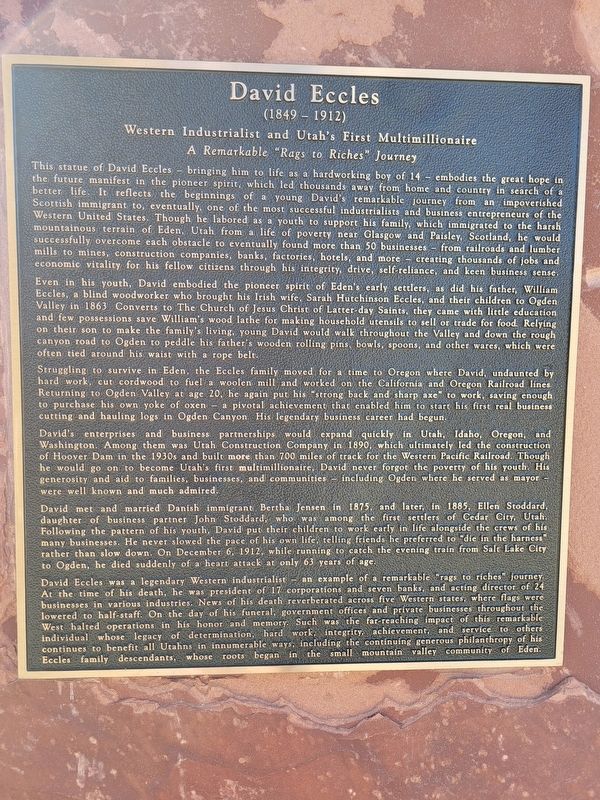
David Eccles
(1849-1912)
Western Industrialist and Utah's First Multimillionaire
A Remarkable "Rags to Riches" Journey
This statue of David Eccles bringing him to life as a hardworking boy of 14 - embodies the great hope in the future manifest in the pioneer spirit, which led thousands away from home and country in search of a better life. It reflects the beginnings of a young David's remarkable journey from an impoverished Scottish immigrant to, eventually, one of the most successful industrialists and business entrepreneurs of the Western United States. Though he labored as a youth to support his family, which immigrated to the harsh mountainous terrain of Eden, Utah from a life of poverty near Glasgow and Paisley, Scotland, he would successfully overcome each obstacle to eventually found more than 50 businesses - from railroads and lumber mills to mines, construction companies, banks, factories, hotels, and more - creating thousands of jobs and economic vitality for his fellow citizens through his integrity, drive, self-reliance, and keen business sense.
Even in his youth, David embodied the pioneer spirit
this page online
Struggling to survive in Eden, the Eccles family moved for a time to Oregon where David, undaunted by hard work, cut cordwood to fuel a woolen mill and worked on the California and Oregon Railroad lines. Returning to Ogden Valley at age 20, he again put his "strong back and sharp axe" to work, saving enough to purchase his own yoke of oxen a pivotal achievement that enabled him to start his first real business cutting and hauling logs in Ogden Canyon. His legendary business career had begun.
David's
Photographed by Jeremy Snow, June 21, 2025
2. Northwestern Shoshone--Early Sojourners of Ogden Valley Marker
David met and married Danish immigrant Bertha Jensen in 1875, and later, in 1885, Ellen Stoddard, daughter of business partner John Stoddard, who was among the first settlers of Cedar City, Utah. Following the pattern of his youth, David put their children to work early in life alongside the crews of his many businesses. He never slowed the pace of his own life, telling friends he preferred to "die in the harness rather than slow down. On December 6, 1912, while running to catch the evening train from Salt Lake City to Ogden, he died suddenly of a heart attack at only 63 years of age.
David Eccles was a
Photographed by Jeremy Snow, June 21, 2025
3. David Eccles / Northwestern Shoshone--Early Sojourners of Ogden Valley Marker
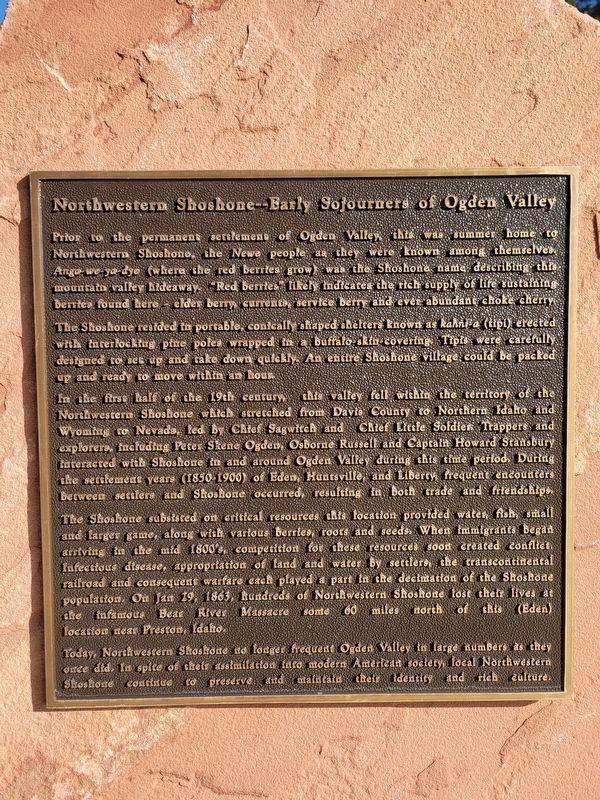
Northwestern Shoshone--Early Sojourners of Ogden Valley
Prior to the permanent settlement of Ogden Valley, this was summer home to Northwestern Shoshone, the Newe people as they were known among themselves. Ango-we-ya-dye (where the red berries grow) was the Shoshone name describing this mountain valley hideaway. "Red berries likely indicates the rich supply of life sustaining berries found here - elder berry, currents, service berry, and ever abundant choke cherry.
The Shoshone resided in portable, conically shaped shelters known as kahni-a (tipi) erected with interlocking pine poles wrapped in buffalo skin covering. Tipis were carefully designed to set up and take down quickly. An entire Shoshone village could be packed up and ready to move within an hour.
In the first half of the 19th century, this valley fell within the territory of the Northwestern Shoshone which stretched from Davis County to Northern Idaho and Wyoming to Nevada, led by Chief Sagwitch and Chief Little Soldier. Trappers and explorers, including Peter Skene Ogden, Osborne Russell and Captain Howard Stansbury interacted with Shoshone in and around Ogden Valley during this time period. During the settlement years (1850-1900) of Eden, Huntsville, and Liberty frequent encounters between settlers and Shoshone occurred, resulting in both trade and friendships.
The Shoshone subsisted on critical resources this location provided water, fish, small and larger game, along with various berries, roots and seeds. When immigrants began arriving in the mid 1800's, competition for these resources soon created conflict. Infectious disease, appropriation of land and water by settlers, the transcontinental railroad and consequent warfare each played a part in the decimation of the Shoshone population. On Jan 19, 1863, hundreds of Northwestern Shoshone lost their lives at the infamous Bear River Massacre some 60 miles north of this (Eden) location near Preston, Idaho.
Today, Northwestern Shoshone no longer frequent Ogden Valley in large numbers as they once did. In spite of their assimilation into modern American society, local Northwestern Shoshone continue to preserve and maintain their identity and rich culture.
Topics. This historical marker is listed in these topic lists: Indigenous Peoples and Communities • Industry & Commerce • Settlements & Settlers.
Location. 41° 17.829′ N, 111° 48.913′ W. Marker is in Eden, Utah, in Weber County. It is on North 5500 East, on the right when traveling north. The marker is located in the SW corner of Eden Park. Touch for map. Marker is at or near this postal address: 2150 N 5500 E, Eden UT 84310, United States of America. Touch for directions.

Regionally, this marker is in the Wasatch Front and in Greater Salt Lake. It is also in the American Mountain West and on the Colorado Plateau. Globally, it is in North America, the Rocky Mountains, the Western Hemisphere, the Western World, and the Anglosphere. Historically, it finds itself in what was once New Spain and also Mexico’s Alta California.
Other nearby markers. At least 8 other markers are within 4 miles of this marker, measured as the crow flies: Eden's Founding (here, next to this marker); Early Life in Eden (here, next to this marker); David Eccles (here, next to this marker); J.M. Wilbur Company Blacksmith Shop (about 400 feet away, measured in a direct line); Eden World War II Memorial (about 600 feet away); Settlement of Eden (about 600 feet away); Leon's Market Building (approx. 3.4 miles away); Huntsville (approx. 3.4 miles away). Touch for a list and map of all markers in Eden.
Credits. This page was last revised on August 13, 2025. It was originally submitted on July 19, 2025, by Jeremy Snow of Cedar City, Utah. This page has been viewed 145 times since then and 46 times this year. Photos: 1, 2, 3. submitted on July 19, 2025, by Jeremy Snow of Cedar City, Utah. • Andrew Ruppenstein was the editor who published this page.
