Eden in Weber County, Utah — The American Mountains (Southwest)
Early Life in Eden
Photographed by Jeremy Snow, June 21, 2025
1. Early Life in Eden Marker
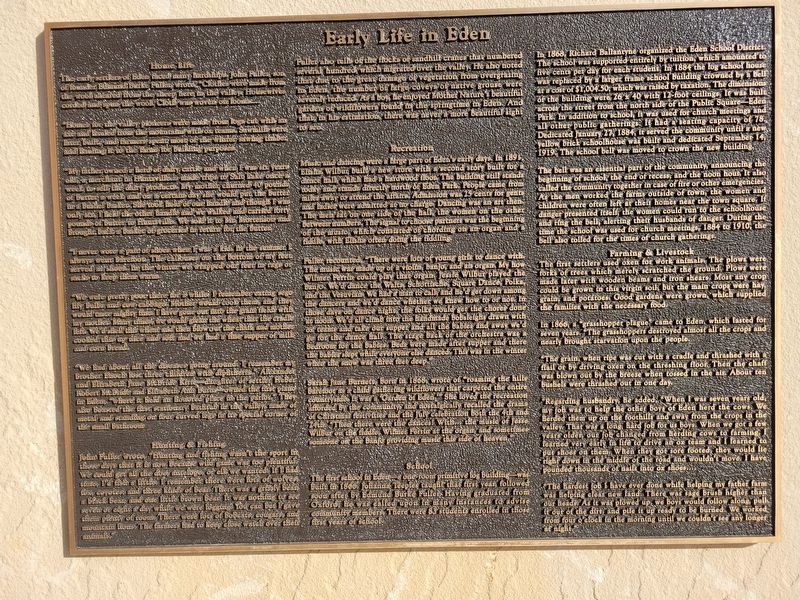
The early settlers of Eden faced many hardships. John Fuller, son of founder Edmund Burke Fuller, wrote, "Clothes were made from the wool sheared from the sheep here in the valley. Housewives corded and spun the wool. Cloth was woven on looms...
"Homes for the valley pioneers were made from logs cut with an axe and hauled from the mountains with ox teams. Sawmills were later built, and farmers spent most of the winter sawing timber and hauling it to the farms for building purposes.
"My father owned a herd of dairy cattle and when I was six years old, a merchant in Huntsville made trips to Salt Lake once a week to sell the dairy products. My mother churned 40 pounds of butter a week and on a certain day she would put the butter in a bushel basket. She took hold of one handle and though I was only six, I held the other handle and we walked and carried forty pounds of butter to Huntsville. We sold it to Mr. Mortenson and brought back a basket of groceries in return for the butter.
"I never wore a pair of shoes when I was a kid. In the summer I always went barefoot. The callouses on the bottom of my feet
this page online
"We were pretty poor there for a while. I remember eating sego lily bulbs and cow cabbage. Mother would cook them, and they would taste mighty fine. I have gone out into the grain fields with my mother. Many times, we would glean the wheat that the cradle left. We'd shell this wheat and then blow out the chaff, and mother cooked this up nice and soft and we had a fine supper of milk and corn bread.
"We had about all the diseases going around. I remember my brother Enoch lost three children with diphtheria." Alexander and Elizabeth Jane McBride Ririe - daughter of settler Heber Robert McBride and Elizabeth Ann Burns - owned the first piano in Eden, "where it held an honored place in the parlor." They also boasted the first stationary bathtub in the valley, made of metal and standing on four curved legs in its special corner of the small bathroom.
Hunting & Fishing
John Fuller wrote, "Hunting and fishing wasn't the sport in those days that it is now because wild game was too plentiful. We could get all the doe, antelope, or elk we wanted.
Photographed by Jeremy Snow, June 21, 2025
2. Early Life in Eden Marker
Fuller also tells of the flocks of sandhill crames that numbered several hundred, which migrated over the valley. He also noted that due to the great damage of vegetation from overgrazing in Eden, the number or large coveys of native grouse were severely reduced. As a boy, he enjoyed Mother Nature's beautiful garden of wildflowers found in the springtime in Eden. And that in his estimation, there was never a more beautiful sight to see.
Recreation
Music and dancing were a large part of Eden's early days. In 1891, Elisha Wilbur built a new store with a second story built for a dance hall, which had a hardwood floor. The building still stands today and stands directly north of Eden Park. People came from miles away to attend the affairs. Admission was 25 cents for gents and ladies were admitted at no charge. Dancing was an art then. The men sat on one side of the hall, the women on the other between numbers. The signal to choose partners was the beginning of the music which consisted of chording on an organ and a fiddle, with Elisha often doing the fiddling.
Fuller recounted, "There were lots of young girls to dance with. The music was made up of a violin, banjo, and an organ. My how Wilmer Ferrin could play that organ. Jessie Wilbur played the banjo. We'd dance the Waltz, Schottische, Square Dance, Polka, and the Vesuvian. We had a man to call, and he'd get down amoung the dancers and we'd dance whether we knew how to or not. In those days on dance night, the folks would get the chores done at noon. We'd all climb into the handmade bobsleighs drawn with ox teams and take our supper and all the babies and away we'd go for the dance hall. The stage back of the orchestra was a bedroom for the babies. Beds were made after supper and there the babies slept while everone else danced. This was in the winter when the snow was three feet deep."
Sarah Jane Burnett, born in 1868, wrote of "roaming the hills barefoot as a child gathering wildflowers that carpeted the entire countryside. It was a Garden of Eden." She loved the recreation afforded by the community, and nostalgically recalled the drama of Christmas festivities and the July celebration both the 4th and the 24th. "Then there were the dances! With...the music of Jess Wilbur on the fiddle, Wilder Ferrin at the organ and sometimes someone on the banjo providing music this side of heaven."
School
The first school in Eden - a one-room primitive log building - was built in 1866. Johanna Teeples taught that first year, followed soon after by Edmund Burke Fuller. Having graduated from Oxford, he was called upon in many instances to advice connunity members. There were 83 students enrolled in those first years of school.
In 1868, Richard Ballantyne organied the Eden School District. The school was supported entirely by tuition, which amounted to five cents per day for each student. In 1884 the log schoolhouse was replaced by a larger frame school building crowned by a bell at a cost of $1,004.50, which was raised by taxation. The dimensions of the building were 26x40 with 12-foot ceilings. It was build across the street from the north side of the public Square - Eden Park. In addition to school, it was used for church meetings and all other public gatherings. It had a seating capacity of 78. Dedicated January 27, 1884, it served the community until a new yellow brick schoolhouse was built and dedicated September 14, 1919. The school bell was moved to crown the new building.
The bell was an essential part of the community, announcing the beginning of school, the end of recess, and the noon hour. It also called the community together in case of fire or other emergencies. As the men worked the farms outside of town, the women and children were often left at their homes near the town square. If danger presented itself, the women could run to the schoolhouse and ring the bell, alerting their husbands of danger. During the time the school was used for church meetings, 1884 to 1910, the bell also tolled for the times of church gatherings.
Farming & Livestock
The first settlers used oxen for work animals. The plows were forks of trees which merely scratched the ground. Plows were made later with wooden beams and irons shears. Most any crop could be grown in this virgin soil, but the main crops were hay, grain, and potatoes. Good gardens were grown, which supplied the families with the necessary food.
In 1866, a “grasshopper plague” came from Eden, which lasted for seven years. "The grasshoppers destroyed almost all the crops and nearly brought starvation upon the people.
"The grain, when ripe was cut with a cradle and thrashed with a flail or by driving oxen on the threshing floor. Then the chaff was blown out by the breeze when tossed in the air. About ten bushels were thrashed out in one day.
"Regaring husbandry, he added, "When I was seven years old, my job was to help the other boys of Eden herd the cows. We herded them up on the foothills and away from the crops in the valley. That was a long, hard job for us boys. When we got a few years older, our job changed from herding cows to farming. I learned very early in life to drive an ox team and I learned to put shoes on them. When they got sore footed, they would lie right down in the middle of the road and wouldn't move. I have pounded thousands of nails into ox shoes...
"The hardest job I have ever done while helping my father farm was helping clear new land. There was sage brush higher than our heads. As it was plowed up, we boys would follow along, pullin it out of the dirt and pile it up ready to be burned. We worked from four o'clock in the morning until we coulnd't see any longer at night."
Topics. This historical marker is listed in these topic lists: Agriculture • Education • Settlements & Settlers.
Location. 41° 17.829′ N, 111° 48.913′ W. Marker is in Eden, Utah, in Weber County. It is on North 5500 East, on the right when traveling north. Touch for map. Marker is at or near this postal address: 2150 N 5500 E, Eden UT 84310, United States of America. Touch for directions.

Regionally, this marker is in the Wasatch Front and in Greater Salt Lake. It is also in the American Mountain West and on the Colorado Plateau. Globally, it is in North America, the Rocky Mountains, the Western Hemisphere, the Western World, and the Anglosphere. Historically, it finds itself in what was once New Spain and also Mexico’s Alta California.
Other nearby markers. At least 8 other markers are within 4 miles of this marker, measured as the crow flies: David Eccles / Northwestern Shoshone--Early Sojourners of Ogden Valley (here, next to this marker); Eden's Founding (here, next to this marker); David Eccles (here, next to this marker); J.M. Wilbur Company Blacksmith Shop (about 400 feet away, measured in a direct line); Eden World War II Memorial (about 600 feet away); Settlement of Eden (about 600 feet away); Leon's Market Building (approx. 3.4 miles away); Huntsville (approx. 3.4 miles away). Touch for a list and map of all markers in Eden.
Credits. This page was last revised on July 21, 2025. It was originally submitted on July 19, 2025, by Jeremy Snow of Cedar City, Utah. This page has been viewed 100 times since then and 26 times this year. Photos: 1, 2. submitted on July 19, 2025, by Jeremy Snow of Cedar City, Utah. • Andrew Ruppenstein was the editor who published this page.
