Cultural Quarter in Southampton, England, United Kingdom — Northwestern Europe (the British Isles)
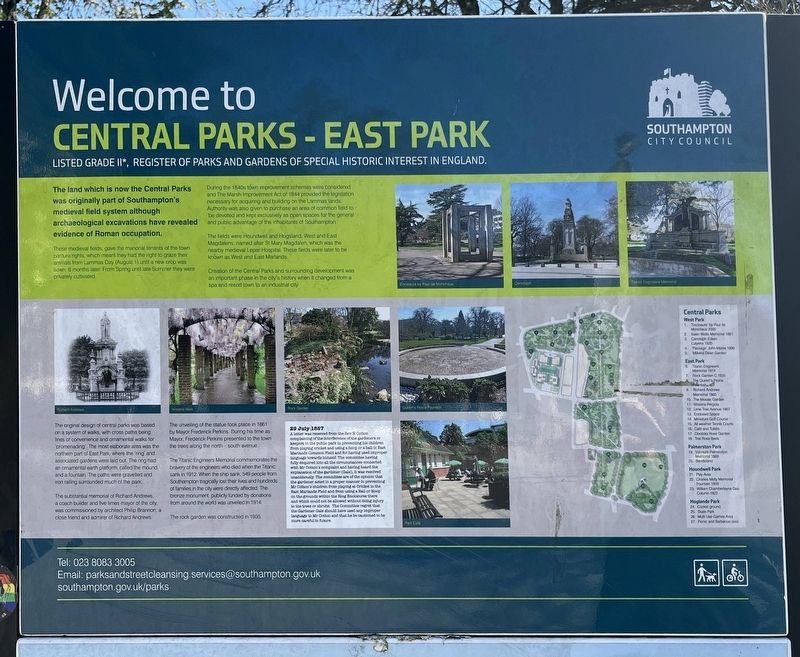
Welcome to Central Parks - East Park
Listed Grade II, Register of Parks and Gardens of Special Historic Interest in England
Photographed by Ray Gurganus, April 1, 2025
1. Welcome to Central Parks - East Park Marker
These medieval fields gave the manorial tenants of the town pasture rights, which meant they had the right to graze their animals from Lammas Day (August 1) until a new crop was sown, 6 months later. From Spring until late Summer they were privately cultivated.
During the 1840s town improvement schemes were considered and The Marsh Improvement Act of 1844 provided the legislation necessary for acquiring and building on the Lammas land. Authority was also given to purchase an area of common field to be devoted and kept exclusively as open spaces for the general and public advantage of the inhabitants of Southampton.
The fields were Houndwell and Hogsland, West and East Magdalens, named after St Mary Magdalen, which was the nearby medieval Leper Hospital. These fields were to be known as West and East Marlands.
Creation of the Cereal Parks and surrounding development was an important phase in the city's history when it changed from spa
this page online
The original design of central parks was based on a system of walks, with cross paths being lines of convenience and ornamental walks for 'promenading'. The most elaborate area was the northern part of East Park, where the 'ring' and associated gardens were laid out. The ring had an ornamental earth platform, called the mound, and a fountain. The paths were gravelled and iron railing surrounded much of the park.
The substantial memorial of Richard Andrews, a coach builder and five times mayor of the city, was commissioned by architect Philip Brannon, close friend and admirer of Richard Andrews.
The unveiling of the statue took place in 1861 by Mayor Frederick Perkins. During his time as Mayor, Frederick Perkins presented to the town the trees along the north-south avenue.
The Titanic Engineers Memorial commemorates the bravery by the engineers who died when the Titanic sank in 1912. When the ship sank 549 people from Southampton tragically lost their lives and hundreds of families in the city were directly affected. The bronze monument, publicly funded by donations from around the world,

Photographed by Ray Gurganus, April 1, 2025
2. Scene in the park
The rock garden was constructed in 1935.
29 July 1857
A letter was received from the Rev N. Cotton complaining of the interference of the gardeners or keepers in the public park in preventing his children from playing cricket and using a hoop or a ball in East Marlands Common Field and for having used improper language towards himself. The committee having fully enquired into all the circumstances connected with Mr Cotton's complaint and having heard the explanation of the gardener (Gale), it was resolved unanimously. The committee are of the opinion that the gardener acted in a proper manner in preventing Mr Cotton's children from playing at Cricket in the East Marlands Field and from using a Ball or Hoop on the grounds within the Ring Enclosures there and which could not be allowed without doing injury to the trees or shrubs. The Committee regret that the Gardener Gale should have used any improper language to Mr Cotton and that he be cautioned to be more careful in future.
Topics. This historical marker is listed in this topic list: Parks & Recreational Areas. A significant historical year for this entry is 1844.
Location. 50° 54.517′ N, 1° 24.158′ W. Marker is in Southampton, England. It is in the Cultural Quarter. It can be reached from Above Bar Street. Touch for map. Marker is at or near this postal address: Above Bar Street, Southampton, England SO14 0DA, United Kingdom. Touch for directions.

Regionally, this marker is in the Hampshire Ports. Globally, it is on the Atlantic Ocean, in the North Atlantic Region, in Europe, in Atlantic Europe, on one of the British Isles, in the Western World, and in the Anglosphere. Historically, it finds itself in what was once the Roman Empire.
Other nearby markers. At least 8 other markers are within walking distance of this marker: Richard Andrews 1798-1859 (about 150 meters away, measured in a direct line); Peaceful Parks (about 180 meters away); Time for Compassion (about 180 meters away); Engineer Officers of the RMS Titanic (about 240 meters away); Blechynden Terrace Gardens (approx. 0.6 kilometers away); Southampton in the Second World War 1939-1945 (approx. 0.6 kilometers away); Bargate and Guildhall (approx. 0.6 kilometers away); Town Walls (approx. 0.7 kilometers away). Touch for a list and map of all markers in Southampton.
Credits. This page was last revised on July 23, 2025. It was originally submitted on July 20, 2025, by Ray Gurganus of Washington, District of Columbia. This page has been viewed 79 times since then and 22 times this year. Photos: 1, 2. submitted on July 20, 2025, by Ray Gurganus of Washington, District of Columbia. • Andrew Ruppenstein was the editor who published this page.
Editor’s want-list for this marker. photo of the marker within its surroundings • Can you help?
