Norman in Cleveland County, Oklahoma — The American South (West South Central)
War Years in Norman
1941-1954
| — | Norman Legacy Trail | — |
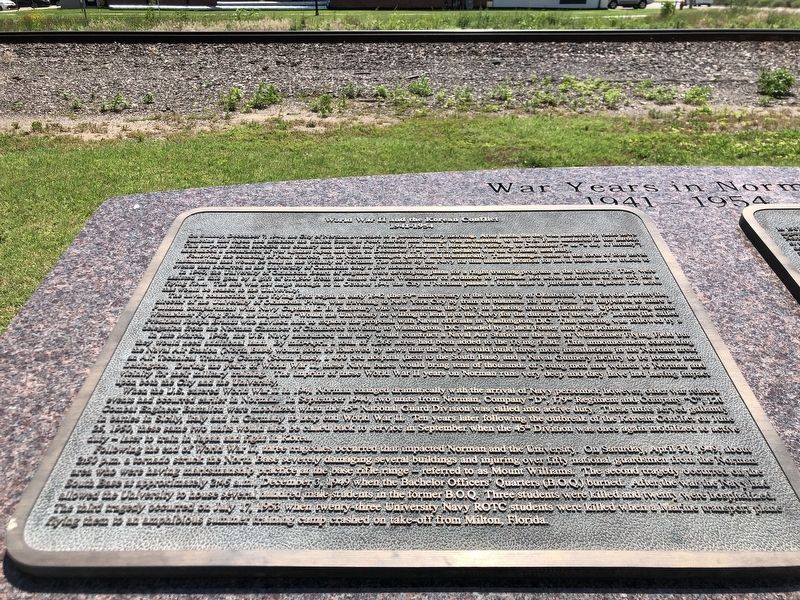
Photographed by Duane and Tracy Marsteller, June 20, 2025
1. War Years in Norman Marker, Side One
1941-1954
Following the bombing of Pearl Harbor, life in Norman changed quickly and dramatically. These changes came in the form of four naval installations that would be built in the vicinity of Norman. The choice by the Navy for this unusual location for naval bases can be traced to events that occurred at the University of Oklahoma only a few months before.
In 1940, the University of Oklahoma Board of Regents were developing plans for a flight training program at the university. They were assisted in this goal by a gift of $10,500 from the estate of Max Westheimer
this page online
The naval connection to the flying field began in early 1942 (the 50th anniversary of the University of Oklahoma) when Savoie Lottinville, director of the University of Oklahoma Press, was traveling to New York City by train on business for the Press. He happened to share a Pullman compartment with Navy Captain K.B. Salisbury who was assisting the Navy in locating training facilities. Upon hearing about Westheimer Flying Field, he inquired “Would the university be willing to lend it to the Navy for the duration of the war?” Lottinville called President Joseph Brandt who advised him to explore the proposal with Naval officials in Washington, D.C. That meeting was followed by a delegation from the Norman Chamber of Commerce traveling to Washington, D.C., headed by J. Jack Foster and Neil Johnson.
In late March, 1942, the U.S. Navy announced that they would construct a Naval Air Station at the site
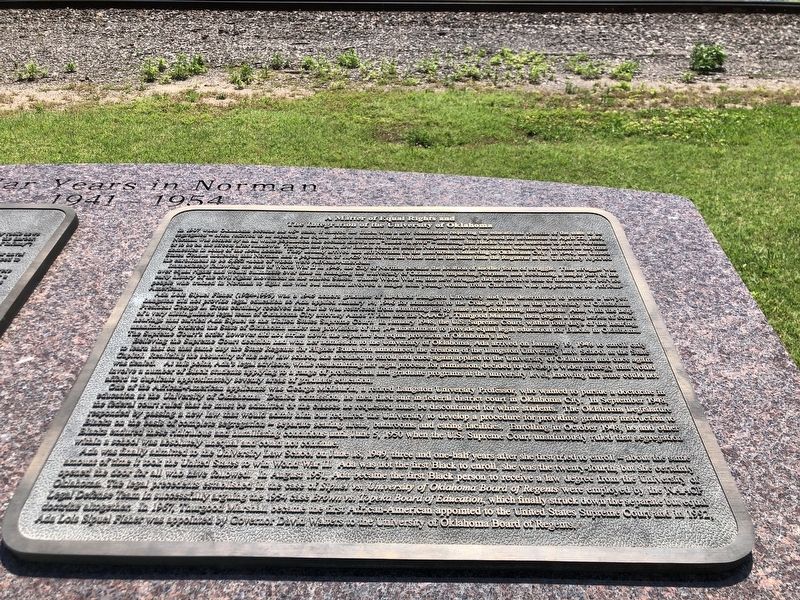
Photographed by Duane and Tracy Marsteller, June 20, 2025
2. War Years in Norman Marker, Side Two
When the U.S. entered World War II in 1941, Norman changed dramatically with the arrival of Navy personnel; however, other war-related events had occurred earlier in Norman. In September 1940, two units from Norman, Company “D”, 179th Regiment and Company “C”, 120th Combat Engineer Battalion were mobilized when the 45th National Guard Division was called into active duty. These units served gallantly
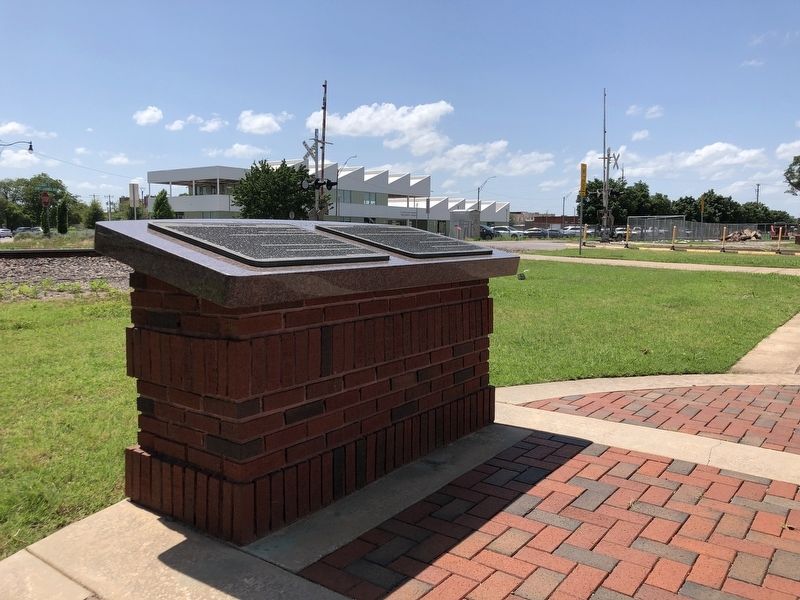
Photographed by Duane and Tracy Marsteller, June 20, 2025
3. War Years in Norman Marker
Following the end of World War II, three tragedies occurred that impacted Norman and the university. On Saturday, April 30, 1949, about 2:50 p.m., a tornado struck the North Base severely damaging several buildings and injuring over fifty National Guardsmen from the Norman area who were having marksmanship practice at the base rifle range – referred to as Mount Williams. The second tragedy occurred on the South Base at approximately 2:45 a.m., December 3, 1949 when the Bachelor Officers' Quarters (B.O.Q. burned. After the was the Navy had allowed the university to house several hundred male students in the former B.O.Q. Three students were killed and twenty were hospitalized. The third tragedy occurred on July 17, 1953 when twenty-three university Navy ROTC students were killed when a Marine transport plane
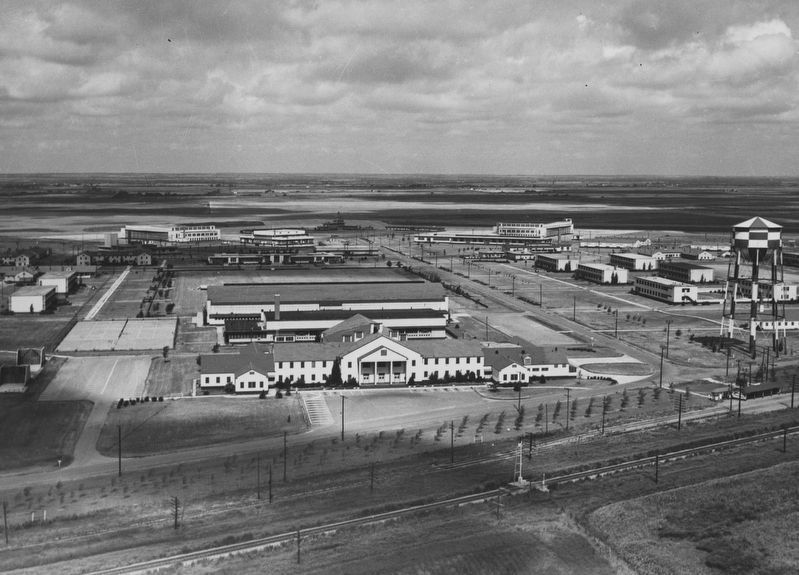
Courtesy of the Cleveland County Historical Society (Public Domain), 1942/45
4. Norman Naval Air Station
Designed by Leonard H. Bailey, it cost more than $9.75 million to build in 1942.
Immediately following the end of World War II in 1945,
unknown; via Oklahoma Higher Education Heritage Society (Public Domain)
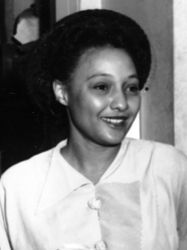
5. Ada Lois Sipuel Fisher (1924-1995)
In 1981, the Smithsonian Institution included her among the 150 black women who changed the course of American history.
Ada Lois Sipuel Fisher (1924-1995) was a 1946 honors graduate of all-Black Langston University and was determined to become a lawyer. Langston did not provide legal education so Ada applied January 14, 1946 for admission to the College of Law at the University of Oklahoma. President George L. Cross cordially received her but he was restricted from admitting her by state laws forbidding integration. Ada, with the help of a very distinguished legal team of Oklahoma City attorney Amos T. Hall and the NAACP's Thurgood Marshall, then began a long series of court hearings that carried Ada Sipuel to the United States Supreme Court. In January, 1948, the U.S. Supreme Court, within four days of the hearing unanimously ordered the State of Oklahoma under the provisions of the 14th Amendment to provide equal legal education for Blacks in Oklahoma. The Supreme Court's order however did not strike down the separate but equal provision of Oklahoma's law.
Believing the Supreme Court decision had won her admission to the University of Oklahoma, Ada arrived on January 18, 1948 to enroll only to learn that on the same day the State Regents for Higher Education announced the creation of the Langston University Law School, at the state capitol. Realizing the absurdity of the new law school, she declined to enroll and once again
New York World-Telegram and the Sun Newspaper Photograph Collection (Library of Congress), 1948
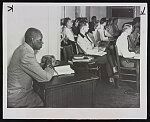
6. McLaurin attends first class after court fight
African American retired professor, George W. McLaurin sits in an anteroom apart from the other students while attending his first class at the University of Oklahoma after the school was forced to admit him following a Supreme Court ruling.
One of the African-American applicants was George McLaurin, a retired Langston University professor, who wanted to pursue a doctorate in education at the University of Oklahoma. Denied admission, he then filed suit in federal district court in Oklahoma City. In September 1948, the federal court ruled that he must be admitted or the classes he requested must be discontinued for white students. The Oklahoma Legislature responded by passing a new law that would admit him but required the university to develop a procedure for providing graduate instruction to Blacks on the basis of complete segregation – separate seating areas, bathrooms, and eating facilities. Enrolling in October 1948, he and other Blacks endured these ridiculous and humiliating conditions until June 5, 1950, when the U.S. Supreme Court unanimously ruled that segregation within a school was absolutely unequal and could not continue.
Ada was finally admitted to the University Law School on June 18, 1949, three and one-half years after she first tried to enroll – about the same amount of time it took the United States to win World War II. Ada was not the first Black to enroll, she was the twenty-fourth, but she certainly opened the door for all who have followed. In August 1951, Ada became the first Black person to receive a law degree from the University of Oklahoma. The legal precedents established in the case of Sipuel vs. University of Oklahoma Board of Regents were employed by the NAACP Legal Defense Team in successfully arguing the 1954 case Brown vs. Topeka Board of Education, which finally struck down the separate but equal doctrine altogether. In 1967, Thurgood Marshall became the first African American appointed to the United States Supreme Court and in 1992, Ada Lois Sipuel Fisher was appointed by Governor David Walters to the University of Oklahoma Board of Regents.
Erected by City of Norman, Oklahoma.
Topics. This historical marker is listed in these topic lists: African Americans • Civil Rights • Education • War, World II. A significant historical month for this entry is October 1941.
Location. 35° 13.126′ N, 97° 26.529′ W. Marker is in Norman, Oklahoma, in Cleveland County. It can be reached from South Jones Avenue south of West Eufaula Street, on the right when traveling south. Marker is on the Norman Legacy Trail, which runs parallel and to the west of South Jones Street. Touch for map. Marker is in this post office area: Norman OK 73069, United States of America. Touch for directions.

Regionally, this marker is in Central Oklahoma—Frontier Country and in Greater Oklahoma City. It is also in the American South, specifically on the prairies, and on the Southern Plains. Globally, it is in North America, the Western Hemisphere, the Western World, and the Anglosphere. Historically, it finds itself in what was once the territory of the Mississippian Culture and also the Louisiana Purchase.
Other nearby markers. At least 8 other markers are within walking distance of this marker: U.S. Naval Air Station (here, next to this marker); Surviving the Depression and Becoming Fifty Years Old (about 300 feet away, measured in a direct line); The Roaring Twenties and Early Bizzell Years (about 300 feet away); Norman the University City (about 300 feet away); The Brooks Years and World War One (about 300 feet away); A Tough Decade (about 300 feet away); University on the Prairie (about 300 feet away); Cleveland County Courthouse (about 500 feet away). Touch for a list and map of all markers in Norman.
Credits. This page was last revised on July 31, 2025. It was originally submitted on July 21, 2025, by Duane and Tracy Marsteller of Murfreesboro, Tennessee. This page has been viewed 94 times since then and 26 times this year. Photos: 1, 2. submitted on July 21, 2025, by Duane and Tracy Marsteller of Murfreesboro, Tennessee. 3, 4. submitted on July 22, 2025, by Duane and Tracy Marsteller of Murfreesboro, Tennessee. 5. submitted on July 12, 2025, by Duane and Tracy Marsteller of Murfreesboro, Tennessee. 6. submitted on July 22, 2025, by Duane and Tracy Marsteller of Murfreesboro, Tennessee.
