Workington in Cumberland, England, United Kingdom — Northwestern Europe (the British Isles)
Decline of the Local Coal Industry
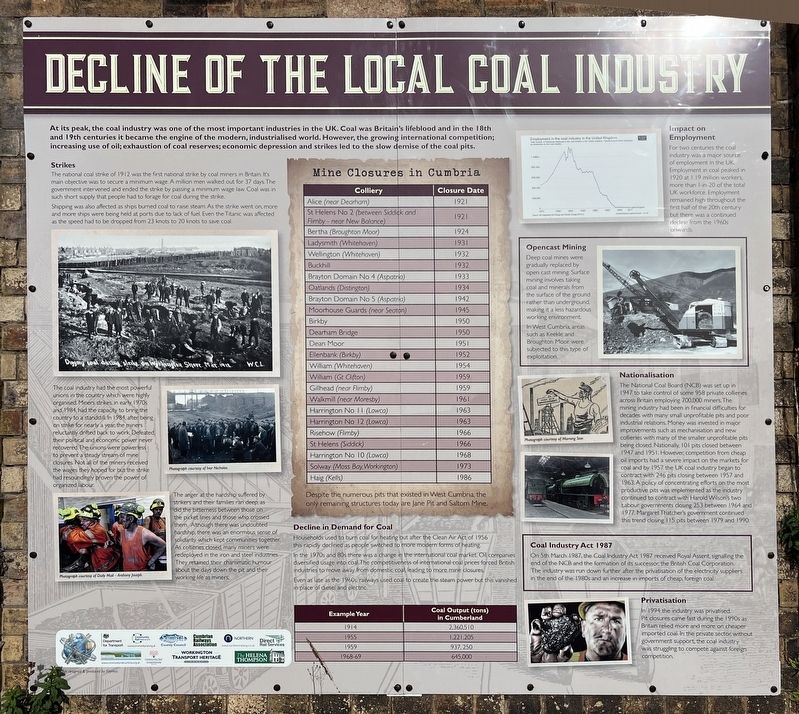
Photographed by Ray Gurganus, April 11, 2025
1. Decline of the Local Coal Industry Marker
Strikes
The national coal strike of 1912 was the first national strike by coal miners in Britain. It's main objective was to secure a minimum wage. A million men walked out for 37 days. The government intervened and ended the strike by passing a minimum wage law. Coal was in such short supply that people had to forage for coal during the strike.
Shipping was also affected as ships burned coal to raise steam. As the strike went on, more and more ships were being held at ports due to lack of fuel. Even the Titanic was affected as the speed had to be dropped from 23 knots to 20 knots to save coal.
The coal industry had the most powerful unions in the country which were highly organised. Miners strikes, in early 1970s and 1984, had the capacity
this page online
The anger at the hardship suffered by strikers and their families ran deep, as did the bitterness between those on the picket lines and those who crossed them. Although there was undoubted hardship, there was an enormous sense of solidarity which kept communities together. As collieries closed, many miners were redeployed in the iron and steel industries. They retained there charismatic humour about the days down the pit and their working life as miners.
Decline in Demand for Coal
Households used to burn coal for heating but after the Clean Air Act of 1956 this rapidly declined as people switched to more modern forms of heating.
In the 1970s and 80s there was a change in the international coal market. Oil companies diversified usage into
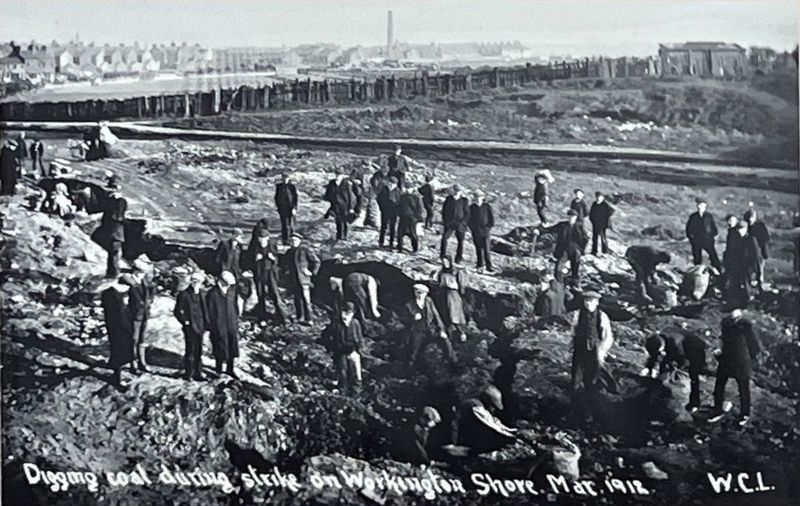
Photograph from marker
2. Digging coal during strike on Workington Shore, Mar. 1912
Even as late as the 1960s, railways used coal to create the steam power but this vanished in place of diesel and electric.
Impact on Employment
For two centuries the coal industry was a major source of employment in the UK. Employment in coal peaked in 1920 at 1.19 million workers, more than 1 in 20 of the total UK workforce. Employment remained high throughout the rest but of the 20th century but there was a continued decline from the 1960s onwards.
Opencast Mining
Deep coal mines were gradually replaced by open cast mining. Surface mining involves taking coal and minerals from the surface of the ground rather than underground, making a less hazardous working environment.
In West Cumbria, areas such as Keekle and Broughton Moor were subjected to this type of exploitation.
Nationalisation
The National Coal Board (NCB) was set up in 1947 to take control of some 958 private collieries across Britain employing 700,000 miners. The mining industry had been in financial difficulties for decades with many small unprofitable pits and poor industrial relations. Money was invested in major improvements such as mechanisation and new collieries with many of the smaller unprofitable pits being closed. Nationally, 101 pits closed between 1947 and 1951. However, competition from cheap oil imports had a severe impact on the markets for coal and by 1957 the UK coal industry began to contract with 246 pits closing between 1957 and 1963. A policy of concentrating efforts on the most productive pits was implemented as the industry continued to contract with Harold Wilson's two Labour governments closing 253 between 1964 and 1977. Margret Thatcher's government continued this trend closing 115 pits between 1979 and 1990.
Coal Industry Act 1987
On 5th March 1987, the Coal Industry Act 1987 received Royal Assent, signalling the end of the NCB and the formation of its successor, the British Coal Corporation. The industry was run down further after the privatisation of the electricity suppliers in the end of the 1980s and an increase in imports of cheap, foreign coal.
Privatisation
In 1994 the industry was privatised. Pit closures came fast during the 1990s as Britain relied more and more on cheaper imported coal in the private sector; without government support the coal industry was struggling to compete against foreign competition.
Erected by Cumbria County Council.
Topics. This historical marker is listed in these topic lists: Industry & Commerce • Labor Unions.
Location. 54° 38.683′ N, 3° 33.56′ W. Marker is in Workington, England, in Cumberland. It can be reached from Findlay Place. On the Workington train station platform. Touch for map. Marker is at or near this postal address: 1 Findlay Place, Workington, England CA14 2XF, United Kingdom. Touch for directions.

Regionally, this marker is in North West England. Globally, it is on the Atlantic Ocean, in the North Atlantic Region, in Europe, in Atlantic Europe, on one of the British Isles, in the Western World, and in the Anglosphere. Historically, it finds itself in what was once the Roman Empire.
Other nearby markers. At least 8 other markers are within walking distance of this marker: A Local History of Coal Mining (here, next to this marker); The Rail Making Process (here, next to this marker); Life in the Coal Mines (here, next to this marker); The Steel Making Process (here, next to this marker); Workington Station Timeline (here, next to this marker); Lost Railways of West Cumbria (a few steps from this marker); Workington Iron and Steel (a few steps from this marker); The Bessemer Impact (a few steps from this marker). Touch for a list and map of all markers in Workington.
Credits. This page was last revised on July 23, 2025. It was originally submitted on July 21, 2025, by Ray Gurganus of Washington, District of Columbia. This page has been viewed 207 times since then and 108 times this year. Photos: 1, 2. submitted on July 21, 2025, by Ray Gurganus of Washington, District of Columbia. • Andrew Ruppenstein was the editor who published this page.
