Workington in Cumberland, England, United Kingdom — Northwestern Europe (the British Isles)
Life in the Coal Mines
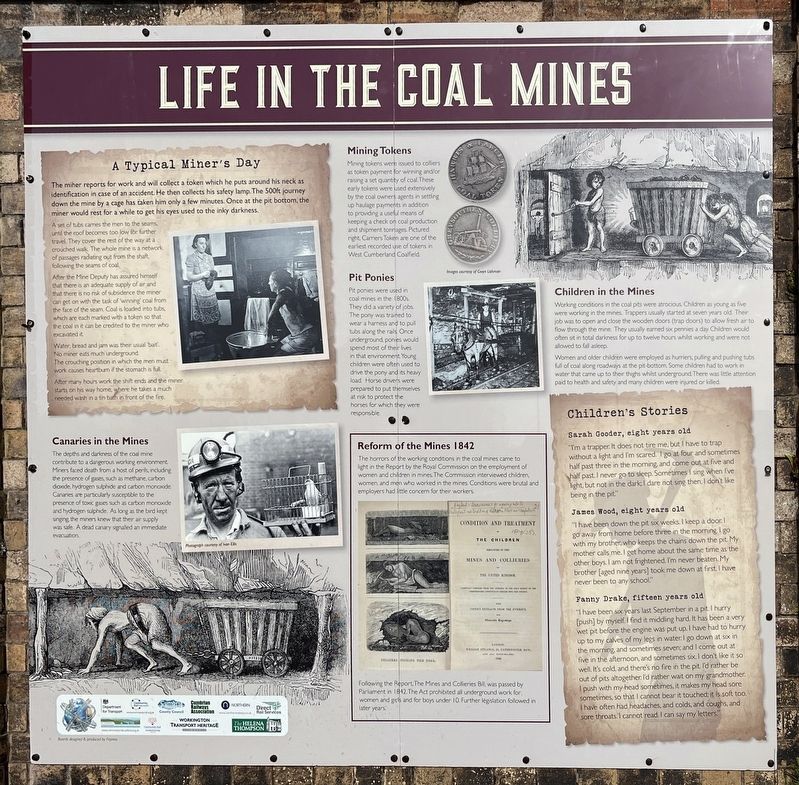
Photographed by Ray Gurganus, April 11, 2025
1. Life in the Coal Mines Marker
A Typical Miner's Day
The miner reports for work and will collect a token which he puts around his neck as identification in case of an accident. He then collects his safety lamp. The 500ft journey down the mine by a cage has taken him only a few minutes. Once at the pit bottom, the miner would rest for a while to get his eyes used to the inky darkness.
A set of tubs carries the to the seams until the roof becomes too low for further travel. They cover the rest of the way crouched walk. The whole mine is a network of passages radiating out from the shaft following the seams of coal.
After the Mine Deputy has assured himself that there is an adequate supply of air and that there is no risk of subsidence the miner can get on with the task of 'winning' coal from the face of the seam. Coal is loaded into tubs, which are each marked with a token so that the coal in it can be credited to the miner who excavated it.
Water, bread and jam was their usual 'bait'. No miner eats much underground. The crouching position in which the men must work causes heartburn if the stomach is full.
After many hours work the shift ends
this page online
Canaries in the Mines
The depths and darkness of the coal mine contribute to a dangerous working environment. Miners faced death from a host of perils, including the presence of gases, such as methane, carbon dioxide, hydrogen sulphide and carbon monoxide. Canaries are particularly susceptible to the presence of toxic gases such as carbon monoxide and hydrogen sulphide. As long as the bird kept singing the miners knew that their air supply was safe. A dead canary signaled an immediate evacuation.
Mining Tokens
Mining tokens were issued to colliers as token payment for winning and rasing a set quantity of coal. These early tokens were used extensively by the coal owners agents in setting up haulage payments in addition to providing a useful means of keeping a check on coal production and shipment tonnages. Pictured right, Carriers Token are one of the earliest recorded use of tokens in West Cumberland Coalfield.
Pit Ponies
Pit ponies were used in coal mines in the 1800s. They did a variety of jobs. The pony was trained
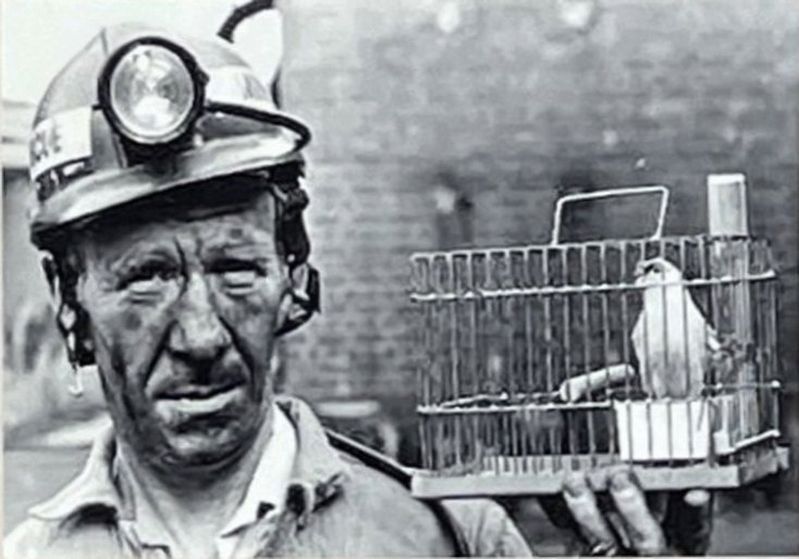
Photograph from the marker, courtesy of Ivan Ellis
2. Canaries in the Mines
Reform of the Mines 1842
The horrors of the working conditions in the coal mines came to light in the Report by the Royal Commission on the employment of women and children in mines. The Commission interviewed children women and men who worked in the mines. Conditions were brutal and employers had little concern for their workers.
Following the Report, The Mines and Collieries Bill was passed by Parliament in 1842. The Act prohibited all underground work for women and girls and for boys under 10. Further legislation followed in later years.
Children in the Mines
Working conditions in the coal pits were atrocious. Children as young as five were working in the mines. Trappers usually started at seven years old. Their job was to open and close the wooden doors (trap doors) to allow fresh air to flow through the mine. They usually earned six pennies a day. Children would often sit in total darkness for up to twelve hours whilst working and were not allowed to fall asleep.
Women and older children were employed as hurriers, pulling and pushing tubs full of coal along roadways at the pit bottom. Some children had to work in water that came up to their thighs whilst underground. There was little attention paid to health and safety and many children were injured or killed.
Children's Stories
Sarah Gooder, eight years old
"I’m a trapper. It does not tire me, but I have to trap without a light and I'm scared. I go at four and sometimes half past three in the morning, and come out at five and half past. I never go to sleep. Sometimes I sing when I've light, but not in the dark; I dare not sing then. I don't like being in the pit."
James Wood, eight years old
I have been down the pit six weeks. I keep a door. I go away from home before three in the morning. I go with my brother who keeps the chains down the pit. My mother calls me. I get home about the same time as the other boys. I am not frightened. I'm never beaten. My brother [aged nine years] took me down at first. I have never been to any school."
Fanny Drake, fifteen years old
I have been six years last September in a pit. I hurry [push] by myself. I find it middling hard. It has been a very wet pit before the engine was put up. I have had to hurry up to my calves of my legs in water. I go down at six in the morning, and sometimes seven; and I come out at five in the afternoon, and sometimes six; I don't like it so well. It's cold and there's no fire in the pit. I'd rather be out of pits altogether. I'd rather wait on my grandmother. I push with my head sometimes, it makes my head sore sometimes, so that I cannot bear it touched; it is soft too. I have often had headaches, and colds, and coughs, and sore throats. I cannot read. I can say my letters."
Erected by Cumbria County Council.
Topics. This historical marker is listed in these topic lists: Civil Rights • Industry & Commerce.
Location. 54° 38.681′ N, 3° 33.563′ W. Marker is in Workington, England, in Cumberland. It can be reached from Findlay Place. On the Workington train station platform. Touch for map. Marker is at or near this postal address: 1 Findlay Pl, Workington, England CA14 2XF, United Kingdom. Touch for directions.

Regionally, this marker is in North West England. Globally, it is on the Atlantic Ocean, in the North Atlantic Region, in Europe, in Atlantic Europe, on one of the British Isles, in the Western World, and in the Anglosphere. Historically, it finds itself in what was once the Roman Empire.
Other nearby markers. At least 8 other markers are within walking distance of this marker: A Local History of Coal Mining (here, next to this marker); Workington Station Timeline (here, next to this marker); Decline of the Local Coal Industry (here, next to this marker); Lost Railways of West Cumbria (here, next to this marker); The Rail Making Process (a few steps from this marker); The Steel Making Process (a few steps from this marker); Workington Iron and Steel (a few steps from this marker); The Bessemer Impact (a few steps from this marker). Touch for a list and map of all markers in Workington.
Credits. This page was last revised on July 29, 2025. It was originally submitted on July 21, 2025, by Ray Gurganus of Washington, District of Columbia. This page has been viewed 81 times since then and 16 times this year. Photos: 1, 2. submitted on July 21, 2025, by Ray Gurganus of Washington, District of Columbia. • Andrew Ruppenstein was the editor who published this page.
Editor’s want-list for this marker. photo of the marker within its surroundings • Can you help?
