
West Harlem in Manhattan in New York County, New York — The American Northeast (Mid-Atlantic)
Blumstein

Photographed by Andrew Ruppenstein, July 19, 2025
1. Blumstein Marker
In 1934, the "Don't buy where you can't work" protest, organized by activists and clercy, resulted in 34 Black hires.
Erected by While We Are Still Here.
Topics and series. This historical marker is listed in these topic lists: African Americans • Civil Rights • Industry & Commerce. In addition, it is included in the While We Are Still Here series list. A significant historical date for this entry is July 26, 1934.
Location. 40° 48.565′ N, 73° 56.971′ W. Marker is in Manhattan, New York, in New York County. It is in West Harlem. It is on West 125th Street, on the right when traveling east. Touch for map. Marker is at or near this postal address: 236 W 125th Street, New York NY 10027, United States of America. Touch for directions.

Regionally, this marker is in New York City. It is also in the American Northeast, in the Mid-Atlantic, and on the Eastern Seaboard. Globally, it is in the North Atlantic Region, North America, the Western Hemisphere, the Western World, and the Anglosphere. Historically, it finds itself in what was once New Netherland and also one of the original Thirteen Colonies.
Other nearby markers. At
this page online
Another marker is no longer nearby. Swing Low: Harriet Tubman Memorial (was approx. 0.2 miles away but has been permanently removed).
Also see . . .
1. Blumstein’s (Harlem Neighborhood Block Association). Excerpt:
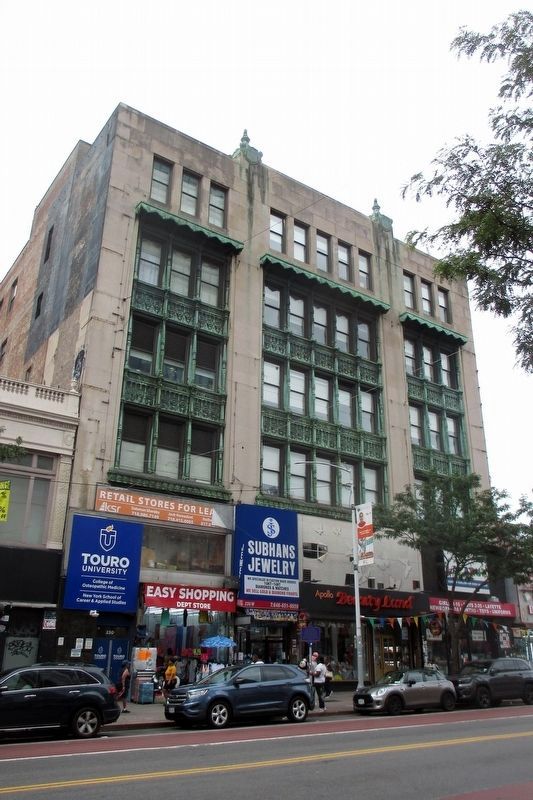
When Blumstein’s opened, Black Harlem had expanded and now lived in a vast stretch of central Harlem, from 111th to 155th Street, from Madison to St. Nicholas Avenue. Despite the demographic shift in the neighborhood, Blumenstein’s hired only or mostly whites. Only in 1929 Blumstein’s did hire its first Black employees — as elevator operators and porters.(Submitted on July 21, 2025.)
During the Depression,the Rev. John H. Johnson, vicar of the Protestant Episcopal St. Martin’s Church, began a “Buy-Where-You-Can-Work” campaign and Harlem’s New York Age noted that 75 percent of Blumstein’s sales were to Black residents but that it refused to hire Black clerks or cashiers. The New York Age called for a boycott of Harlem’s largest department store.Photographed by Larry Gertner, August 16, 20252. Formerly Blumstein’s Department Store, 230 West 125th Street
Picketing began twelve years before The Rev. Adam Clayton Powell Jr. started his long career as a Congressman. The Reverand, however, had numbers — preaching to 2,000 Harlemites at the Abyssinian Baptist Church.
The New York Age published names and photographs of Black shoppers who crossed the picket line. On July 26, William Blumstein, head of the store capitulated, promising to hire 35 Black clerical workers and salespeople.
Reverend Powell then organized the Greater New York Coordinating Committee for Employment and in 1938 won an agreement from Woolworth’s, Kress, A. S. Beck and other major businesses not to discriminate against Black shoppers. In 1943 Blumstein’s had the first black Santa Claus, was the first to use black models and mannequins and successfully appealed to cosmeticmanufacturers to produce make-up for non-white skin tones.Photographed by Andrew Ruppenstein, July 19, 20253. Blumstein Marker - wide viewNote that what appears to be a person leaning up against the marker’s pole is a mannequin.

2. Don’t Buy Where You Can’t Work Movement (Encyclopedia.com). Excerpt:
The "Don't Buy Where You Can't Work" movement, also known as the "Buy Where You Can Work" movement, emerged in major northern U.S. cities during the Great Depression to protest black unemployment rates that often were double or triple the national average…(Submitted on July 21, 2025.)
Credits. This page was last revised on August 18, 2025. It was originally submitted on July 21, 2025, by Andrew Ruppenstein of Lamorinda, California. This page has been viewed 174 times since then and 55 times this year. Photos: 1. submitted on July 21, 2025, by Andrew Ruppenstein of Lamorinda, California. 2. submitted on August 18, 2025, by Larry Gertner of New York, New York. 3. submitted on July 21, 2025, by Andrew Ruppenstein of Lamorinda, California.
