Near Fairburn in Custer County, South Dakota — The American Midwest (Upper Plains)
America's First Environmental Success Story
Photographed by Daniel Barriball, June 12, 2025
1. America's First Environmental Success Story Marker
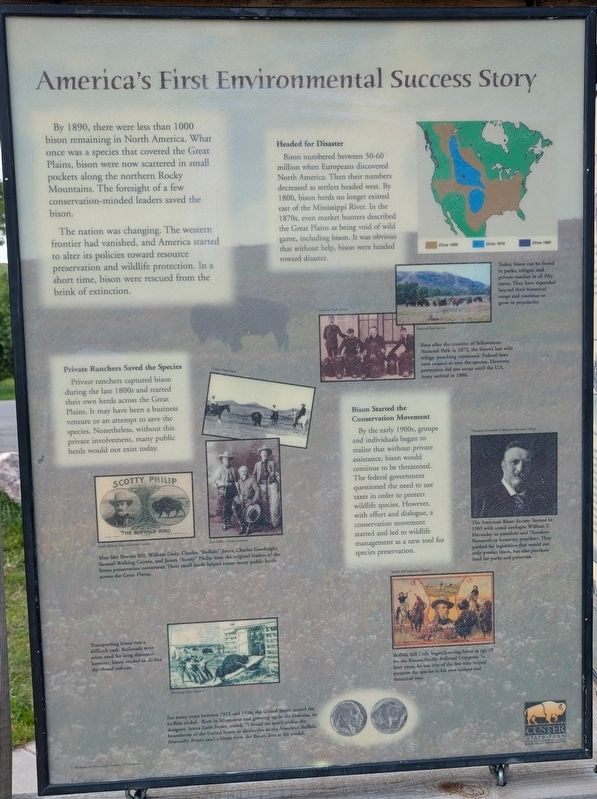
By 1890, there were less than 1000 bison remaining in North America. What once was a species that covered the Great Plains, bison were now scattered in small pockets along the northern Rocky Mountains. The foresight of a few conservation-minded leaders saved the bison.
The nation was changing. The western frontier had vanished, and America started to alter its policies toward resource preservation and wildlife protection. In a short time, bison were rescued from the brink of extinction.
Headed for Disaster
Bison numbered between 50-60 million when Europeans discovered North America. Then their numbers decreased as settlers headed west. By 1800, bison herds no longer existed east of the Mississippi River. In the 1870s, even market hunters described the Great Plains as being void of wild game, including bison. It was obvious that without help, bison were headed toward disaster.
Photo captions: Even after the creation of Yellowstone National Park in 1872, the bison's last wild refuge, poaching continued. Federal laws were created to save the species. However, protection did not occur until the U.S. Army arrived in 1886.
Today,
this page online
Private Ranchers Saved the Species
Private ranchers captured bison during the late 1800s and started their own herds across the Great Plains. It may have been a business venture or an attempt to save the species. Nonetheless, without this private involvement, many public herds would not exist today.
Photo caption: Men like Pawnie Bill, William Cody, Charles "Buffalo" Jones, Charles Goodnight, Samuel Walking Coyote, and James "Scotty" Philip were the original leaders of the bison preservation movement. Their small herds helped create many public herds across the Great Plains.
Bison Started the Conservation Movement
By the early 1900s, groups and individuals began to realize that without private assistance, bison would continue to be threatened. The federal government questioned the need to use taxes in order to protect wildlife species. However, with effort and dialogue, a conservation movement started and led to wildlife management as a new tool for species preservation.
Photo captions:
Photographed by Daniel Barriball, June 12, 2025
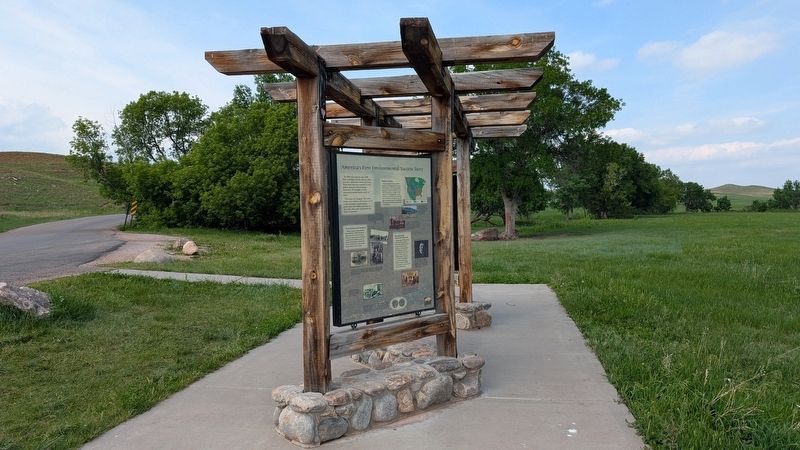
2. America's First Environmental Success Story Marker in context
The American Bison Society formed in 1905 with noted zoologist William T. Hornaday as president and Theodore Roosevelt as honorary president. They pushed for legislation that would not only protect bison, but also purchase land for parks and preserves.
Buffalo Bill Cody began hunting bison at age 19 for the Kansas Pacific Railroad Company. In later years, he was one of the few who helped preserve the species in his own unique and theatrical way.
For many years between 1913 and 1938, the United States coined the buffalo nickel. Born in Minnesota and growing up in the Dakotas, its designer, James Earle Fraser, stated, "I found no motif within the boundaries of the United States so distictive as the American Buffalo." Ironically, Fraser used a bison from the Bronx Zoo as his model.
Erected by Custer State Park.
Topics. This historical marker is listed in these topic lists: Animals • Environment.
Location. 43° 38.451′ N, 103° 22.053′ W. Marker is near Fairburn, South Dakota, in Custer County. It is on Csp Road 1, on the left when traveling west. This marker is located along the Wildlife Loop Road within Custer State Park. Touch for map. Marker is at or near this postal address: 13442 Csp Road 1, Custer SD 57730, United States of America. Touch for directions.

Regionally, this marker is in West River and in Greater Rapid City. It is also in the American Black Hills, in the Lewis & Clark Corridor, on the prairies, and on the Northern Plains. Globally, it is in North America, the Western Hemisphere, the Western World, and the Anglosphere. Historically, it finds itself in what was once Rupert’s Land and also the Louisiana Purchase.
Other nearby markers. At least 8 other markers are within 8 miles of this marker, measured as the crow flies: Market Hunting was a Gruesome Business (here, next to this marker); Custer State Park: A Legacy of Conservation and Preservation (here, next to this marker); The Buffalo: More Than an Animal-A Way of Life (here, next to this marker); Bison: Symbol of the American West (here, next to this marker); Bison are Making a Comeback (here, next to this marker); The Buffalo Corrals (approx. 1.2 miles away); Life in a Prairie Dog Town (approx. 7.6 miles away); Early Game Preserve (approx. 7.6 miles away). Touch for a list and map of all markers in Fairburn.
Credits. This page was last revised on July 21, 2025. It was originally submitted on July 21, 2025, by Daniel Barriball of Chesterton, Indiana. This page has been viewed 97 times since then and 16 times this year. Photos: 1, 2. submitted on July 21, 2025, by Daniel Barriball of Chesterton, Indiana. • Andrew Ruppenstein was the editor who published this page.
