Hartland Township near Wolsey in Beadle County, South Dakota — The American Midwest (Upper Plains)
Duck Factory of North America
⎯⎯⎯
Prairie - A Treasure Worth Preserving

Photographed by Mark Parker, June 28, 2025
1. Duck Factory of North America side of marker
Duck Factory of North America
Receding glaciers sculpted the shallow wetlands of the Prairie Pothole Region, making the region a magnet for waterfowl.
Ten thousand years ago, melting glaciers created millions of shallow depressions called potholes in the central part of North America. Now called the Prairie Pothole Region, this area nurtures a variety of insect and plant life important to waterfowl. The Prairie Pothole Region is North America's most important waterfowl breeding habitat.
Ducks and grese feed on insects that hatch in the wetland. They nest in prairie grasses. They rear their young in permanent and temporary wetlands, and they stay until the ducklings are big enough to by south in the fall.
Sidebar
Preserving the Prairie Potholes
The Prairle Pothole Region lies at the heart of the Central Flyway, one of North America's four major waterfowl migration corridors. Since the 1900s, 40 to 70 percent of the wetlands in the region have been drained for agriculture and other development. This makes conservation of the remaining wetlands even more critical.
The U.S. Fish and Wildlife Service works to protect habitat by purchasing waterfowl production areas, wetland easements, and grassland easements to conserve migratory bird habitat forever. The primary purpose of these lands and waters is to preserve duck and goose breeding grounds.
Prairie - A Treasure Worth Preserving
The
this page online
The Great Plains are home to a unique mix of bird species. The grasslands found here provide the songbirds, game birds, raptors, and other grassland birds with the food, nest sites, and shelter that they need.
Prior to the 1800s, prairie grasslands covered nearly one-third of the United States. Since that time, nearly half of that grassland has been converted to farmland and other developments. These habitat losses have sent grassland bird populations into a sharp decline. In the past half-century, the populations of nearly 9 out of 10 prairie bird species have steadily dropped.
Today, grassland birds are the most imperiled group of birds in North America. One key to protecting these birds is protecting large tracts of grassland habitat such as what you see here at Maga Ta-Hohpi Waterfowl Production Area.
Side bar
Grasslands of the Great Plains
America's grasslands are concentrated in the Great Plains of the Midwest, where the historical combination of low rainfall and frequent fires created ideal conditions for grasslands. Tallgrass prairie is found in the eastern part of the Great Plains, where relatively wet conditions exist. Shortgrass prairie dominates in the drier western part of the Great Plains. Mixed-grass prairie is found in the transition zone between the two.
Helping Inhabitants of Native Prairie
Protecting What Remains
Grassland birds depend on grasslands year-round. The U.S. Fish and Wildlife Service works to conserve prairie by purchasing waterfowl production areas, establishing conservation casements with private landowners, and working with other partners.
Insects: A Vital Food Source
Insects found in wetlands and grasslands provide essential protcin for birds in the spring and summer. Pesticides and insecticides used on crops and lawns reduce the number and diversity of insects available for birds to eat.
The Dangers of Ground Nesting By necessity, most grassland birds nest on the ground. That makes the eggs, incubating adults, and fledglings naturally more vulnerable to predators such as raccoons and skunks. Waterfowl production areas, grassland easements, predator removal, and delayed haying help improve nesting success.
Topics.

Photographed by Mark Parker, June 28, 2025
2. Prairie - A Treasure awor side of marker
Location. 44° 22.264′ N, 98° 23.844′ W. Marker is near Wolsey, South Dakota, in Beadle County. It is in Hartland Township. It is at the intersection of U.S. 14 and 391st Avenue, on the right when traveling west on U.S. 14. The marker is at a turnoff near the trailhead for Maga Ta-Hohpi Trail. Touch for map. Marker is at or near this postal address: 39100 US Hwy 14, Wolsey SD 57384, United States of America. Touch for directions.

Regionally, this marker is in the Yankton Sioux Tribe, in East River, and specifically in the James River Valley. It is also in the American Midwest, in the Lewis & Clark Corridor, in the Corn Belt, on the prairies, and on the Northern Plains. Globally, it is in North America, the Western Hemisphere, the Western World, and the Anglosphere. Historically, it finds itself in what was once Rupert’s Land and also the Louisiana Purchase.
Other nearby markers. At least 8 other markers are within 9 miles of this marker, measured as the crow flies: Prairie Plants: More Than Meets the Eye / Preserving America's Wildlife Heritage
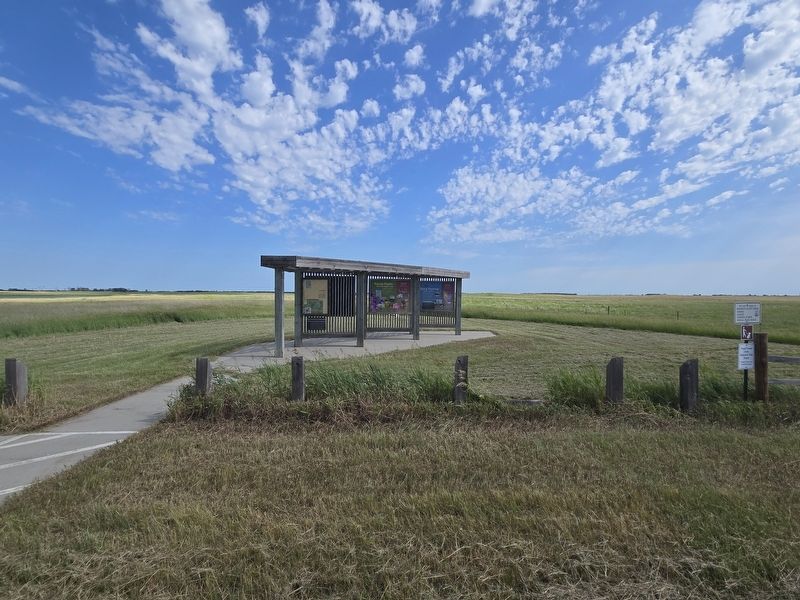
Photographed by Mark Parker, June 28, 2025
3. Front side of markers from US 14 Duck Factory of North America on the right

Photographed by Mark Parker, June 28, 2025
4. Reverse side looking towards US 14
The Prairie Marker is on the left.
Credits. This page was last revised on July 22, 2025. It was originally submitted on July 21, 2025, by Mark Parker of Hickory, North Carolina. This page has been viewed 86 times since then and 22 times this year. Photos: 1, 2. submitted on July 21, 2025, by Mark Parker of Hickory, North Carolina. 3, 4. submitted on July 22, 2025, by Mark Parker of Hickory, North Carolina. • J. Makali Bruton was the editor who published this page.
