Near Fairburn in Custer County, South Dakota — The American Midwest (Upper Plains)
The Buffalo: More Than an Animal-A Way of Life
Photographed by Daniel Barriball, June 12, 2025
1. The Buffalo: More Than an Animal-A Way of Life Marker
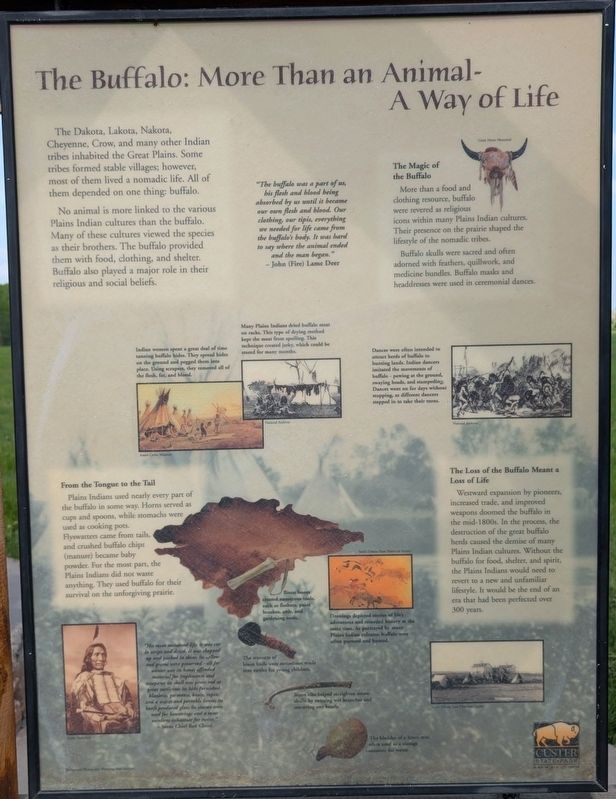
The Dakota, Lakota, Nakota, Cheyenne, Crow, and many other Indian tribes inhabited the Great Plains. Some tribes formed stable villages; however, most of them lived a nomadic life. All of them depended on one thing: buffalo.
No animal is more linked to the various Plains Indian cultures than the buffalo. Many of these cultures viewed the species as their brothers. The buffalo provided them with food, clothing, and shelter. Buffalo also played a major role in their religious and social beliefs.
"The buffalo was a part of us, his flesh and blood being absorbed by us until it became our own flesh and blood. Our clothing, our tipis, everything we needed for life came from the buffalo's body. It was hard to say where the animal ended and the man began." —John (Fire) Lame Deer
The Magic of the Buffalo
More than a food and clothing resource, buffalo were revered as religious icons within many Plains Indian cultures. Their presence on the prairie shaped the lifestyle of the nomadic tribes.
Buffalo skulls were sacred and often adorned with feathers, quillwork, and medicine bundles. Buffalo masks and headdresses were used
this page online
Caption Dances were often intended to attract herds of buffalo to hunting lands. Indian dancers imitated the movements of buffalo—pawing at the ground, swaying heads, and stampeding. Dances went on for days without stopping, as different dancers stepped in to take their turns.
From the Tongue to the Tail
Plains Indians used nearly every part of the buffalo in some way. Horns served as cups and spoons, while stomachs were used as cooking pots. Flyswatters came from tails, and crushed buffalo chips (manure) became baby powder. For the most part, the Plains Indians did not waste anything. They used buffalo for their survival on the unforgiving prairie.
Captions Indian women spent a great deal of time tanning buffalo hides. they spread hides on the ground and pegged them into place. Using scrapers, they removed all of the flesh, fat, and blood.
Many Plains Indians dried buffalo meat on racks. This type of drying method kept the meat from spoiling. This technique created jerky, which could be stored for many months.
Bison bones created numerous tools, such as fleshers, paint brushes, awls, and gardening tools.
Drawings
Photographed by Daniel Barriball, June 12, 2025
2. The Buffalo: More Than an Animal-A Way of Life Marker
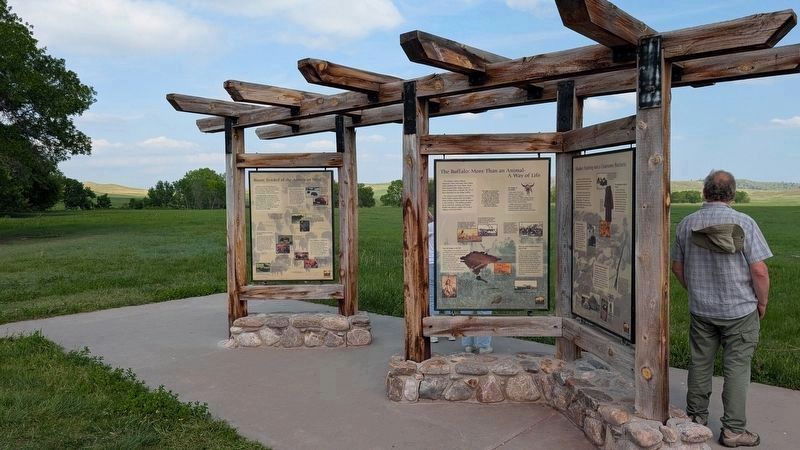
This marker is on the middle panel.
The scrotum of bison bulls were sometimes made into rattles for young children.
Bison ribs helped straighten arrow shafts by twisting wet branches and removing any bends.
The bladder of a bison was often used as a storage container for water.
"His meat sustained life; it was cut in strips and dried, it was chopped up and packed in skins, its tallow and grease were preserved—all for winter use; its bones afforded material for implements and weapons; its skull was preserved as great medicine; its hide furnished blankets, garments, beads, ropes, and a warm and portable house; its hoofs produced glue; its sinews were used for bowstrings and a most excellent substitute for twine." —Sioux Chief Red Cloud
The Loss of the Buffalo Meant a Loss of Life
Westward expansion by pioneers, increased trade, and improved weapons doomed the buffalo in the mid-1800s. In the process, the destruction of the great buffalo herds caused the demise of many Plains Indian cultures. Without the buffalo for food, shelter, and spirit, the Plains Indians would need to revert to a new and unfamiliar lifestyle. It would be the end of an era that had been perfected over 300 years.
Erected by Custer State Park.
Topics. This historical marker is listed in these topic lists: Animals • Indigenous Peoples and Communities.
Location. 43° 38.453′ N, 103° 22.053′ W. Marker is near Fairburn, South Dakota, in Custer County. It is on Csp Road 1, on the left when traveling west. This marker is located along the Wildlife Loop Road within Custer State Park. Touch for map. Marker is at or near this postal address: 13442 Csp Rd 1, Custer SD 57730, United States of America. Touch for directions.

Regionally, this marker is in West River and in Greater Rapid City. It is also in the American Black Hills, in the Lewis & Clark Corridor, on the prairies, and on the Northern Plains. Globally, it is in North America, the Western Hemisphere, the Western World, and the Anglosphere. Historically, it finds itself in what was once Rupert’s Land and also the Louisiana Purchase.
Other nearby markers. At least 8 other markers are within 8 miles of this marker, measured as the crow flies: Market Hunting was a Gruesome Business (here, next to this marker); Custer State Park: A Legacy of Conservation and Preservation (here, next to this marker); Bison: Symbol of the American West (here, next to this marker); America's First Environmental Success Story (here, next to this marker); Bison are Making a Comeback (here, next to this marker); The Buffalo Corrals (approx. 1.2 miles away); Life in a Prairie Dog Town (approx. 7.6 miles away); Early Game Preserve (approx. 7.6 miles away). Touch for a list and map of all markers in Fairburn.
Credits. This page was last revised on July 29, 2025. It was originally submitted on July 22, 2025, by Daniel Barriball of Chesterton, Indiana. This page has been viewed 86 times since then and 16 times this year. Photos: 1, 2. submitted on July 22, 2025, by Daniel Barriball of Chesterton, Indiana. • J. Makali Bruton was the editor who published this page.
