Stratford in Perth County, Ontario — Central Canada (North America)
Stratford’s Furniture Industry
Glimpses of Stratford - Furniture Industry
Photographed by Tim Boyd, July 18, 2025
1. Stratford’s Furniture Industry Marker
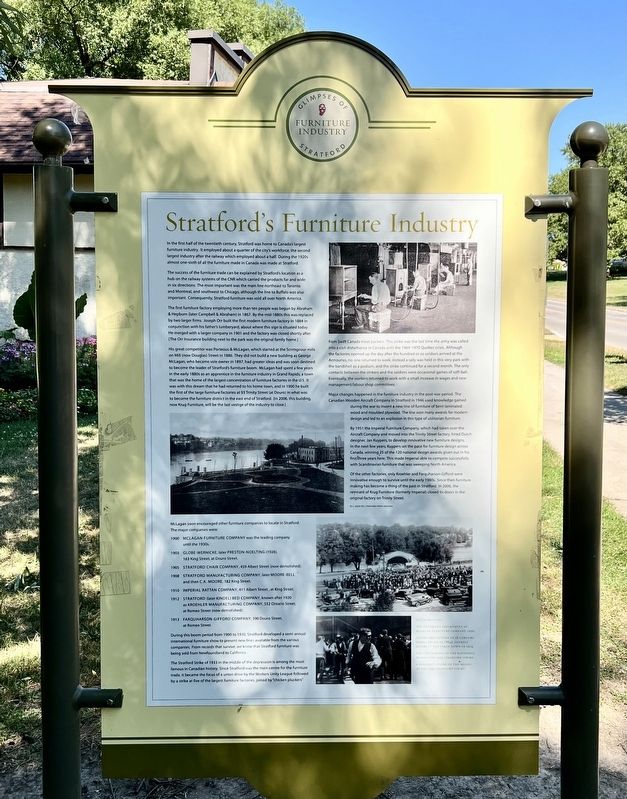
In the first half of the twentieth century, Stratford was home to Canada's largest furniture industry. It employed about a quarter of the city's workforce, the second largest industry after the railway which employed about a half. During the 1920s almost one-sixth of all the furniture made in Canada was made at Stratford.
The success of the furniture trade can be explained by Stratford's location as a hub on the railway systems of the CNR which carried the products far and wide in six directions. The most important was the main line northeast to Toronto and Montreal, and southwest to Chicago, although the line to Buffalo was also important. Consequently, Stratford furniture was sold all over North America.
The first furniture factory employing more than ten people was begun by Abraham & Hepburn (later Campbell & Abraham) in 1867. By the mid-1880s this was replaced by two larger firms. Joseph Orr built the first modern furniture factory in 1884 in conjunction with his father's lumberyard, about where this sign is situated today. He merged with a larger company in 1901 and the factory was closed shortly after (The Orr
this page online
His great competitor was Porteous & McLagan, which started at the Scrimgeour mills on Mill (now Douglas) Street in 1886. They did not build a new building as George McLagan, who became sole owner in 1897, had greater ideas and was soon destined to become the leader of Stratford's furniture boom. McLagan had spent a few years in the early 1880s as an apprentice in the furniture industry in Grand Rapids, a town that was the home of the largest concentration of furniture factories in the U.S. It was with this dream that he had returned to his home town, and in 1900 he built the first of the large furniture factories at 93 Trinity Street (at Douro). In what was to become the furniture district in the east end of Stratford. (In 2006, this building, now Krug Furniture, will be the last vestige of the industry to close.)
McLagan soon encouraged other furniture companies to locate in Stratford. The major companies were:
1900 MCLAGAN FURNITURE COMPANY was the leading company until the 1930s.
1903 GLOBE-WERNICKE, later PRESTON-NOELTING (1920) 163 King Street, at Douro
Photographed by Tim Boyd, July 18, 2025
2. Stratford’s Furniture Industry Marker
1905 STRATFORD CHAIR COMPANY, 459 Albert Street (now demolished)
1908 STRATFORD MANUFACTURING COMPANY, later MOORE-BELL and then C.A. MOORE, 182 King Street
1910 IMPERIAL RATTAN COMPANY, 411 Albert Street, at King Street
1912 STRATFORD (later KINDEL) BED COMPANY, known after 1920 aS KROEHLER MANUFACTURING COMPANY, 552 Ontario Street at Romeo Street (now demolished)
1913 FARQUHARSON-GIFFORD COMPANY, 390 Douro Street, at Romeo Street
During this boom period from 1900 to 1930, Stratford developed a semi-annual international furniture show to present new lines available from the various companies. From records that survive, we know that Stratford furniture was being sold from Newfoundland to California.
The Stratford Strike of 1933 in the middle of the depression is among the most famous in Canadian history. Since Stratford was the main centre for the furniture trade. It became the focus of a union drive by the Workers Unity League followed by a strike at five of the largest furniture factories, joined by “chicken pluckers” from Swift Canada meat packers. This strike was the last time the army was called into a civil disturbance in Canada until the 1969-1970 Quebec crisis. Although the factories opened up the day after the hundred or so soldiers arrived at the Armouries, no-one returned to work. Instead a rally was held in this very park with the bandshell as a podium, and the strike continued for a second month. The only contacts between the strikers and the soldiers were occasional games of soft-ball. Eventually, the workers returned to work with a small increase in wages and new management/labour shop committees.
Major changes happened in the furniture industry in the post-war period. The Canadian Wooden Aircraft Company in Stratford in 1946 used knowledge gained during the war to invent a new line of furniture of bent laminated wood and moulded plywood, The line won many awards for modern design and led to an explosion in this type of utilitarian furniture.
By 1951 the Imperial Furniture Company, which had taken over the Aircraft Company and moved into the Trinity Street factory, hired Dutch designer, Jan Kuypers, to develop innovative new furniture designs. In the next few years, Kuypers set the pace for furniture design across Canada, winning 25 of the 120 national design awards given out in first three years here. This made Imperial able to compete successfully with Scandinavian furniture that was sweeping North America.
Of the other factories, only Kroehler and Farquarson-Gifford were innovative enough to survive until the early 1980s. Since then furniture making has become a thing of the past in Stratford. In 2006, the remnant of Krug Furniture (formerly Imperial) closed its doors in the original factory on Trinity Street.
Topics. This historical marker is listed in these topic lists: Industry & Commerce • Labor Unions. A significant historical year for this entry is 1867.
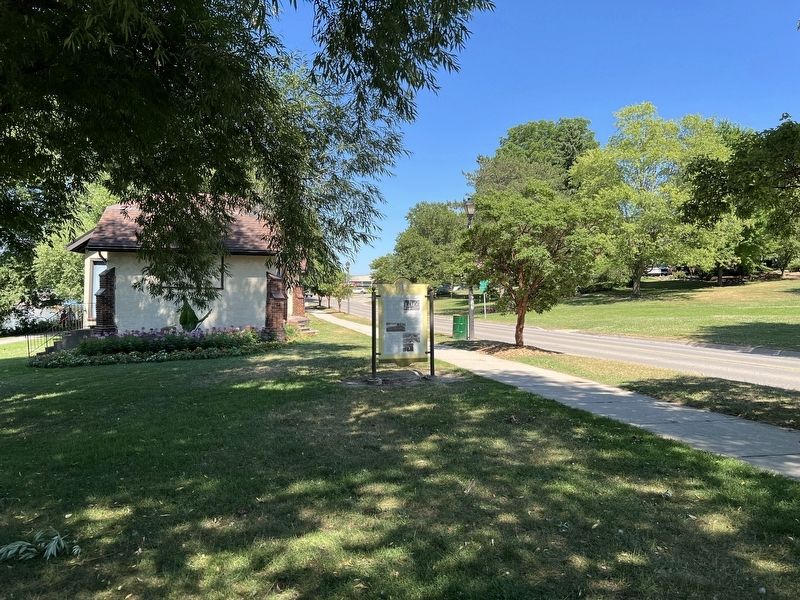
Location. 43° 22.363′ N, 80° 58.877′ W. Marker is in Stratford, Ontario, in Perth County. It is on Veterans Drive 0.1 kilometers west of Waterloo Street South, on the right when traveling west. Touch for map. Marker is at or near this postal address: 37 Veterans Drive, Stratford ON N5A 4X9, Canada. Touch for directions.

Regionally, this marker is in the Huron-Perth-Waterloo-Wellington Area and in Southwestern Ontario. It is also in Central Canada. Globally, it is in North America, the Western Hemisphere, the Western World, and the Anglosphere. Historically, it finds itself in what was once a British colony, the Viceroyalty of New France, the Haudenosaunee (Iroquois) Confederacy, and Rupert’s Land.
Other nearby markers. At least 8 other markers are within walking distance of this marker: The Bandshell (a few steps from this marker); The Saving of the Stratford Parks (about 120 meters away, measured in a direct line); The Stratford War Memorial (about 120 meters away); 70-76 Ontario (about 150 meters away); Site of the Shakespeare Hotel (about 150 meters away); The Freeman Memorial Fountain (about 150 meters away); The Freeland Fountain (about 150 meters away); R. Thomas Orr 1870-1957 (about 150 meters away). Touch for a list and map of all markers in Stratford.
Credits. This page was last revised on July 30, 2025. It was originally submitted on July 23, 2025, by Tim Boyd of Hamilton, Ontario. This page has been viewed 665 times since then and 323 times this year. Photos: 1, 2. submitted on July 23, 2025, by Tim Boyd of Hamilton, Ontario. • Andrew Ruppenstein was the editor who published this page.
