Valdosta in Lowndes County, Georgia — The American South (South Atlantic)
St. Augustine Road
Photographed by Tim Fillmon, July 25, 2025
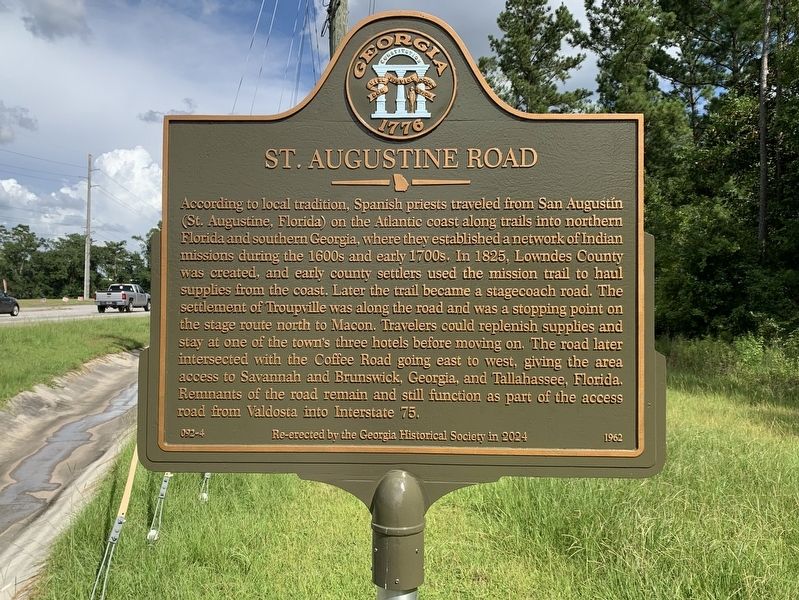
1. St. Augustine Road Marker
According to local tradition, Spanish priests traveled from San Augustín (St. Augustine, Florida) on the Atlantic coast along trails into northern Florida and southern Georgia, where they established a network of Indian missions during the 1600s and early 1700s. In 1825, Lowndes County was created, and early county settlers used the mission trail to haul supplies from the coast. Later the trail became a stagecoach road. The settlement of Troupville was along the road and was a stopping point on the stage route north to Macon. Travelers could replenish supplies and stay at one of the town’s three hotels before moving on. The road later intersected with the Coffee Road going east to west, giving the area access to Savannah and Brunswick, Georgia, and Tallahassee, Florida. Remnants of the road remain and still function as part of the access road from Valdosta into Interstate 75.
Erected 2024 by Georgia Historical Society. (Marker Number 092-4.)
Topics. This historical marker is listed in these topic lists: Roads & Vehicles • Settlements & Settlers. A significant historical year for this entry is 1825.
Location. 30° 50.909′ N, 83° 20.25′ W.
this page online

Regionally, this marker is on the Coastal Plain. It is also in the American South, specifically in the Deep South, and in the Wiregrass. Globally, it is in North America, the Western Hemisphere, the Western World, and the Anglosphere. Historically, it finds itself in what was once the territory of the Mississippian Culture, one of the original Thirteen Colonies, one of the Confederate States of America, and the Antebellum South.
Other nearby markers. At least 8 other markers are within 4 miles of this marker, measured as the crow flies: Troupville (about 400 feet away, measured in a direct line); Site of Troupville (approx. half a mile away); Valdosta Street Railroad Company Waiting Station, 1917 (approx. 3 miles away); Drexel Park (approx. 3 miles away); Valdosta Institute (approx. 3½ miles away); Old Carnegie Library (approx. 3½ miles
Photographed by Tim Fillmon, July 25, 2025
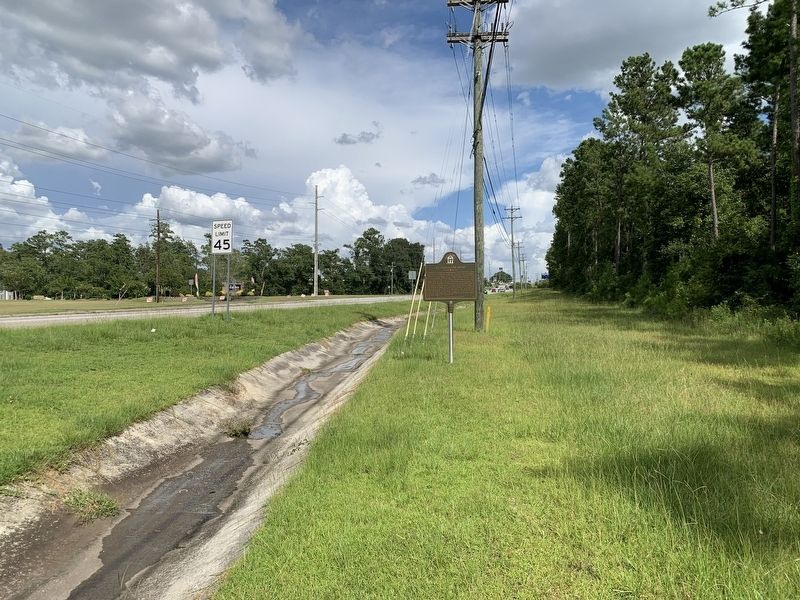
2. St. Augustine Road Marker
Regarding St. Augustine Road. This marker replaces an earlier version with different text that disappeared over thirty years ago. It was originally located on the opposite side of I-75 in front of a defunct hotel. The original read as follows:
Spanish priests from St. Augustin (St. Augustine, Florida), according to tradition, blazed this trail from the Atlantic coast into Northern Florida and Southern Georgia to visit their network of Indian missions during the 1600's and early 1700's.
In 1825 Lowndes County was created and early settlers in the county used the mission trail as a road to haul salt and other supplies from the coast. Later the trail became a stage coach road. The town of Troupville was built near the road and was a stopping point on the stage route north to Macon. The road made this wilderness town a mecca for weary travelers who refreshed themselves at one of its three hotels before moving northward. The road also served as Troupville's lifeline with the world. It later intersected with the Coffee Road going west to give the area access to Tallahassee, Florida. Remnants of the road remain and still function as a transportation route by virtue of being part of the access road from Valdosta into Interstate 75.
092-4 Georgia Historical Commission 1962
Credits. This page was last revised on July 26, 2025. It was originally submitted on July 26, 2025, by Tim Fillmon of Webster, Florida. This page has been viewed 126 times since then and 26 times this year. Photos: 1, 2. submitted on July 26, 2025, by Tim Fillmon of Webster, Florida.
