
Near Cross Keys in Rockingham County, Virginia — The American South (Mid-Atlantic)
The Guns of Mill Creek Ridge
"Screaming and Hissing Shells"
| — | The Battle of Cross Keys (June 8, 1862) | — |

Photographed by Bradley Owen, July 21, 2025
1. The Guns of Mill Creek Ridge Marker
The Confederate defensive line was centered around a powerful group of cannon positioned on the ridgeline to your right, including Courtney's, Raine's, Rice's, and Lusk's batteries. Another battery, the Baltimore Light Artillery under Capt. John B. Brockenbrough, was on the far left of the line. Perched along this high ground, the gunners had a commanding field of fire.
Courtney's Battery was the first to rumble into position when it unlimbered and opened fire on Union troops pursuing the 15th Alabama. As the opposing Federals deployed in greater strength - including their own artillery - Ewell added the other batteries, establishing a daunting mass of defensive fire.
The cannon of both sides opened fire around 10 a.m., beginning with scattered blasts from individual guns but quickly building to a thunderous, ground-shaking roar. New York Times reporter Charles H. Webb, who was near Union Church, wrote that "The diabolical precision with which shot and shell were instantly pitched at us exceeded anything I had before imagined."
The gunners also helped defend against Union infantry. One Federal foot soldier described
this page online
Situated behind the crest of the ridge, the gunners were protected from the direct fire of Union cannon, but higher-arcing shells took a toll. One of Latimer's sergeants was struck in the head by a shell that knocked away fragments of his skull. The fire was also hazardous to infantry units supporting the guns. "Solid shot, grape, and bombs seemed like they were raining down upon us," said Irby G. Scott of the 12th Georgia. A single shell killed or wounded nine men.
By the end of the battle, the Federals had failed to reach Mill Creek Ridge, thanks in no small part to the Confederate artillerymen who had stood bravely up to their work" throughout the long day.
(Caption):
Lt. Joseph Latimer, later famous as "The Boy Major of the Confederacy." Latimer was mortally wounded at Gettysburg and died in Harrisonburg on August 1, 1863.
Courtesy Virginia Military Institute.
Erected 2025 by Shenandoah
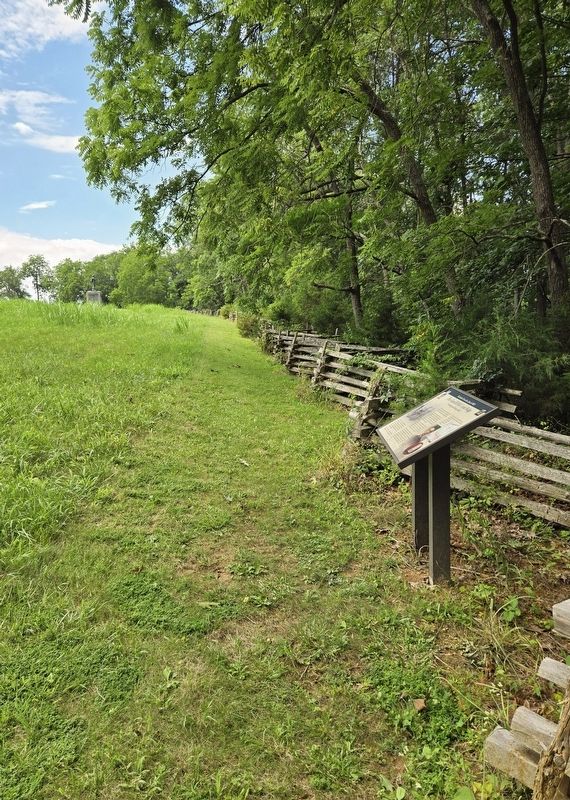
Photographed by Bradley Owen, July 21, 2025
2. The Guns of Mill Creek Ridge Marker
Topics. This historical marker is listed in this topic list: War, US Civil. A significant historical date for this entry is August 1, 1863.
Location. 38° 20.753′ N, 78° 50.079′ W. Marker is near Cross Keys, Virginia, in Rockingham County. It can be reached from Bowtie Road 0.2 miles north of Artillery Road, on the right when traveling north. Marker is located at the Cross Keys Battlefield Artillery Ridge Trail. Touch for map. Marker is at or near this postal address: 4232 Bowtie Road, Port Republic VA 24471, United States of America. Touch for directions.

Regionally, this marker is in Virginia’s Shenandoah Valley. It is also in the American South and specifically in the Upper South. Globally, it is in North America, the Western Hemisphere, the Western World, and the Anglosphere. Historically, it finds itself in what was once the territory of the Mississippian Culture, one of the original Thirteen Colonies, one of the Confederate States of America, and the Antebellum South.
Other nearby markers. At least 8 other markers are within walking distance of this marker: Schenck's Advance (within shouting

Photographed by Bradley Owen, July 21, 2025
3. Monument and Markers Along Mill Creek Ridge
Another marker is no longer nearby. Battle of Cross Keys (was about 300 feet away but has been permanently removed).
Credits. This page was last revised on July 27, 2025. It was originally submitted on July 27, 2025, by Bradley Owen of Morgantown, West Virginia. This page has been viewed 168 times since then and 29 times this year. Photos: 1, 2, 3. submitted on July 27, 2025, by Bradley Owen of Morgantown, West Virginia.
